For many personal injury law firms, rising marketing costs are only part of the challenge. A larger issue is losing qualified cases after the lead has already been generated. Firms invest in SEO for personal injury lawyers, paid search, and digital campaigns to attract high-intent prospects, but many opportunities never become signed clients because the intake process cannot respond or qualify them quickly enough.
Today, legal intake is a revenue driver, not simply an administrative task. The speed at which a qualified inquiry moves from first contact to a signed retainer directly affects firm profitability, making case value velocity an increasingly important performance metric.
Marketing Planet helps law firms strengthen this process by combining technical search infrastructure, high-performing websites, and streamlined intake systems that reduce lead leakage and improve the return on every marketing investment.
Here is the Quick Answer:
- Generating more legal leads does not always increase revenue. Personal injury firms should measure performance through signed matters, not lead volume alone.
- Case Value Velocity focuses on moving qualified inquiries from first contact to signed retainer faster by reducing intake delays, routing gaps, and lead leakage.
- Response speed matters. Lead-response research shows that qualification odds decline sharply when firms wait beyond the first few minutes, making rapid intake routing a direct driver of Cost Per Signed Case.
- Conversational data capture, CRM automation, and electronic fee agreements help reduce friction between initial inquiry and signed case.
- Marketing Planet helps personal injury firms connect SEO, website infrastructure, analytics, and intake systems to create a more efficient client acquisition pipeline.
The Flawed Arithmetic of Raw Lead Volume
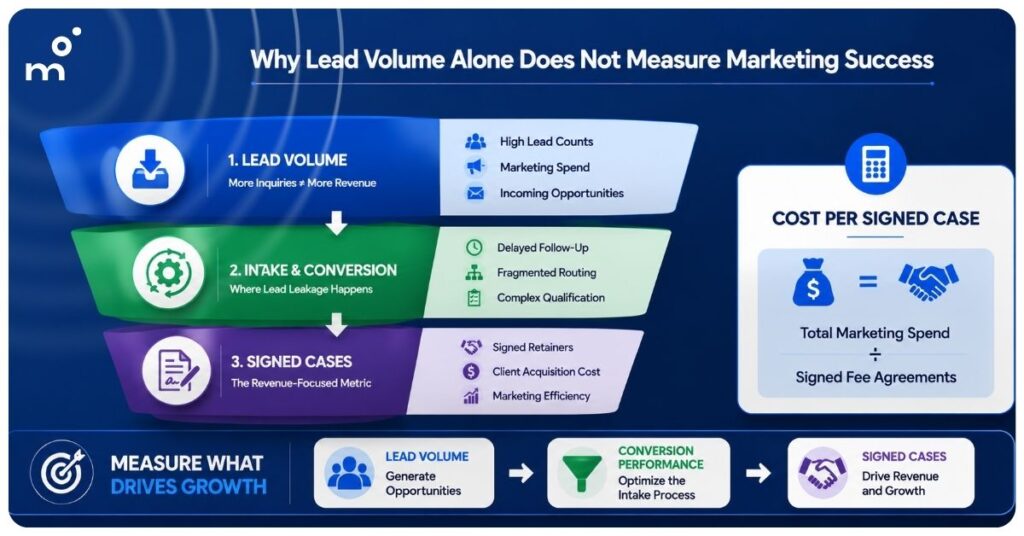
Generating more inquiries does not automatically increase profitability. If qualified leads fail to progress to signed retainers, marketing costs continue to rise while revenue potential declines. Measuring performance through downstream conversion outcomes rather than front-end lead volume provides a more accurate view of marketing efficiency and firm profitability.
This aligns with broader legal-market pressure identified by Thomson Reuters, where changing client expectations, competitive dynamics, and AI-driven technology are reshaping how law firms evaluate growth and operational performance.
Why More Leads Don’t Always Mean More Revenue
Many personal injury firms invest significant budgets in paid advertising and organic search to increase lead volume. While these campaigns may generate a steady flow of inquiries, higher lead counts do not necessarily translate into more signed cases.
For example, a firm may receive 200 accident inquiries in a month, but if only a small percentage complete the intake process and sign a retainer, much of the marketing investment fails to generate revenue.
As paid acquisition costs continue to increase, every qualified inquiry represents a larger financial investment. Every unanswered call, delayed response, or incomplete qualification creates pipeline leakage, allowing valuable opportunities to leave the firm before an attorney becomes involved.
Measuring success by signed retainers instead of lead volume provides a clearer picture of marketing performance.
Understanding Cost Per Signed Case
Cost per signed case measures the amount a firm invests in marketing to acquire each signed client rather than each inquiry. Unlike cost per lead (CPL), which counts every submitted form or phone call, this metric focuses on the outcomes that directly contribute to firm revenue.
Formula: Cost Per Signed Case = Total Marketing Spend ÷ Signed Fee Agreements
For example, if a firm spends $50,000 on digital marketing and signs 25 new clients, its cost per signed case is $2,000. If the same budget generates only 15 signed retainers because qualified leads are lost during intake, the cost per signed case increases substantially even though the number of incoming inquiries may remain similar.
This calculation connects marketing investment with business outcomes. A campaign generating fewer inquiries but more signed matters may produce stronger profitability than one generating a higher lead volume with poor conversion rates.
The Hidden Cost of Lead Leakage
Lead leakage occurs when qualified inquiries fail to become signed clients because the intake process introduces unnecessary delays or operational friction. These losses often occur before the legal team has the opportunity to evaluate the case.
For example, an injured driver may complete a website inquiry after a collision and expect a prompt response. If the submission remains unassigned for an hour because it is waiting in a manual review queue, the prospective client may contact another law firm that responds within minutes.
Common causes of lead leakage include:
- Delayed Follow-Up: Qualified inquiries wait too long before receiving a meaningful response.
- Fragmented Routing: Leads are passed between departments or systems before reaching the appropriate decision-maker.
- Lengthy Qualification Processes: Complex intake workflows increase the likelihood that prospective clients abandon the process before signing.
Reducing these operational gaps helps preserve valuable opportunities, improve conversion rates, and increase the return generated from every marketing dollar invested.
Case Value Velocity: The Engine of Practice Margin
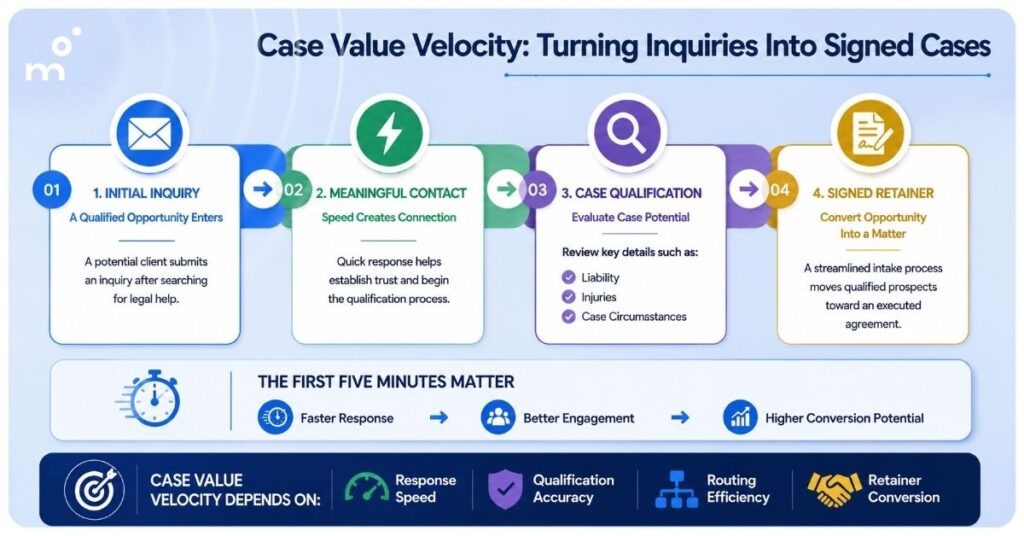
Case value velocity is the rate at which a qualified legal inquiry progresses from initial contact to a signed retainer.
By reducing delays throughout the intake process, personal injury law firms can preserve high-value opportunities, improve conversion efficiency, and increase the return generated from their personal injury lawyer marketing investments.
What is case value velocity?
Case value velocity measures how efficiently a law firm moves a qualified inquiry through intake and into an executed fee agreement. Instead of focusing only on the number of leads generated, this metric evaluates how quickly and effectively marketing opportunities become signed matters.
A strong case value velocity framework focuses on:
- Speed To Meaningful Contact: Connecting with qualified prospects quickly after they submit an inquiry.
- Qualification Accuracy: Capturing critical information such as liability indicators, injury details, and case circumstances.
- Routing Efficiency: Ensuring qualified inquiries reach the appropriate team member without unnecessary delays.
- Retainer Conversion: Moving qualified prospects toward an executed agreement through a streamlined intake process.
Improving these areas helps firms protect the value of their marketing investment while creating a more predictable path from initial search interaction to signed case.
Why The First Five Minutes Matter
The first few minutes after an inquiry are critical because injured prospects are often actively seeking representation and may contact multiple firms.
A fast response allows firms to begin qualification, collect important details, and establish the first meaningful connection.
Fast response times improve more than speed-to-lead metrics. They support the first meaningful interaction with a potential client, allowing firms to gather relevant information, establish trust, and reduce the risk of losing qualified opportunities to competing firms.
How Delayed Responses Reduce Case Value
The value of a qualified inquiry can decline as response time increases. This process, often described as prospect decay, occurs because potential clients may continue searching for representation when their initial inquiry does not receive timely attention.
Delayed responses can contribute to:
- Lost Client Engagement: Prospects may become less responsive after waiting too long.
- Increased Competitive Exposure: Other firms may establish the first meaningful connection.
- Lower Conversion Probability: Qualified inquiries may fail to become signed agreements.
Reducing response delays helps preserve case value, improve intake efficiency, and create a stronger connection between marketing investment and signed matters.
Comparison Table: High-Velocity Intake Vs. Traditional Intake
The structure of an intake system directly affects how efficiently a firm converts qualified inquiries into signed matters. The table below compares a high-velocity intake model with traditional processes that can create delays and missed opportunities.
| Traditional Intake Vs. High-Velocity Intake: A Pipeline Efficiency Comparison | ||
|---|---|---|
| Operational Area | High-Velocity Intake | Traditional Intake |
| Lead Retention | Immediate engagement helps preserve high-intent inquiries and keeps qualified prospects connected throughout the intake process. | Delayed responses and manual follow-up can increase abandonment and reduce the number of inquiries that become signed cases. |
| Time to Retainer | Streamlined qualification and electronic fee agreements help move suitable prospects toward retention more efficiently. | Multiple review stages and manual communication can extend the time between initial contact and signed agreement. |
| Competitive Risk | Faster response workflows reduce the opportunity for competing firms to establish the first meaningful connection. | Extended response windows increase the likelihood that prospects contact or retain another firm. |
| Response Time | Automated capture and routing systems enable rapid engagement after an inquiry is submitted. | Leads may wait for manual review, callbacks, or internal assignment before receiving a response. |
| Qualification Accuracy | Conversational data capture collects relevant case details while guiding prospects through a structured evaluation process. | Static forms may collect limited information, requiring additional follow-up to understand case viability. |
The Structural Failure of Static Web Forms
Static web forms often create friction during high-intent legal inquiries by requiring prospective clients to complete complex fields before meaningful engagement begins. These structural limitations can reduce completion rates and limit case qualification.
The following sections examine the key challenges and how modern intake systems address them.
The American Bar Association has also framed client intake as part of a broader technology shift in law firms, where efficiency, empathy, and security increasingly shape the first client experience.
Why Long Legal Forms Create Friction
Traditional legal intake forms often prioritize internal data requirements over the user experience. A person seeking legal support after an injury may be dealing with stress, uncertainty, and time-sensitive decisions.
Requiring extensive information upfront can create cognitive overload and make the intake process feel more demanding than necessary.
Long forms can reduce completion rates because users may not have every detail available during their first interaction. Rigid fields, complex questions, and limited response options can also prevent prospective clients from explaining the circumstances of their situation in their own words. A more effective intake experience reduces unnecessary barriers while still collecting the information needed for proper qualification.
Understanding Form Abandonment
Form abandonment occurs when a prospective client begins an inquiry but leaves before completing the submission process. For personal injury firms, this creates a gap between website traffic and actual qualified opportunities.
Research on online conversion behavior shows that longer forms, excessive required fields, and poor mobile experiences can increase abandonment. Since many legal searches begin on mobile devices, intake experiences must be designed around ease of completion, clarity, and accessibility.
Reducing abandonment requires identifying unnecessary friction points and creating an intake process that captures valuable information without overwhelming users during a high-stress moment.
General form-abandonment research commonly reports high drop-off when forms are long, complicated, or difficult to complete. While these figures are not legal-intake-specific, they reinforce the same operational point: every unnecessary field can reduce the number of qualified inquiries that reach the firm.
How Conversational Data Capture Improves Intake
Conversational Data Capture provides a more flexible alternative to traditional forms by allowing prospective clients to share information through guided interactions.
Instead of forcing users through a fixed sequence of fields, conversational systems can collect relevant details while adapting to the information provided.
This approach allows firms to gather important case information, including liability factors, treatment status, insurance details, and the individual’s personal account of the incident. By combining structured qualification with a more natural interaction, conversational intake improves data quality while reducing friction.
A streamlined intake experience helps connect marketing efforts with stronger qualification workflows, allowing firms to better identify valuable opportunities and improve overall conversion efficiency.
Eradicating Lead Leakage: A Step-by-Step Infrastructure Map
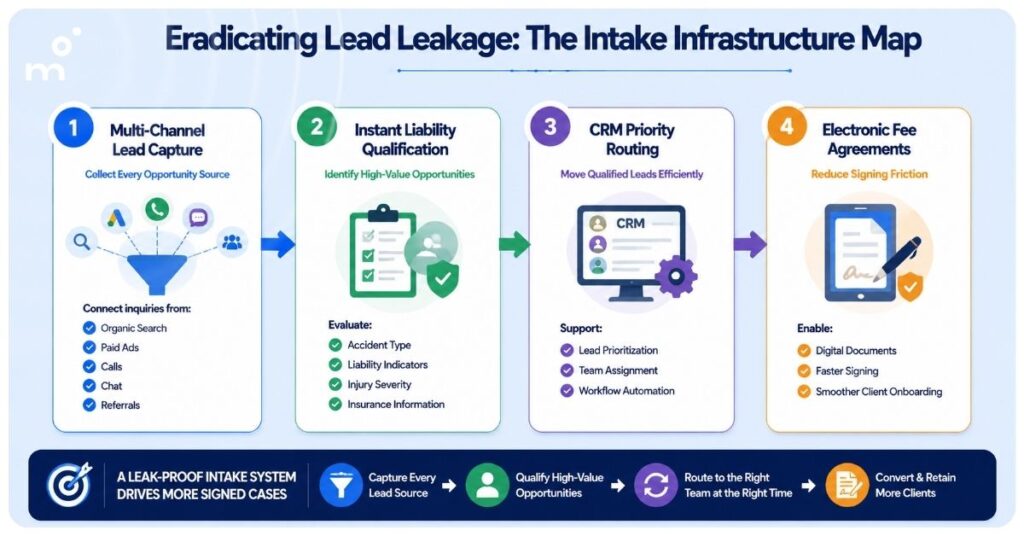
Reducing lead leakage requires a connected intake infrastructure that captures inquiries, qualifies opportunities, routes information efficiently, and supports a smoother path from first contact to signed agreement.
The following steps outline how firms can build a high-velocity intake system that protects the value of every marketing-generated opportunity.
Step 1: Multi-Channel Lead Capture
A strong intake infrastructure begins by collecting inquiries from every channel where potential clients search for legal support. Each source should feed into a unified system that provides visibility into lead activity and conversion performance.
Key capture channels include:
- Organic Search: Capturing high-intent prospects who discover the firm through search engines.
- Paid Ads: Converting targeted traffic from campaigns designed to reach specific legal needs.
- Calls: Tracking direct phone inquiries from potential clients seeking immediate assistance.
- Chat: Providing an interactive entry point for users who prefer digital communication.
- Referrals: Integrating external recommendations into the same intake workflow.
Step 2: Instant Liability Qualification
After an inquiry enters the system, the next stage focuses on collecting relevant information to determine alignment with the firm’s evaluation criteria. Faster qualification helps teams prioritize opportunities while providing attorneys with better context.
Important qualification factors include:
- Accident Type: Identifying the circumstances surrounding the incident.
- Liability Indicators: Understanding available details related to responsibility and fault factors.
- Injury Severity: Capturing information about injuries, treatment, and potential case impact.
- Insurance Information: Gathering relevant coverage details and involved parties.
Step 3: CRM Priority Routing
A structured CRM workflow ensures qualified inquiries reach the appropriate team members without unnecessary delays. Routing systems transform incoming inquiries into organized opportunities that can be evaluated efficiently.
Effective CRM routing combines qualification scoring, attorney assignment, and workflow automation. Qualification scoring helps prioritize inquiries based on available case information and evaluation criteria, while attorney assignment ensures qualified opportunities reach the appropriate legal team member.
Automation reduces manual handoffs, maintains consistent workflows, and helps teams respond to valuable opportunities more efficiently.
Step 4: Electronic Fee Agreements
The final stage focuses on reducing friction between qualification and client onboarding. Electronic Fee Agreements allow firms to deliver documents quickly while creating a more convenient experience for prospective clients.
A streamlined agreement process supports faster mobile signing, rapid document delivery, and fewer delays between case qualification and retention. By allowing clients to complete agreements digitally, firms can maintain engagement during the critical transition from initial inquiry to signed matter.
By connecting these four stages, firms can create a high-velocity intake system that reduces lead leakage, improves operational efficiency, and helps convert more qualified inquiries into signed cases.
Maximizing the Capital Yield of SEO for Personal Injury Lawyers
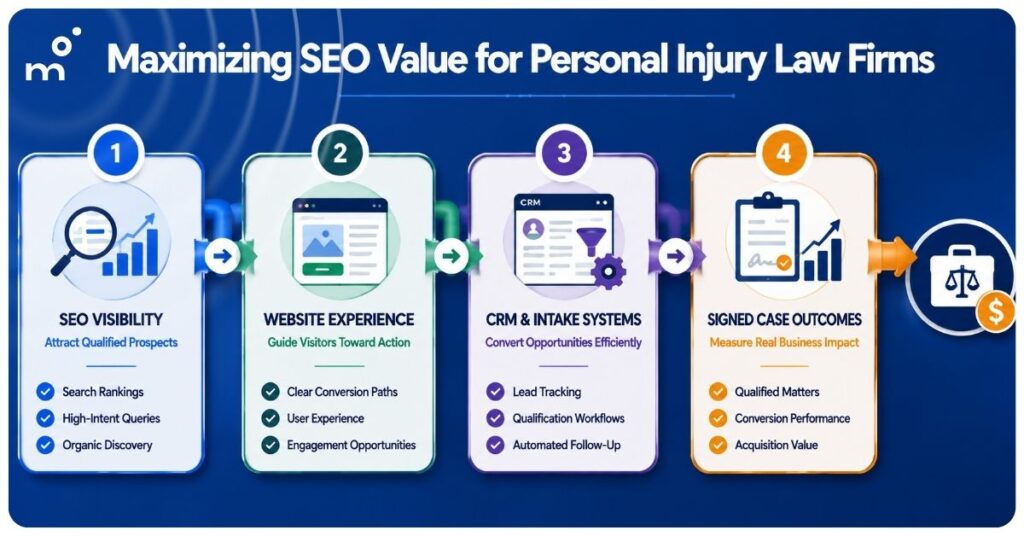
SEO performance should be measured by more than rankings, impressions, or website traffic. For personal injury firms, the true value of search visibility is realized when qualified visitors move through an optimized intake process and become signed matters. Connecting SEO, website infrastructure, CRM systems, and analytics creates a complete revenue pathway from search discovery to client acquisition.
SEO is only valuable if intake converts
Investing in SEO for personal injury lawyers helps firms attract prospects actively searching for legal support. However, rankings and traffic only create value when the website experience and intake process convert those visitors into qualified opportunities.
A firm may generate strong search visibility but still lose potential cases through unclear conversion paths, slow response times, or inefficient intake workflows. SEO creates demand, while optimized intake infrastructure determines how much of that demand becomes measurable business growth.
Connecting Search Signals to CRM Automation
Modern legal marketing requires a connection between front-end search performance and back-end conversion systems. When SEO-generated inquiries enter a structured CRM workflow, firms gain better visibility into which channels, pages, and campaigns contribute to signed cases.
A connected system allows firms to:
- Track qualified inquiries from their original search source.
- Identify which pages and keywords generate valuable opportunities.
- Route leads based on qualification data and priority factors.
- Measure performance using signed matters rather than surface-level traffic metrics.
This connection transforms SEO from a visibility initiative into a measurable acquisition system. Search signals become more valuable when they are linked directly to intake outcomes and pipeline performance.
Why Marketing Planet Builds Complete Revenue Infrastructure
Marketing Planet approaches digital growth as an interconnected system rather than a collection of separate marketing activities. Our legal marketing agency solutions combine SEO, website UX, CRM automation, analytics, and technical infrastructure to help personal injury firms capture more value from their existing demand.
Our approach focuses on:
- SEO: Building search visibility that attracts qualified prospects with strong intent.
- Website UX: Creating digital experiences that guide visitors toward meaningful engagement.
- CRM Automation: Connecting inquiries with efficient qualification and follow-up workflows.
- Analytics: Measuring performance through actionable conversion and pipeline data.
This broader infrastructure approach connects search retrieval systems with downstream revenue generation. Through our case studies, Marketing Planet demonstrates how strategic SEO, technical improvements, and conversion-focused systems help businesses strengthen their digital performance.
As explained in The Enterprise Guide to Information Retrieval: Engineering Growth Marketing Infrastructure for High-LTV Client Acquisition, modern growth systems depend on aligning information discovery with structured conversion pathways. By connecting search signals, technical architecture, and intake operations, firms can create a more complete framework for sustainable client acquisition.
How Marketing Planet Connects Search Visibility with Case Value Velocity
Search visibility and intake performance are connected parts of the same acquisition system. Marketing Planet helps personal injury firms turn high-intent search demand into measurable opportunities by aligning SEO, website experiences, CRM workflows, and analytics.
As an advanced SEO partner and technical infrastructure partner, we develop SEO for personal injury lawyers strategies that attract qualified prospects while building the technical foundation needed to convert them. Through custom website engineering, CRM integration, and performance tracking, we help firms reduce lead leakage and improve the path from first search interaction to signed matter.
Our personal injury lawyer marketing approach focuses on creating a complete revenue infrastructure. By combining search optimization, user-focused website design, automation, and analytics, Marketing Planet helps firms understand how marketing efforts contribute to pipeline growth.
As a marketing agency focused on measurable outcomes, we help identify the gaps affecting conversion performance. Schedule an enterprise infrastructure audit to uncover hidden lead leakage, strengthen intake workflows, and improve pipeline efficiency.
Conclusion
Generating qualified leads is only one part of building a successful personal injury marketing system. The value of those opportunities depends on what happens after the initial search interaction. Without an efficient intake process, firms risk losing high-intent prospects before they become signed matters.
Improving Case Value Velocity helps protect marketing investment by reducing delays, minimizing lead leakage, and creating a more predictable path from inquiry to engagement.
When SEO, website infrastructure, CRM workflows, and analytics operate together, firms gain a stronger foundation for sustainable client acquisition and long-term growth.
Marketing Planet helps personal injury firms identify the technical and operational gaps affecting their acquisition pipeline. Request a custom pipeline performance review to evaluate your current systems, uncover hidden conversion barriers, and build a more efficient path from search visibility to signed cases.
FAQs
Why is my personal injury law firm experiencing a high Cost Per Signed Case despite steady lead volume?
A high Cost Per Signed Case often comes from conversion gaps after lead generation. Delayed responses, intake friction, and poor routing can prevent qualified inquiries from becoming signed matters.
What is a benchmark intake conversion rate for a high-performing personal injury practice?
Intake conversion benchmarks vary by practice area, lead source, case criteria, and response process. Rather than relying on a universal percentage, high-performing firms should track the share of qualified inquiries that become consultations and signed agreements, then compare that figure across channels, response times, and intake workflows.
How does speed-to-lead impact case value retention?
Faster responses help firms connect with high-intent prospects before they lose interest or contact another firm. Quick engagement helps preserve valuable case opportunities.
Why do traditional website contact forms create high abandonment rates?
Long forms, complex questions, and poor mobile experiences can create friction and cause users to leave before completing an inquiry.
What information should a conversational legal intake system capture?
A conversational intake system should collect details about the accident, liability factors, injuries, treatment status, insurance information, and the client’s situation.
How do CRM automation loops improve marketing attribution and intake efficiency?
CRM automation connects marketing sources with intake outcomes, helping firms track qualified opportunities, improve routing, and measure performance beyond lead volume.
Can conversational AI support human intake teams during off-hours?
Yes. Conversational AI can provide immediate responses, collect initial information, and support human teams by organizing inquiries for follow-up.
Disclaimer: This content is provided for general informational and educational purposes only and does not constitute legal, financial, business, or professional marketing advice. Reading this article does not establish an agency-client relationship with Marketing Planet Inc. or Marketing Planet Media Group. Digital marketing platforms, algorithms, tools, and best practices change frequently, and results vary significantly based on individual industries, budgets, competition, and implementation. Marketing Planet makes no guarantees regarding specific outcomes, ROI, or performance metrics. References to third-party products or services do not imply endorsement. Please evaluate your specific business circumstances or consult with a professional before executing any strategies or making investments based on this content.
Source:
- American Bar Association — Law’s New First Impression: Transforming Client Intake
- Thomson Reuters — 2025 Report on the State of the US Legal Market
- Clio — Legal Trends Report
- Nielsen Norman Group — Website Forms Usability: Top 10 Recommendations
- Lead Response Management — Lead Response Management Study Overview
- Blue Sky Legal — Accelerating Success: The Power of Case Velocity in Your Law Firm
- Chris Dreyer — How to Calculate Case Velocity for Your Law Firm
- Claim Supply — How to Calculate Your True Cost Per Signed Case
- DM Law Partners — Cost Per Signed Case: Definition and Overview
- SiteAscend — The Hidden Cost of Lead Leakage: Why Qualified Prospects Never Become Pipeline
- LeadSquared — Lead Leakage: What It Is and How to Prevent It
- Saber — Sales Velocity Metrics: Definition, Examples & Use Cases
- ValueWorks — Sales Velocity Formula: How to Measure Sales Growth