
International expansion creates new search challenges for enterprise brands managing multiple languages, regions, and digital experiences.
A successful cross border seo agency strategy requires more than translation. It requires technical systems that manage URL structures, hreflang relationships, and regional search signals.
Modern multilingual SEO depends on building a scalable search infrastructure that helps search engines understand localized content across markets. From international routing to entity localization, every technical layer impacts visibility, authority, and long-term global growth.
Here is the Quick Answer:
- International SEO requires a scalable technical infrastructure, not translation alone. URL architecture, hreflang implementation, and localized entities all influence global search visibility.
- Choosing the right domain structure, validating hreflang relationships, and optimizing edge delivery help search engines efficiently crawl and index multilingual websites.
- Localized structured data and entity mapping improve how search engines and AI-powered platforms understand organizations across different languages and regions.
- High-performance multilingual SEO combines technical execution, analytics, and regional optimization to support sustainable international growth while protecting domain authority.
- Hreflang accuracy is a high-risk technical issue: a SEMrush analysis reported by Search Engine Journal found that 75% of multilingual websites had at least one hreflang implementation mistake, making automated validation essential for enterprise multilingual SEO.
Architecture Paradigms: Isolation vs. Authority Consolidation
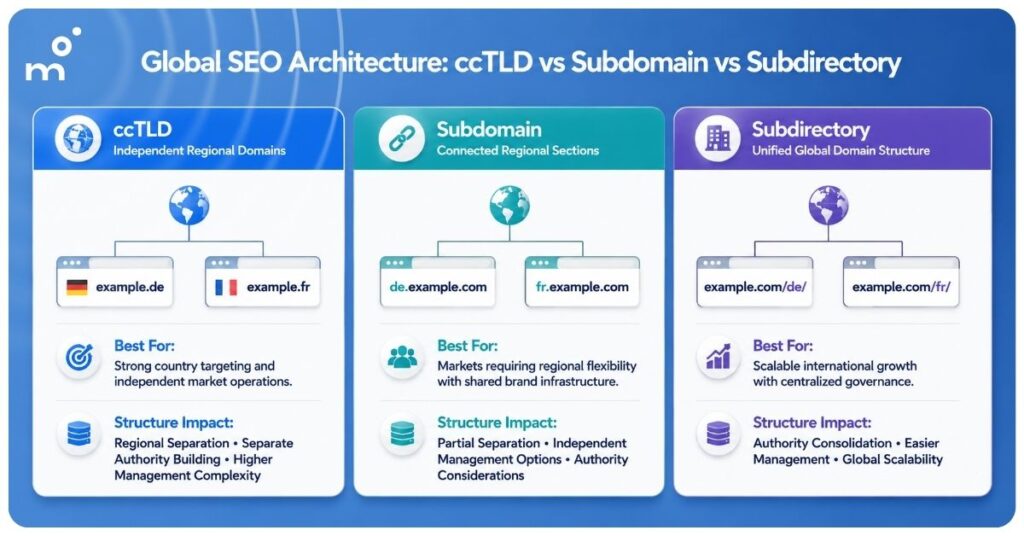
Enterprise organizations expanding into international markets must select a website architecture that balances regional targeting with long-term search scalability. Country Code Top-Level Domains (ccTLDs), subdomains, and subdirectories each provide different approaches to managing geographic relevance, authority distribution, technical complexity, and multilingual content operations across global search environments.
ccTLD vs Subdomain vs Subdirectory: Choosing the Right Global Structure
The foundation of international SEO depends on how effectively a website structure communicates regional relationships to search engines. ccTLDs, subdomains, and subdirectories each create different levels of separation, authority consolidation, and technical management requirements.
The right choice depends on business operations, market requirements, and the organization’s ability to maintain global search infrastructure.
ccTLDs: Strong Regional Signals With Independent Management
ccTLDs use country-specific domain extensions to create dedicated regional websites.
Examples:
➤ example.de
➤ example.fr
ccTLDs provide strong geographic association because the domain extension directly indicates the intended country market. This structure can support organizations that require significant regional independence, separate business operations, or market-specific digital strategies.
However, each ccTLD functions as an independent domain property. This means authority development, technical maintenance, and content management must be handled separately for each market.
As organizations expand into more countries, maintaining multiple domains can introduce additional operational complexity.
Subdomains: Partial Separation With Connected Brand Infrastructure
Subdomains create separate regional sections while maintaining a connection to the primary brand domain.
Examples:
➤ de.example.com
➤ fr.example.com
This structure allows organizations to separate regional experiences while keeping a consistent brand identity. Subdomains can be useful when different markets require independent technical environments, regional teams, or customized content management systems.
However, subdomains require careful technical management because search engines may evaluate them as distinct sections of the overall website. Organizations must consider how authority signals are distributed and how regional content relationships are communicated.
Subdirectories: Consolidated Authority for Global Expansion
Subdirectories organize international content within a single root domain.
Examples:
➤ example.com/de/
➤ example.com/fr/
This approach allows organizations to maintain one central domain while creating dedicated regional sections for different languages and markets.
Subdirectories are often effective for enterprise brands seeking scalable international expansion because technical management, analytics, and authority signals remain connected.
A well-structured subdirectory model supports centralized governance while allowing localized experiences for different markets. This makes it easier to manage multilingual SEO services at scale while maintaining a unified search infrastructure.
Comparison Table: International Domain Architectures
Selecting an international domain structure requires evaluating how each model impacts authority, regional control, technical requirements, and long-term scalability. The comparison below highlights the operational differences between ccTLDs, subdomains, and subdirectories.
| International Domain Architecture Comparison: ccTLD vs Subdomain vs Subdirectory | |||
|---|---|---|---|
| Feature | ccTLD | Subdomain | Subdirectory |
| Link Equity Retention | Authority is developed separately for each country-specific domain, requiring independent growth across markets. | Authority management requires careful coordination between regional subdomains and the main domain. | Authority remains consolidated within one primary domain structure across international sections. |
| Regional Separation | Provides the strongest separation between country markets with clear geographic signals. | Creates moderate separation while maintaining a connection to the primary domain. | Provides regional targeting while keeping all markets within one unified website structure. |
| Technical Complexity | Requires separate domain configurations, maintenance processes, and regional infrastructure management. | Requires additional technical setup and monitoring for each regional subdomain. | Allows centralized technical management through a shared website framework. |
| Maintenance Requirements | Multiple domains increase ongoing management requirements across regions. | Requires coordination across separate regional environments. | Centralized updates simplify management across multilingual sections. |
| Scalability | Expansion requires creating and maintaining additional country domains. | Supports expansion but requires careful management of regional subdomain relationships. | Enables scalable international growth through structured regional folders. |
| Entity Management | Each domain may represent a separate regional entity requiring independent signals. | Regional entities require clear connections to the main brand structure. | Centralized entity relationships make global brand management more consistent. |
Engineering the Algorithmic Hreflang Pipeline
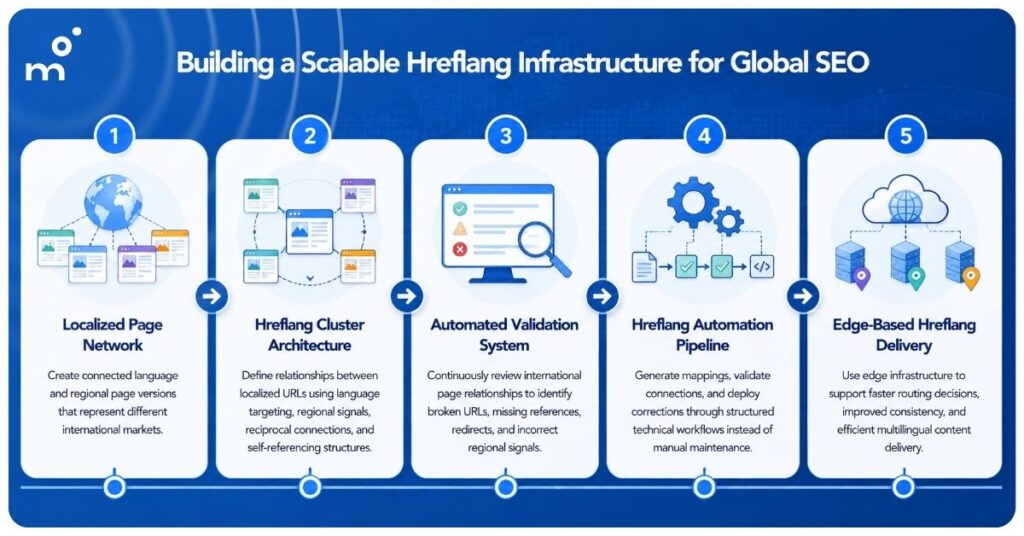
Hreflang infrastructure helps search engines identify the correct localized version of a page for specific languages and regions.
For enterprise websites operating across multiple markets, a properly engineered hreflang pipeline reduces regional indexing conflicts, improves content relationships, and creates clearer signals between international page variations.
Understanding Hreflang Clusters
A Hreflang Cluster is a network of localized URLs connected through language and regional signals. It helps search engines understand that multiple pages represent different versions of the same content for specific markets.
For example, an enterprise website may have an English version for North America, a French version for Canada, and a German version for Germany. Each page uses hreflang attributes to define its language, geographic audience, and relationship with other localized versions.
Language targeting identifies the page language, country targeting specifies the intended market, bidirectional validation ensures localized pages reference each other correctly, and self-referencing hreflang confirms each page’s role within the cluster.
As websites expand across more regions, maintaining accurate hreflang relationships becomes increasingly complex and requires structured validation to protect international search visibility.
The Exponential Hreflang Configuration Deficit
As enterprises expand into more markets, hreflang complexity increases rapidly. Each new language, region, and page combination creates additional validation requirements across the international search network.
For example:
5 Languages
×
100 Pages
500 Localized URLs
However, the complexity does not stop at creating these URLs. Each localized version requires ongoing management of:
- Alternate page references
- Reciprocal hreflang relationships
- URL validation
- Redirect monitoring
- Error detection
A global website with hundreds or thousands of localized pages can quickly develop thousands of connection points that require continuous accuracy. Without a structured validation system, broken relationships, missing references, or incorrect regional signals can reduce the effectiveness of international search targeting.
Enterprise multilingual SEO requires automated processes that can monitor these relationships continuously rather than relying on manual updates.
Automating Hreflang Validation Pipelines
A scalable hreflang system requires centralized data management and automated validation workflows. Instead of manually reviewing every localized page relationship, enterprises can create structured pipelines that monitor and maintain international connections.
The process typically includes:
Step 1: Generate Hreflang Mappings From Centralized Data
International page relationships are created from a centralized content and URL database. This ensures every language and regional version is connected through consistent rules.
Step 2: Validate Reciprocal Relationships
Each localized page is checked to confirm that hreflang references point back correctly. This maintains the integrity of the Hreflang Cluster and prevents incomplete relationships.
Step 3: Identify Broken URLs and Redirect Issues
Automated checks detect unavailable pages, redirect chains, and incorrect references that could interrupt international indexing signals.
Step 4: Deploy Corrections Automatically
Validated updates can be applied through structured deployment systems, reducing delays between identifying issues and correcting them.
A validation pipeline transforms hreflang management from a manual maintenance task into a controlled technical process that supports global expansion.
Edge Worker Hreflang Injection
Edge Worker Hreflang Injection allows organizations to manage hreflang signals closer to the user request layer by using edge infrastructure such as Cloudflare or Fastly processing environments.
Instead of relying entirely on the application layer to generate every international routing signal, edge systems can dynamically process regional requirements before content reaches the user or search crawler.
This approach can support:
- Faster international routing decisions.
- Reduced workload on application servers.
- More efficient server-side rendering processes.
- Improved consistency across multilingual page variations.
By integrating edge processing with international SEO systems, enterprises can create faster and more reliable multilingual experiences. This infrastructure approach helps large websites maintain accurate regional targeting while improving the operational efficiency of global search delivery.
Edge Infrastructure and Content Velocity Optimization
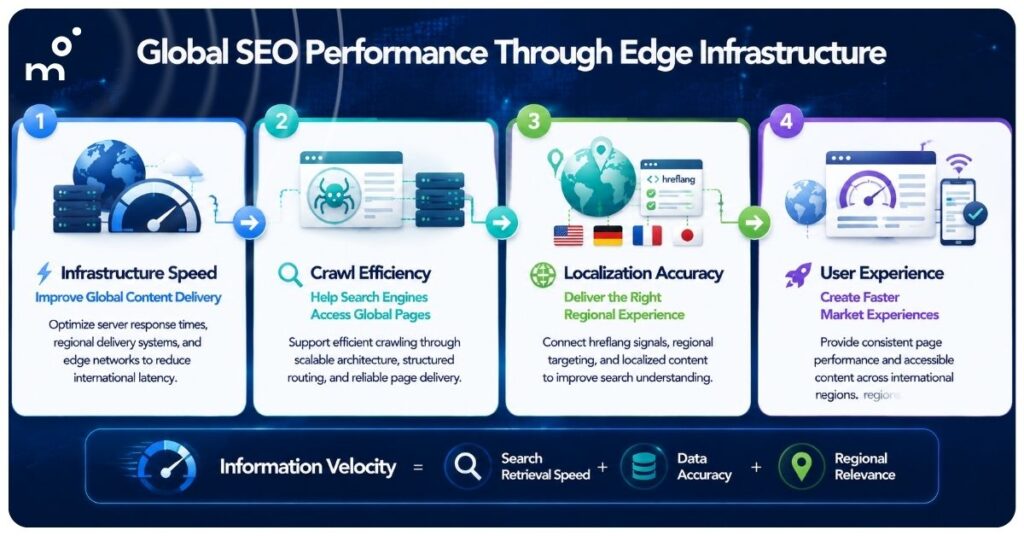
Global search performance depends on more than multilingual content. Server response times, regional delivery systems, and modern edge infrastructure all influence how efficiently search engines crawl localized pages and how quickly users access region-specific experiences.
Optimizing these technical layers helps support scalable international visibility and a consistent experience across global markets.
The Cross-Border Information Velocity Model
The Cross-Border Information Velocity Model is a framework for evaluating how efficiently international websites deliver localized content to both users and search engines.
Rather than focusing on rankings alone, it measures how infrastructure, search accessibility, and regional relevance work together to improve global discoverability.
The model considers four connected factors:
- Time to First Byte (TTFB): Faster server response times allow search engines and users to access localized pages more efficiently.
- Crawl Efficiency: Well-structured infrastructure enables crawlers to process international content with fewer delays and unnecessary requests.
- Localization Accuracy: Correct regional targeting, hreflang implementation, and localized content help search engines deliver the appropriate version of a page.
- User Experience: Fast loading pages and consistent regional experiences support stronger engagement across international markets.
The framework can be summarized as:
Information Velocity = Search Retrieval Speed + Data Accuracy + Regional Relevance
When these components are optimized together, enterprise websites can improve both international search accessibility and operational scalability.
Building Global CDN Delivery Systems
Content Delivery Networks (CDNs) distribute website resources across geographically dispersed edge locations, allowing users and search engines to access content from servers closer to their physical location.
This approach reduces unnecessary travel time between users and origin servers while improving international content delivery.
Modern infrastructures such as Cloudflare and Fastly support enterprise multilingual websites through regional edge locations that cache frequently requested content and reduce repeated requests to origin servers. Regional caching allows localized pages to be delivered more efficiently while supporting faster crawling across multiple markets.
For enterprise organizations managing international websites, CDN infrastructure helps maintain consistent delivery performance without requiring every request to reach a single centralized server.
Reducing International Latency Through Edge Architecture
Edge architecture reduces latency by serving content from infrastructure located closer to users in different regions. Instead of relying on one primary server to deliver every international request, regional edge networks distribute content through multiple delivery points worldwide.
This approach improves response consistency across markets while supporting stronger core web vitals performance for international visitors.
Faster response times also improve search accessibility by allowing crawlers to retrieve localized pages more efficiently and allocate crawl resources more effectively across large multilingual websites.
As enterprise websites expand into additional regions, reducing international latency becomes increasingly important for maintaining consistent search visibility and user experiences across all supported markets.
Enterprise Expansion Case Study: Migrating Global Search Infrastructure
The following example illustrates a common international expansion scenario for a large enterprise organization.
Problem: A global website experienced fragmented regional pages, inconsistent hreflang relationships, and slow international page delivery. These issues created indexing inconsistencies and reduced visibility across several target markets.
↓
Solution: The organization migrated to an edge-based delivery infrastructure while implementing automated hreflang validation and localized entity mapping across its international website. Regional content delivery and structured routing were integrated into a centralized global architecture.
↓
Outcome: Following implementation, the organization observed improved pipeline velocity, stronger regional visibility, and more consistent international search performance. Any performance metrics, latency improvements, crawl efficiency changes, or regional visibility gains should be verified against production analytics before publication.
➤ Data Validation Notice: All performance metrics, latency improvements, crawl efficiency measurements, and regional visibility data should be verified against production environments before publication to ensure technical accuracy and compliance.
AI Citation Graph Alignment Across Non-English Indexes
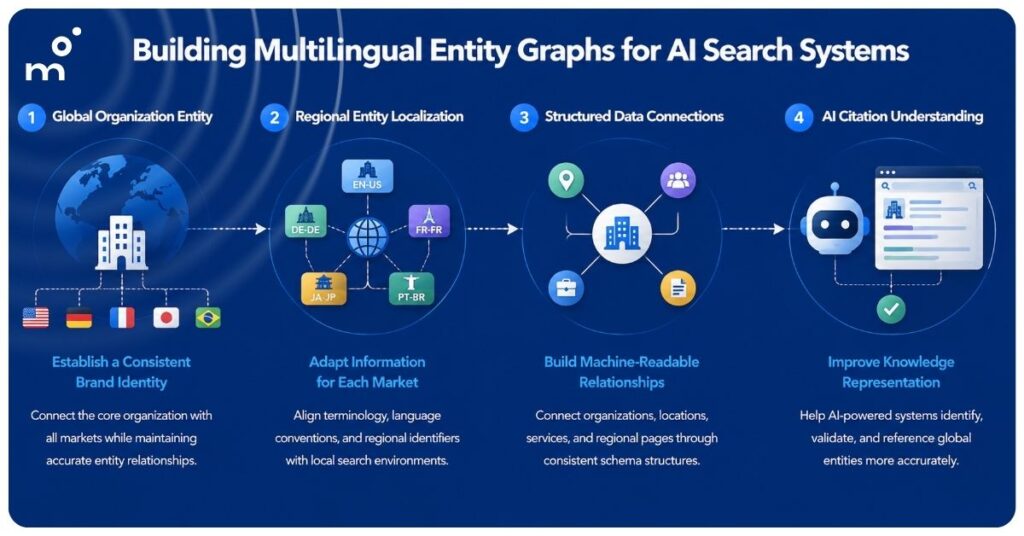
Localized entity structures help AI-powered search systems understand organizations across multiple languages and markets.
By connecting regional entities through consistent structured data, multilingual websites can improve knowledge representation, reduce ambiguity, and strengthen citation accuracy across global search experiences.
Entity Schema Localization for Global Search Systems
Entity Schema Localization is the process of adapting structured data to match regional terminology, language conventions, and market-specific knowledge systems. Rather than translating schema properties alone, organizations align entity information with how people and search engines understand businesses within each target market.
A localized schema implementation should accurately represent the organization while preserving consistent relationships across every language version of the website.
This includes defining the organization through appropriate organization schema, connecting physical locations with LocalBusiness schema where applicable, and using language-specific attributes and regional identifiers that reflect local search behavior.
Maintaining consistency between structured data and visible website content helps search engines understand that localized pages belong to the same global organization while accurately representing each regional entity.
Building Multi-Language Knowledge Representation
AI-powered search systems understand websites by identifying relationships between organizations, locations, services, and regional entities. Localized structured data helps these systems distinguish market-specific information while maintaining a consistent global brand identity.
By creating connected entity networks across languages, organizations improve citation accuracy and help AI systems deliver more relevant information in multilingual search results.
Connecting Global Discovery Models to Enterprise Information Retrieval
Global multilingual search systems represent a distributed discovery layer within broader enterprise information retrieval frameworks.
Every localized page, structured entity, and regional relationship contributes to how search engines and AI systems discover, validate, and connect information across international markets.
This broader relationship is explored in The Enterprise Guide to Information Retrieval: Engineering Growth Marketing Infrastructure for High-LTV Client Acquisition, which explains how multilingual entity mapping, structured search architecture, and information retrieval systems work together to support scalable enterprise growth.
Within this framework, localized entity structures become foundational components that help global organizations maintain consistent visibility while serving users across multiple languages and regions.
How a Cross Border SEO Agency Engineers Multilingual SEO Services
Scaling into international markets requires more than multilingual content. It requires a technical foundation that helps search engines understand regional websites, localized entities, and cross-border relationships at scale.
As a cross border SEO agency, Marketing Planet builds enterprise search infrastructures designed for sustainable international growth.
As a technical SEO partner, enterprise architecture partner, and provider of multilingual SEO services, our approach includes:
- Hreflang Pipelines: Building and validating multilingual hreflang relationships to support accurate regional targeting.
- Scalable URL Architecture: Designing international website structures that strengthen authority while supporting global expansion.
- Edge Infrastructure: Improving international content delivery through modern edge computing and optimized routing.
- Entity Localization: Aligning structured data with regional languages, markets, and AI-powered search systems.
- Analytics Systems: Connecting international search performance with actionable reporting across countries and languages.
- Technical SEO Execution: Implementing enterprise-grade technical improvements that support scalable cross border B2B marketing strategies.
Every component is designed to work together as a connected infrastructure rather than as isolated SEO tasks. Request an advanced cross-border infrastructure audit to identify technical barriers, strengthen your multilingual search architecture, and support long-term international growth.
Enterprise Cross-Border SEO Readiness Checklist
A scalable multilingual SEO strategy depends on a strong technical foundation. Use the checklist below to assess whether your international search infrastructure is prepared to support long-term global growth.
✔ International URL Architecture Is Clearly Defined: Your website uses a consistent structure that supports regional targeting and scalable expansion.
✔ Hreflang Clusters Are Validated Bidirectionally: Localized pages include accurate reciprocal hreflang relationships across all language versions.
✔ Canonical Signals Match Regional Targeting: Canonical tags correctly support localized content without creating indexing conflicts.
✔ Regional Pages Load Efficiently Worldwide: Optimized infrastructure delivers fast, reliable experiences across international markets.
✔ Structured Data Supports Localized Entities: Schema markup accurately represents organizations, locations, and services for each region.
✔ Analytics Track International Performance: Reporting measures visibility, traffic, and conversions across countries and languages.
✔ Translation Workflows Align With Search Intent: Localized content reflects regional terminology and user search behavior.
A well-engineered multilingual infrastructure helps organizations expand globally while maintaining consistent search visibility and operational efficiency.
Conclusion
Expanding into international markets requires more than translating content into multiple languages. Sustainable global SEO depends on a technical infrastructure that connects URL architecture, hreflang validation, localized entities, and high-performance delivery systems into a unified framework. When these components work together, organizations can improve international visibility while supporting scalable growth across regions.
Marketing Planet helps enterprises build high-performance multilingual search systems through advanced technical SEO, cross-border architecture, and data-driven execution.
Request an advanced cross-border SEO assessment to identify technical barriers and strengthen your international search infrastructure.
Disclaimer: This content is provided for general informational and educational purposes only and does not constitute legal, financial, business, or professional marketing advice. Reading this article does not establish an agency-client relationship with Marketing Planet Inc. or Marketing Planet Media Group. Digital marketing platforms, algorithms, tools, and best practices change frequently, and results vary significantly based on individual industries, budgets, competition, and implementation. Marketing Planet makes no guarantees regarding specific outcomes, ROI, or performance metrics. References to third-party products or services do not imply endorsement. Please evaluate your specific business circumstances or consult with a professional before executing any strategies or making investments based on this content.
Source:
Google Search Central — International and Multilingual SEO
Google Search Central — Local Business Structured Data
Google Search Central — Organization Structured Data
Google Search Central — Introduction to Structured Data Markup
Google Search Central — Core Web Vitals and Page Experience
Google Search Central — Tell Google About Localized Versions of Your Page
Google Search Central — Managing Multi-Regional and Multilingual Sites
WHATWG HTML Living Standard — The hreflang Attribute
Google Search Central — Consolidate Duplicate URLs
Google for Developers — Crawl Budget Documentation
Strapi — Multilingual SEO: Best Practices for Any Industry
Digital Applied — International SEO: Hreflang & Multilingual Guide
Search Engine Journal — 75% of Multilingual Websites Have Hreflang Implementation Mistakes