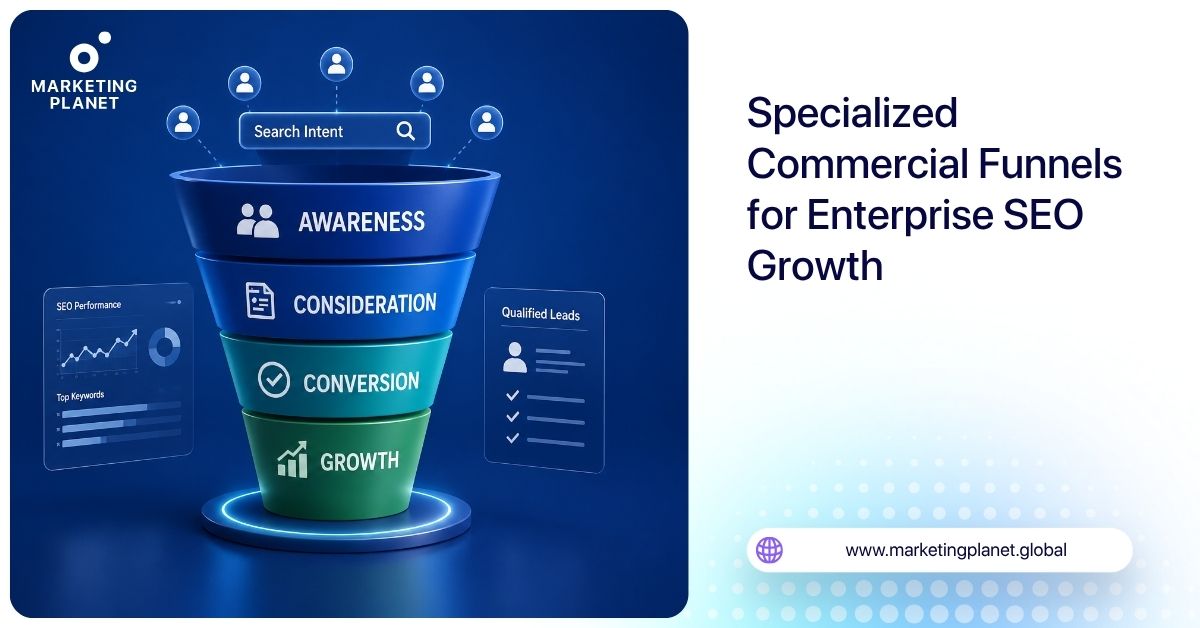
Enterprise organizations often invest heavily in SEO and content marketing yet struggle to connect organic traffic with qualified pipeline. Generic service pages, disconnected site architecture, and keyword-focused campaigns may attract visitors, but they rarely provide the retrieval paths, commercial context, or conversion signals needed to support complex buying decisions.
As enterprise sales cycles become longer and buying committees more diverse, modern B2B lead generation tactics must be designed to guide high-value prospects from search to measurable business outcomes.
Specialized commercial funnels address this challenge by organizing content around entities, search tasks, and commercial intent rather than isolated keywords. By connecting retrieval architecture, evidence-based page design, conversion pathways, qualification criteria, and CRM reporting, organizations can create a traceable system that links organic visibility to pipeline contribution.
This approach is increasingly valuable for enterprise businesses operating across markets such as California and Vancouver, where complex service offerings, multiple stakeholders, and high-value opportunities require search strategies built for long-term commercial growth rather than traffic alone.
Here is the Quick Answer:
- Enterprise commercial funnels should organize search demand around connected entities, search tasks, evidence requirements, conversion routes, and measurable pipeline states rather than isolated keyword targets.
- Diagnosis, comparison, validation, selection, implementation, and support searches require different page objects, proof modules, CTAs, qualification fields, and next steps.
- Technical SEO, internal linking, conversion design, analytics, and CRM data must operate as one system to create traceable content-to-pipeline lineage.
- Form submissions should not automatically be treated as MQLs; qualification and sales acceptance require documented criteria, ownership, and lifecycle rules.
- Executive reporting should prioritize qualified rate, sales acceptance, opportunity creation, pipeline value, velocity, and closed outcomes within clearly stated attribution boundaries.
Why Enterprise Lead Generation Must Begin With Entity Architecture
Enterprise SEO succeeds when it reflects how customers search for services, evaluate solutions, and make purchasing decisions. Instead of organizing content around isolated keywords, organizations should structure their websites around commercial entities and the search tasks associated with them.
This creates stronger retrieval paths, clearer information architecture, and a direct connection between search visibility and qualified pipeline.
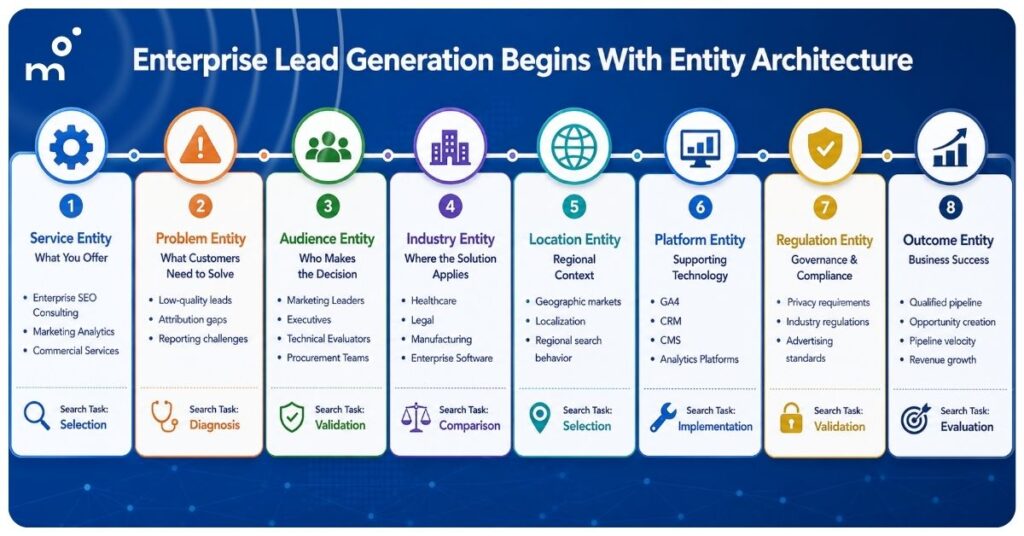
What makes a high-value entity?
High-value entities represent the core components of an enterprise buying journey rather than individual search terms. Each entity serves a distinct commercial purpose and helps define the content, evidence, and conversion path required to support a specific business objective.
Service Entities: The products or services an organization provides, such as enterprise SEO consulting or marketing analytics services.
Problem Entities: The business challenges prospects are trying to solve, such as fragmented attribution, low-quality leads, or disconnected reporting.
Audience Entities: The stakeholders involved in the buying process, including marketing leaders, executives, technical evaluators, and procurement teams.
Industry Entities: Vertical markets that require specialized messaging, workflows, and compliance considerations, such as healthcare, legal, manufacturing, or enterprise software.
Location Entities: Geographic markets that influence search behavior, regulations, localization, and regional business strategies.
Platform Entities: The technologies supporting marketing and sales operations, including GA4, CRM platforms, CMS solutions, and analytics tools.
Regulation Entities: Industry standards, privacy requirements, or advertising regulations that affect content, data collection, and user experience.
Outcome Entities: The measurable business objectives that define success, such as qualified pipeline contribution, opportunity creation, pipeline velocity, or revenue growth.
High-Value Entities vs Keyword Lists
Traditional keyword research identifies search demand, but enterprise growth requires understanding how entities relate to one another across the customer journey. A service entity may connect to multiple industries, audiences, locations, and business problems, each requiring different evidence and conversion paths.
This entity-based approach strengthens topical authority SEO by building interconnected content that reflects real business relationships instead of isolated keyword targets.
As retrieval systems gain a deeper understanding of these relationships, organizations can better match commercial intent with the appropriate page type, supporting greater retrieval depth and more qualified lead generation throughout the buying process.
Entity Class Matrix
Every high-value entity should have a clearly defined commercial purpose within the enterprise funnel. The matrix below illustrates how different entity classes support distinct search tasks and business objectives, helping organizations build retrieval systems that connect search demand to qualified pipeline rather than isolated keyword rankings.
Enterprise Entity Class Matrix |
|||
|---|---|---|---|
| Entity Class | Example | Commercial Role | Search Task |
| Service | Enterprise SEO Consulting | Defines the Primary Commercial Offering | Selection |
| Problem | Low-Quality Lead Generation | Addresses a Business Challenge | Diagnosis |
| Audience | VP of Marketing | Identifies the Decision-Maker | Validation |
| Industry | Healthcare Networks | Tailors Content to a Specific Vertical | Comparison |
| Location | California | Supports Regional Relevance and Localization | Selection |
| Platform | Google Analytics 4 (GA4) | Connects Measurement and Reporting | Implementation |
| Regulation | HIPAA Compliance | Defines Governance and Compliance Requirements | Validation |
| Outcome | Qualified Pipeline Contribution | Represents the Desired Business Result | Evaluation |
Enterprise entity architecture becomes significantly more effective when it is integrated into a broader retrieval strategy. For a deeper explanation of how retrieval systems, information architecture, and commercial entities work together to support high-LTV acquisition, see The Enterprise Guide to Information Retrieval: Engineering Growth Marketing Infrastructure for High-LTV Client Acquisition.
How Search Tasks Reshape Commercial Funnel Design
Enterprise buyers do not follow a single path from search to purchase. Each search task reflects a different stage of decision-making and requires content, evidence, and conversion mechanisms that match the user’s immediate objective.
Designing commercial funnels around search tasks creates more relevant retrieval experiences while improving lead qualification and pipeline efficiency.
Understanding Enterprise Search Tasks
Enterprise search behavior typically progresses through several distinct tasks, each requiring different information and user experiences.
Diagnosis: Identifying a business problem or operational challenge that requires investigation.
Comparison: Evaluating multiple solutions, providers, or approaches before narrowing available options.
Validation: Confirming technical capabilities, methodology, compliance, integrations, or implementation feasibility.
Selection: Choosing the preferred solution based on commercial fit, business requirements, and organizational priorities.
Implementation: Seeking guidance on deployment, integration, onboarding, or technical execution after a decision is made.
Support: Looking for ongoing optimization, troubleshooting, governance, or long-term operational resources.
Search Task Determines Funnel Design
Each search task should guide how a commercial funnel is built. Rather than directing every visitor to the same landing page and contact form, organizations should align content and conversion paths with the information prospects need at that stage of the buying journey.
As search tasks evolve, so do the required commercial page objects, supporting evidence modules, calls to action, qualification fields, and CRM routing. A prospect researching a business challenge may only need educational resources, while someone evaluating vendors may require case studies, implementation details, or a consultation request.
Matching these elements to search intent helps improve lead quality while providing sales teams with more meaningful qualification data.
Search Task to Commercial Page Matrix
Each search task requires a different combination of content, supporting evidence, and conversion strategy. The table below illustrates how enterprise organizations can align commercial page objects with user intent, qualification requirements, and the appropriate next step in the buying journey.
Enterprise Search Task and Commercial Page Framework |
||||
|---|---|---|---|---|
| Search Task | Commercial Page Object | Evidence | CTA | Qualification |
| Diagnosis | Educational Guide or Pillar Page | Industry Insights, Frameworks | Read Related Resources | Business Challenge |
| Comparison | Comparison or Solution Page | Feature Comparisons, Methodologies | Request Information | Company Size, Industry |
| Validation | Case Study or Technical Resource | Case Evidence, Certifications, Implementation Process | Schedule a Consultation | Technical Requirements |
| Selection | Service or Solution Page | Pricing Approach, Project Methodology, Expected Deliverables | Request a Proposal | Budget, Timeline, Decision Authority |
| Implementation | Implementation or Onboarding Resource | Deployment Process, Integrations, Governance | Speak With a Specialist | Platform, Implementation Scope |
| Support | Resource Center or Knowledge Base | Documentation, Best Practices, Ongoing Guidance | Contact Support | Existing Customer Status |
Why Enterprise Funnels Cannot Be Universal
Enterprise commercial funnels should adapt to the complexity of each buying environment rather than relying on a single awareness-to-conversion model. Buying cycles vary significantly across organizations, while different industries introduce unique compliance requirements, procurement processes, and technical expectations.
Decision-making also changes based on risk profile, organizational structure, and the number of stakeholders involved. A healthcare organization evaluating a technology partner follows a different retrieval path than a B2B software company expanding into new markets.
Building specialized commercial funnels around these variables creates more relevant user journeys, improves qualification accuracy, and better aligns search activity with measurable pipeline outcomes.
How Buying Committees Create Parallel Retrieval Paths
Enterprise purchasing decisions rarely depend on a single stakeholder. Multiple decision-makers evaluate a solution from different perspectives, requiring content that addresses their individual responsibilities, concerns, and approval criteria.
Commercial funnels should support these parallel retrieval paths by delivering the right information to the right audience at the appropriate stage of the buying process.
Mapping Enterprise Buying Committees
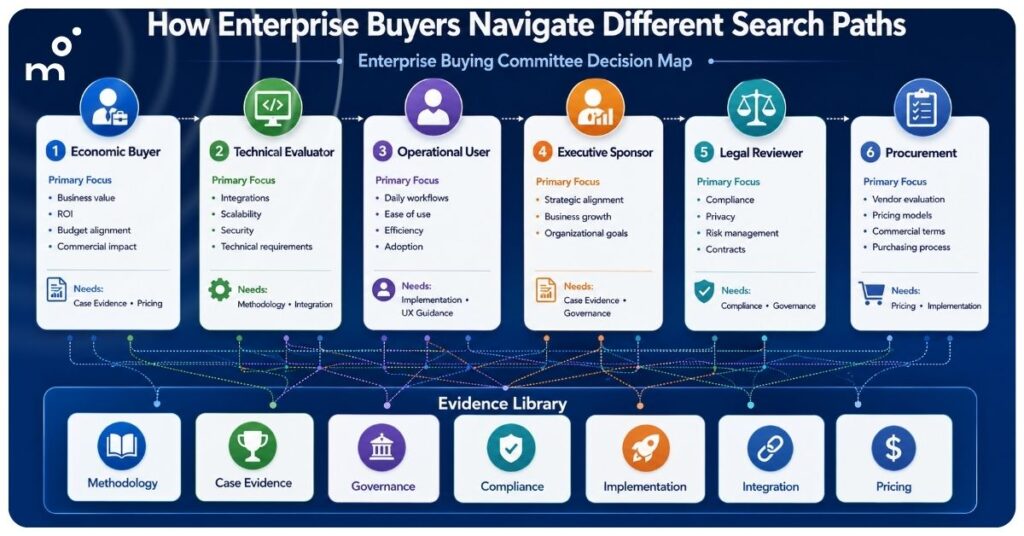
Enterprise buying committees consist of stakeholders with different objectives, each following a unique search journey before contributing to the final purchasing decision.
Economic Buyer: Evaluates commercial value, expected return, budget alignment, and overall business impact.
Technical Evaluator: Reviews technical capabilities, integrations, scalability, security, and implementation requirements.
Operational User: Assesses usability, workflows, efficiency improvements, and day-to-day operational impact.
Executive Sponsor: Determines whether the proposed solution supports broader organizational strategy and long-term business goals.
Legal Reviewer: Verifies contractual obligations, privacy requirements, regulatory considerations, and organizational risk.
Procurement: Manages vendor evaluation, purchasing processes, pricing documentation, and commercial negotiations.
Matching Evidence to Decision Makers
Different stakeholders require different forms of evidence before moving a buying decision forward. Delivering the same messaging to every audience often creates unnecessary friction and slows the sales process.
- Methodology helps technical evaluators understand how services are delivered and managed.
- Case Evidence demonstrates proven experience and provides practical examples for executive sponsors and economic buyers.
- Governance explains ownership, quality assurance, reporting, and operational controls that support long-term success.
- Compliance addresses regulatory requirements, privacy standards, and organizational policies that influence legal review.
- Implementation outlines deployment processes, timelines, onboarding, and technical responsibilities for operational teams.
- Integration demonstrates compatibility with existing platforms, workflows, and enterprise systems.
- Pricing supports procurement and executive decision-making by explaining commercial models and project scope.
UX Routing for Multiple Stakeholders
Enterprise websites should guide different stakeholders toward the information most relevant to their role instead of directing every visitor through the same navigation path. Well-structured navigation allows users to quickly access industry pages, solution pages, technical documentation, and supporting resources without unnecessary complexity.
Strategic internal links connect related content so users can move naturally between educational resources, implementation details, case studies, and service pages.
Dedicated evidence pathways ensure each stakeholder can locate the documentation needed to validate a purchasing decision, while structured commercial routing directs qualified visitors toward the most appropriate consultation, assessment, proposal request, or contact option based on their search intent and stage in the buying process.
How Commercial Page Objects Transform Search Into Qualified Pipeline
Commercial funnels are built from purpose-driven page objects that connect high-value search entities with the evidence, conversion paths, and qualification logic required at each stage of the buying journey.
When every page serves a defined commercial role, organizations create clearer retrieval paths and stronger connections between organic search, qualified leads, and pipeline contribution.
Commercial Page Object Framework
Each commercial page object supports a specific entity, search task, and business objective rather than attempting to satisfy every type of user intent.
- Pillar Pages: Establish topical authority by providing comprehensive coverage of a core commercial subject while connecting related content through structured internal links.
- Service Pages: Present individual services with clear capabilities, supporting evidence, and conversion opportunities for high-intent buyers.
- Solution Pages: Address specific business problems by demonstrating how services solve defined operational or technical challenges.
- Industry Pages: Adapt messaging, examples, and evidence to the needs of individual sectors such as healthcare, legal, manufacturing, or enterprise technology.
- Location Pages: Support regional deployment where geographic relevance influences search intent, regulations, or service availability.
- Comparison Pages: Help prospects evaluate different solutions, approaches, or service models during the consideration stage.
- Case Study Pages: Provide measurable project examples, methodologies, and implementation outcomes that support commercial validation.
- Integration Pages: Explain how services connect with existing enterprise platforms, workflows, and technology ecosystems.
- Resource Pages: Deliver educational content, technical documentation, frameworks, and implementation guidance that supports earlier-stage research and ongoing customer success.
Page Eligibility Rules
Not every keyword variation or business topic deserves its own landing page. Enterprise websites should create new commercial page objects only when they satisfy clear architectural and commercial requirements.
A page should represent a unique entity, address a distinct search task, provide meaningful evidence that cannot be found elsewhere on the site, and offer clear conversion value that supports business objectives. If these criteria are not met, expanding the website may increase complexity without improving retrieval performance or lead quality.
Preventing Low-Value Scaled Content
Instead of creating pages through simple keyword or geographic substitutions, organizations should require unique entity value, a distinct search task, original evidence, and a measurable conversion role. As verified in July 2026, Google classifies large-scale production of low-value or unoriginal pages created primarily to manipulate rankings as scaled content abuse, regardless of whether the pages are produced manually or through automation.
Google’s broader content guidance recommends creating helpful, reliable, people-first information rather than material produced primarily to manipulate search visibility.
How Retrieval Infrastructure Supports Commercial Discovery
Commercial content can only contribute to pipeline when search engines and users can consistently discover, understand, and navigate it.
A well-designed retrieval infrastructure combines technical SEO, information architecture, and contextual linking to create efficient paths from search demand to qualified conversion opportunities.
Building Retrieval Paths
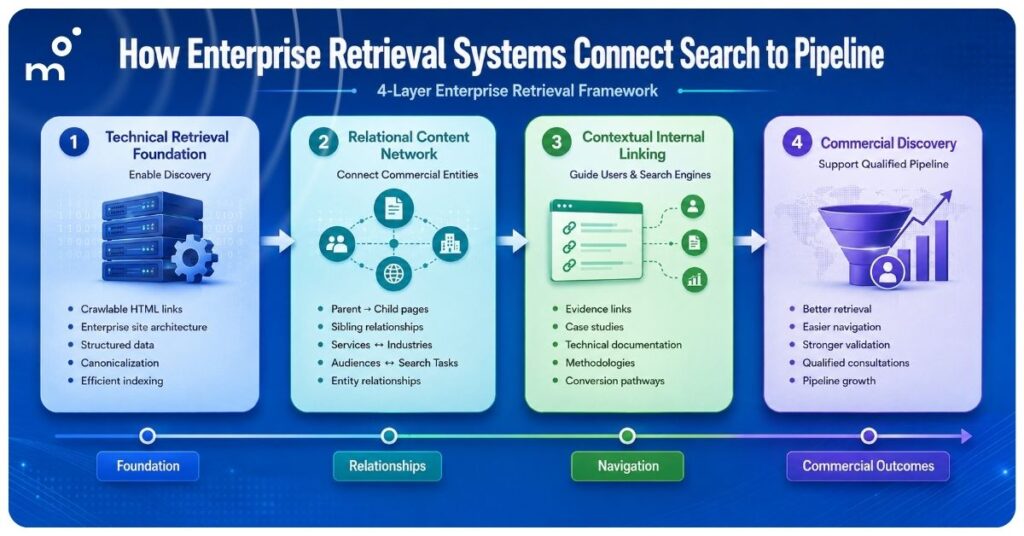
Effective retrieval begins with a technical foundation that allows every commercial page to be discovered, indexed, and understood within the broader website structure.
Enterprise technical SEO ensures that search engines can efficiently access and evaluate content, while a well-planned SEO website architecture organizes pages into logical relationships based on services, industries, audiences, and business objectives.
Strong retrieval paths also depend on clear crawl paths that connect important pages through crawlable HTML links rather than isolated navigation or orphaned content. Google recommends crawlable links with descriptive anchor text so that both users and Google can understand the destination page.
Structured data helps search engines interpret commercial entities and their relationships, while consistent canonicalization prevents duplicate or competing versions of similar pages from weakening retrieval signals. Together, these elements improve both search visibility and the efficiency of enterprise content discovery.
Relational Internal Linking
Internal links should reinforce the relationships between commercial entities instead of functioning as isolated navigation elements. A relational linking strategy creates multiple pathways that support both retrieval systems and users throughout the buying journey.
- Parent-child links connect broad pillar pages with more specialized service, industry, or technical resources.
- Sibling links connect related pages covering similar entities, industries, or search tasks.
- Evidence links guide users from commercial pages to supporting case studies, methodologies, technical documentation, or compliance resources.
- Conversion links direct qualified visitors toward consultations, assessments, proposal requests, or other actions that match their search intent and buying stage.
This layered structure strengthens topical relationships, improves crawl efficiency, and helps users move naturally between education, validation, and conversion.
From Flat Directories to Relational Data Hubs
Traditional blog directories often organize content chronologically, making it difficult for search engines and users to understand how individual pages relate to one another. Enterprise websites benefit from replacing these flat structures with relational content hubs that organize information around connected entities, search tasks, and commercial objectives.
By grouping related pages through structured navigation, contextual internal links, and shared entity relationships, organizations create stronger retrieval signals while making it easier for prospects to progress through complex buying journeys.
For a deeper exploration of this architecture, see The Death of Flat Site Architecture: Transforming Legacy Blog Directories into Relational Data Hubs.
Why AI Search Raises the Standard for Commercial Evidence
AI-assisted search experiences increase the practical value of clear, original, well-supported commercial information because content may be retrieved, summarized, or presented beyond a conventional list of search results. However, no universal public model explains how every AI platform selects or cites sources. Enterprise pages should therefore prioritize demonstrable value, accurate sourcing, technical accessibility, and clear evidence rather than unsupported AI-optimization tactics.
AI Search Prioritizes Evidence
High-value commercial content should provide information that helps users complete meaningful search tasks while demonstrating credibility through transparent evidence.
Original Analysis: Present unique insights, frameworks, research, or practical expertise instead of repeating widely available information.
Methodology: Clearly explain how recommendations, processes, or implementation approaches are developed and applied.
Sourcing: Support technical, regulatory, and industry-specific statements with authoritative references where appropriate.
Expert Review: Ensure specialized content is reviewed by individuals with relevant subject-matter expertise before publication.
Limitations: Acknowledge assumptions, scope, and implementation boundaries to provide balanced and trustworthy information.
Together, these elements strengthen the quality of commercial pages while making their content more useful to both users and retrieval systems.
Building Citation-Ready Commercial Pages
Commercial pages should organize information so that both users and search systems can easily identify important concepts and supporting evidence. Structured evidence presented through logical headings, comparison tables, methodologies, and supporting documentation improves clarity and information retrieval.
Maintaining technical accuracy through regular reviews, supported by clear governance processes for content updates and quality assurance, helps keep information reliable over time. Combined with strong retrieval architecture, these practices improve retrieval quality by making commercial content easier to discover, interpret, and evaluate across traditional and AI-powered search experiences.
AI Visibility Boundaries
Organizations should avoid assuming that technical optimization alone will result in visibility within AI-generated search experiences. No website can guarantee inclusion in AI-generated answers, citations, featured experiences, or organic rankings.
As verified in July 2026, Google’s guidance for generative Search experiences remains grounded in established SEO principles, including valuable content, clear technical structure, crawlability, and index eligibility. Google states that no special AI-specific markup is required and that meeting its requirements does not guarantee crawling, indexing, serving, ranking, or inclusion in generative Search features.
How Specialized Commercial Funnels Change by Industry
Enterprise commercial funnels should adapt to the operational, regulatory, and decision-making requirements of each industry.
While the underlying retrieval framework remains consistent, the entities, evidence, search tasks, and conversion strategies vary based on the audience, buying process, and level of commercial risk associated with each market.
Commercial Funnel Comparison by Industry
Every industry has its own buying process, compliance requirements, and decision-making criteria. As a result, commercial funnels should adapt their entity focus, supporting evidence, and conversion strategy to match the specific needs of each market.
How Commercial Funnel Requirements Differ Across Industries |
||||
|---|---|---|---|---|
| Industry | Entity Focus | Search Task | Evidence | CTA |
| B2B E-Commerce | Product Categories, Product Variants, Technical Specifications | Product Evaluation and Solution Selection | Product Data, Implementation Methodology, Technical Documentation | Request a Technical Audit |
| Legal | Practice Areas, Legal Issues, Jurisdictions | Case Evaluation and Attorney Selection | Case Process, Legal Experience, Consultation Workflow | Schedule a Case Evaluation |
| Healthcare | Medical Services, Specialties, Providers, Locations | Provider Evaluation and Appointment Planning | Clinical Processes, Patient Experience, Compliance Information | Request an Appointment Assessment |
| Multilingual | Languages, Regions, International Services | Market Expansion and Localization Planning | Hreflang Implementation, Localization Strategy, Regional Architecture | Request a Cross-Border Consultation |
| Regulated Industries | Compliance Standards, Governance Requirements, Regulated Services | Vendor Validation and Risk Assessment | Compliance Frameworks, Governance Controls, Documentation | Request a Compliance Review |
Commercial funnel architecture should reflect the requirements of each vertical rather than applying a single template across every industry.
For example, enterprise e-commerce organizations often prioritize catalog architecture and technical product relationships, while legal organizations focus on practice-area entities, jurisdictional relevance, and case qualification.
Enterprise e-commerce SEO services require commercial funnels that connect product families, variants, technical specifications, procurement intent, and catalog infrastructure with appropriate audit or consultation pathways.
Healthcare providers require patient-centered retrieval paths supported by privacy and compliance considerations, while multilingual organizations depend on regional entity mapping, localization, and international search infrastructure.
Multilingual funnels also support cross border B2B marketing by connecting locale, language, regional search intent, evidence, and conversion requirements across markets.
These differences become even more significant in highly regulated industries, where governance, advertising requirements, and data handling influence both content strategy and conversion design. Each vertical requires specialized retrieval paths, evidence modules, and qualification workflows that align with its operational environment and commercial objectives.
Explore Related Industry Frameworks
Each industry requires a specialized retrieval model that aligns search behavior with commercial objectives. Explore these related resources for a deeper look at vertical-specific funnel architecture:
B2B E-Commerce: The Enterprise Pipeline Catalog: Structuring Technical B2B E-Commerce Search Signals for Multi-Variant Platforms explores catalog architecture, product entities, and technical search systems for complex product environments.
Legal Services: The Hidden Economics of Legal Intake: Maximizing Case Value Velocity for Personal Injury Law Firms explains how entity-driven search supports case qualification, intake workflows, and pipeline value.
Healthcare: Patient Acquisition Marketing: Engineering Local Booking Frameworks for Multi-Location Dental and Medical Networks examines patient acquisition, location-based search, and booking infrastructure. For privacy and compliance considerations, see HIPAA & PHI Compliance in Digital Search: Secure Patient Acquisition Protocols for Multi-Location Medical Networks.
Multilingual Enterprises: Multilingual Algorithmic Pipelines: Deploying High-Performance Cross-Border SEO Strategies for Global Scale covers international entity architecture, hreflang implementation, and regional search infrastructure.
Regulated Industries: Regulatory Advertising Ethics: Navigating Legal Compliance Constraints on Aggressive High-Intent Landing Pages explains how governance and advertising requirements influence commercial funnel design.
Designing Conversion Components Around Search Intent
Conversion components should match the search task a visitor is trying to complete rather than directing every prospect toward the same action. Aligning CTAs, qualification fields, and user experience with commercial intent creates smoother buying journeys and improves lead quality.
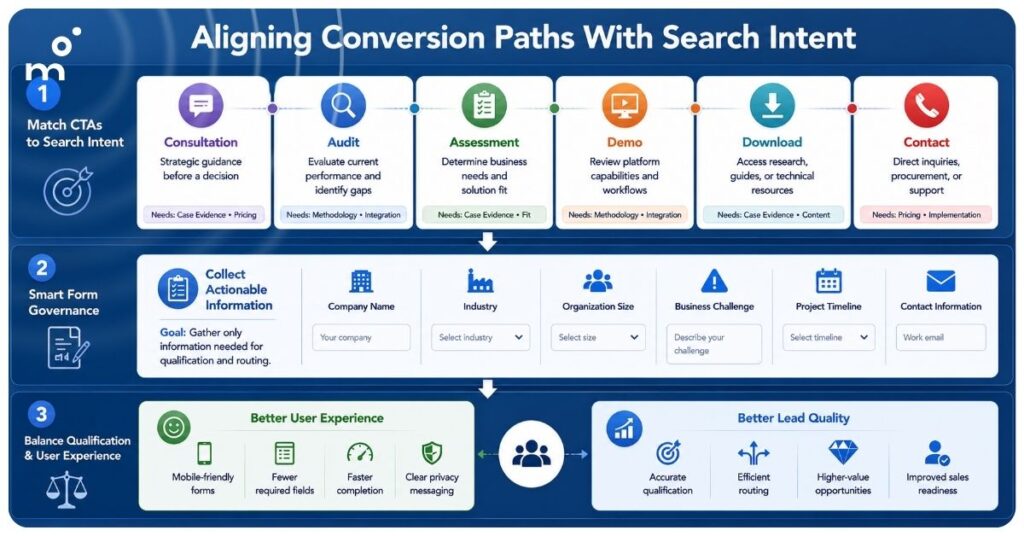
CTA Architecture
Different search tasks require different conversion paths.
- Consultation: For prospects seeking strategic guidance before making a decision.
- Audit: For organizations evaluating existing systems or identifying performance gaps.
- Assessment: For businesses determining needs and solution fit.
- Demo: For evaluating platforms, workflows, or technical capabilities.
- Download: For accessing research, guides, or technical resources.
- Contact: For direct inquiries, procurement discussions, or support.
Matching the CTA to search intent helps increase engagement while providing sales teams with more relevant inquiries.
Form Field Governance
Enterprise lead forms should collect only the information necessary to evaluate and route opportunities effectively. Every additional field increases friction, so each question should have a clear operational purpose within the sales process.
Useful qualification fields typically include company name, industry, organization size, business challenge, project timeline, and contact details. Collecting only actionable data reduces form abandonment, improves completion rates, and enables more accurate routing to the appropriate sales or technical team.
Balancing Qualification and User Experience
Effective conversion design balances commercial qualification with a positive user experience. Forms should be optimized for mobile usability, allowing users to complete key actions quickly across devices without unnecessary complexity.
Reducing unnecessary fields and simplifying interactions helps minimize abandonment, while clear explanations about data collection support privacy expectations and build trust. At the same time, forms should capture enough information to support meaningful sales qualification, allowing teams to prioritize high-value opportunities without creating excessive friction for prospective buyers.
Connecting Content to Revenue Through GA4 and CRM
Enterprise SEO becomes more commercially measurable when website interactions can be connected with documented CRM states. Integrating GA4 and CRM data can support content-to-pipeline lineage, but the resulting reports remain dependent on identity matching, offline-data coverage, duplicate handling, lifecycle definitions, and the organization’s chosen attribution model.
Lead tracking software can support this process by connecting form activity, source data, lifecycle changes, and opportunity records, but the reporting model is only reliable when event definitions, CRM fields, identity rules, and ownership are standardized.
From Search Visit to Qualified Outcome
A complete measurement model should connect website interactions with documented lead and CRM states. The exact sequence depends on the organization’s analytics configuration, CRM lifecycle, identity controls, consent requirements, and offline-event capabilities.
A typical model may include:
- page_view: a visitor views a commercial page.
- form_start: the visitor begins completing a lead form.
- generate_lead: the visitor submits lead or contact information.
- qualify_lead: the lead meets documented qualification criteria.
- working_lead: a representative begins active follow-up.
- disqualify_lead: the lead is rejected under a recorded reason.
- close_convert_lead: the lead reaches the organization’s defined converted state.
- close_unconvert_lead: the lead is closed without conversion.
These event names follow Google Analytics’ recommended lead-generation event framework, as verified in July 2026.
Sales acceptance, opportunity creation, opportunity value, and closed revenue may remain CRM lifecycle states unless the organization has confirmed custom or imported analytics events for them.
➤ Implementation Warning: Confirm the deployed GA4 events, parameters, CRM lifecycle stages, identity keys, offline-data process, and reporting destination before using this model.
Content-to-CRM Lineage
Content-to-CRM lineage creates a direct connection between search content and revenue reporting. Every qualified lead should be traceable back to its original landing page and associated entity cluster, while the CRM records its lifecycle stage, assigned owner, related opportunity, and eventual revenue outcome.
This provides a consistent view of how enterprise content contributes to pipeline without relying solely on website engagement metrics.
Required CRM Fields
A consistent CRM schema allows enterprise teams to trace a lead from its original search interaction through qualification, sales handling, opportunity creation, and closure.
| CRM Field | Purpose |
| Original source | Records the measurable acquisition source under the agreed attribution method. |
| Landing page | Identifies the first recorded commercial page associated with the lead. |
| Entity cluster | Connects the lead to the service, problem, industry, location, platform, regulation, or outcome entity that generated the inquiry. |
| Campaign context | Stores relevant campaign, channel, or referral information where available. |
| Company | Identifies the prospect organization. |
| Sector | Supports industry-specific qualification and reporting. |
| Lifecycle stage | Records whether the record is an inquiry, MQL, SAL, SQL, opportunity, customer, disqualified lead, or another documented state. |
| Owner | Identifies the person or team responsible for the next action. |
| Disposition | Records whether the lead was accepted, rejected, deferred, duplicated, or closed, with a reason. |
| Opportunity | Links the lead or account to the relevant sales opportunity. |
| Opportunity value | Stores estimated pipeline value without presenting it as revenue. |
| Closure status | Records whether the opportunity was won, lost, withdrawn, or remains open. |
➤ Data Warning: Confirm the organization’s CRM fields, lifecycle definitions, ownership rules, and reporting model before implementation.
For a deeper look at integrating GA4 measurement with enterprise CRM reporting, see The B2B Tech Stack Blueprint: Engineering Seamless Data Loops Between GA4 and Enterprise CRM Platforms.
Assess Your Retrieval and Measurement Architecture
A reliable commercial funnel requires crawlable retrieval paths, accurate conversion tracking, documented CRM mapping, clear ownership, and dependable data-quality controls. Marketing Planet can review how these layers connect and identify infrastructure gaps before they weaken qualification or executive reporting.
Measuring Enterprise SEO Through Pipeline Contribution
Enterprise SEO should be measured by its contribution to qualified pipeline rather than by traffic or rankings alone. Executive reporting is most valuable when it connects organic search activity to measurable business outcomes throughout the sales process.
A meaningful scorecard prioritizes metrics such as qualified lead rate, sales acceptance rate, opportunity rate, pipeline velocity, pipeline contribution, win rate, and closed outcomes. Measuring B2B marketing ROI should be based on verified pipeline and revenue data rather than lead volume or website engagement. Do not publish performance figures until the underlying pipeline and revenue data have been validated.
Where the organization uses pipeline velocity, it should define the formula before presenting the result. One commonly used commercial model is:
Pipeline Velocity = Number of Qualified Opportunities × Average Opportunity Value × Win Rate ÷ Average Sales-Cycle Length
Do not report pipeline velocity until the opportunity count, average value, win rate, and sales-cycle duration have each been validated. The organization should also state the reporting period, opportunity definition, currency, and treatment of duplicated or reopened opportunities.
Accurate reporting also depends on clear attribution boundaries. Organizations should define their attribution model, establish processes for identity resolution and duplicate handling, and incorporate offline sales data where appropriate to provide a more complete view of marketing performance.
Ultimately, website traffic is only an indicator of demand. Executive teams are better served by reports that focus on commercial contribution, qualified opportunities, and pipeline growth, providing a clearer understanding of how enterprise SEO supports long-term business objectives.
Technical Failure Modes That Break Commercial Funnels
Even well-designed commercial funnels can underperform when technical issues interrupt retrieval, conversion, or measurement. Identifying and resolving these failure points helps ensure that enterprise SEO supports qualified pipeline by maintaining reliable content discovery, user experience, analytics, and CRM data integrity.
Common Technical Failures and Their Commercial Impact
Technical issues can interrupt the journey from search visibility to qualified pipeline at multiple stages. The table below highlights some of the most common enterprise failure points, the business impact they create, and practical approaches for resolving them before they affect retrieval, conversions, or revenue reporting.
Common Technical Failures That Affect Commercial Funnel Performance |
||
|---|---|---|
| Failure | Commercial Impact | Solution |
| Orphan Pages | Valuable Commercial Content Remains Difficult for Search Engines and Users to Discover, Limiting Qualified Traffic. | Strengthen Internal Linking and Connect Pages Through a Clear Information Architecture. |
| Redirect Chains | Multiple Redirects Slow Page Delivery, Waste Crawl Resources, and Reduce User Experience. | Consolidate Redirect Paths and Point Links Directly to the Final Destination. |
| Canonical Conflicts | Duplicate or Conflicting Canonical Signals Can Prevent Preferred Pages From Being Indexed Correctly. | Align Canonical Tags With Intended Regional or Commercial Landing Pages. |
| Crawl Traps | Infinite URLs or Poor Navigation Reduce Crawl Efficiency and Delay Indexing of Important Commercial Pages. | Improve Crawl Paths, Navigation, and URL Management to Eliminate Unnecessary Crawl Depth. |
| Broken Forms | Qualified Visitors Cannot Complete Conversions, Resulting in Lost Leads and Reduced Pipeline Contribution. | Continuously Test Forms, Validation Rules, and Submission Workflows Across Devices. |
| Missing Events | Incomplete Analytics Prevent Accurate Reporting of Lead Generation and Funnel Performance. | Validate GA4 Event Tracking and Ensure Key Conversion Events Are Properly Configured. |
| CRM Duplication | Duplicate Records Distort Qualification Metrics, Pipeline Reporting, and Revenue Attribution. | Implement Data Validation, Deduplication Rules, and Standardized CRM Governance. |
Many of these issues extend beyond SEO alone and affect the entire commercial measurement framework. Technical problems such as inefficient crawl paths, redirect loops, or indexing barriers can reduce search visibility, while data-quality issues weaken attribution and executive reporting.
For a deeper technical discussion, see Crawl Budget Remediation: Eliminating Multi-Layer Redirect Loops and Server Performance Drops for SREs.
To understand how search quality changes can affect entity visibility and commercial performance over time, see Tracking Semantic Core Updates: Deconstructing High-Density Entity Realignment in Search Indexes.
Governance for Sustainable Enterprise Funnel Architecture
Enterprise funnel architecture requires ongoing governance to remain effective as search behavior, commercial priorities, and technology platforms evolve. Clearly defined ownership, standardized release processes, and structured update criteria help organizations maintain technical quality, measurement accuracy, regulatory compliance, and consistent commercial performance over time.
Enterprise RACI Model
A sustainable enterprise funnel depends on cross-functional ownership rather than a single department. Each team contributes to maintaining search visibility, user experience, data integrity, and revenue generation throughout the customer journey.
- SEO: Owns search strategy, entity architecture, technical optimization, and organic performance monitoring.
- Content: Produces, updates, and governs commercial content based on search intent and business objectives.
- Development: Implements technical requirements, website functionality, structured data, and performance improvements.
- Design: Maintains user experience, accessibility, conversion components, and visual consistency across commercial pages.
- Analytics: Validates tracking, attribution, dashboards, and measurement accuracy across marketing and sales systems.
- Revenue Operations: Oversees CRM configuration, lifecycle management, lead routing, and pipeline reporting.
- Sales: Qualifies leads, provides commercial feedback, and validates opportunity quality.
- Legal: Reviews regulatory compliance, privacy requirements, marketing claims, and governance policies.
- Executive: Sets strategic priorities, approves investments, and evaluates business performance against commercial objectives.
Release Gate Framework
Every major update to enterprise funnel architecture should pass through a structured release process before deployment. Technical QA verifies pages, structured data, redirects, and integrations, while analytics QA confirms that conversion tracking and attribution continue to function correctly.
Accessibility reviews help maintain a consistent user experience across devices and assistive technologies. CRM mapping ensures lead data flows accurately into downstream systems, legal review verifies compliance where required, and a documented rollback plan enables teams to quickly reverse changes if unexpected technical or measurement issues occur after launch.
Update Trigger Matrix
Enterprise funnel architecture should evolve in response to measurable business and technical signals rather than fixed publishing schedules.
Google describes core updates as broad changes to its search algorithms and systems rather than penalties aimed at individual pages. When visibility changes coincide with a confirmed core update, organizations should review content quality, relevance, technical accessibility, and user value before assuming that one isolated technical factor caused the decline.
Sales feedback can uncover recurring qualification issues or content gaps that affect conversions. Likewise, sustained declines in qualified leads, pipeline contribution, or conversion rates should trigger a structured review before optimization efforts are prioritized.
Entity-to-Revenue Control System
An entity-to-revenue control system provides a standardized framework for connecting search intent, commercial content, conversion pathways, and pipeline measurement.
By defining how each entity progresses from discovery through conversion and CRM reporting, enterprise organizations can evaluate whether every commercial page supports a measurable business objective while maintaining consistent governance across SEO, marketing, analytics, and sales.
Entity-to-Revenue Control Table
The following framework illustrates how enterprise organizations can standardize the relationship between commercial entities, user search tasks, conversion pathways, analytics, and CRM reporting. Mapping each entity class to measurable pipeline outcomes helps ensure that every commercial page supports a defined business objective rather than simply generating website traffic.
| Entity-to-Revenue Control Framework | |||||||||
|---|---|---|---|---|---|---|---|---|---|
| Entity Class | Search Task | Commercial Page Object | Evidence Module | CTA | Analytics Event | CRM Field | Pipeline KPI | Governance Owner | Implementation Status |
| Service Entity | Solution Evaluation | Service Page | Methodology, Scope, Relevant Case Evidence, and Limitations | Book a Consultation | generate_lead | Service Interest | Qualified Lead Rate | Marketing and Sales | Requires Organization-Specific Validation |
| Industry Entity | Vendor Validation | Industry Solution Page | Sector Experience, Operational Controls, and Regulatory Boundaries | Request an Assessment | generate_lead | Industry or Sector | Opportunity-Creation Rate | Marketing and Compliance | Requires Organization-Specific Validation |
| Problem Entity | Problem Diagnosis | Diagnostic Guide or Problem Page | Original Analysis, Diagnostic Framework, and Implementation Considerations | Request an Audit | generate_lead | Primary Business Challenge | Qualified Diagnostic-Request Rate | Content and Revenue Operations | Requires Organization-Specific Validation |
| Location Entity | Regional Provider Selection | Regional Service Page | Delivery Coverage, Local Capabilities, and Jurisdictional Considerations | Discuss Regional Requirements | generate_lead | Geographic Market | Sales-Accepted Lead Rate by Market | Marketing and Sales | Requires Organization-Specific Validation |
| Platform Entity | Technical Validation | Integration or Platform Page | Compatibility, Workflow, Security, and Implementation Requirements | Speak With a Technical Specialist | generate_lead or qualify_lead* | Platform or Integration Requirement | Opportunity Rate by Platform Need | Technical and Revenue Operations | Requires Organization-Specific Validation |
| Regulation Entity | Compliance Validation | Compliance or Governance Page | Applicable Requirements, Review Process, Limitations, and Data Controls | Request a Compliance-Focused Assessment | generate_lead | Regulatory Requirement | Qualified Opportunity Rate | Compliance and Legal | Requires Organization-Specific Validation |
| Outcome Entity | Commercial Selection | Solution or Executive Business-Case Page | Measurement Model, Attribution Boundaries, and Relevant Evidence | Schedule an Executive Diagnostic | generate_lead | Target Commercial Outcome | Pipeline Contribution Under the Stated Attribution Model | Executive, Marketing, and Revenue Operations | Requires Organization-Specific Validation |
➤ Implementation Note: This framework is illustrative. Event mappings, CRM fields, ownership, lifecycle rules, KPIs, and verification dates must be validated against the organization’s deployed analytics and revenue-operations systems before implementation.
* Use qualify_lead only after the lead has met documented qualification criteria, not merely because a visitor has submitted a technically focused form. Google’s recommended lead-generation events define generate_lead as a lead-information submission and qualify_lead as the point at which a lead is marked as meeting qualification criteria.
Identify Where Your Entity-to-Revenue System Breaks Down
Marketing Planet helps enterprise teams assess how search entities, commercial pages, evidence modules, conversion components, analytics events, and CRM states work together. An executive diagnostic can uncover retrieval gaps, weak qualification paths, and reporting breaks that limit visibility into qualified pipeline contribution.
Disqualification Triggers
Not every page belongs in an enterprise commercial funnel. Pages without a unique entity often duplicate existing content, while those without a defined search task lack a clear role in the buyer journey.
Commercial pages should also provide supporting evidence, such as technical documentation, case studies, or implementation guidance, to help users make informed decisions. A reliable crawl path is equally important so search engines and users can consistently discover the content.
Finally, every page should support a measurable conversion and have clear CRM ownership to ensure leads are tracked, routed, and reported accurately. If these elements are missing, the page is unlikely to contribute meaningfully to qualified pipeline or revenue measurement.
How Marketing Planet Builds Enterprise Commercial Funnel Infrastructure
Marketing Planet operates as a boutique enterprise growth partner, bringing together enterprise SEO, B2B digital strategy, specialist SEO consulting, content architecture, UI/UX, analytics, and conversion infrastructure. The objective is to help organizations connect search visibility with clearer qualification pathways and more traceable pipeline reporting.
We build integrated commercial funnel infrastructure that aligns SEO, content, analytics, and CRM systems around measurable business outcomes.
Our approach combines technical SEO, retrieval architecture, and structured content architecture to create scalable entity-driven websites that support conventional search discovery and emerging AI-assisted search experiences. We also optimize UI/UX by designing navigation, conversion paths, and calls to action around user intent to improve engagement and lead quality.
To support commercial measurement, our framework aligns GA4, CRM data, and content-to-CRM lineage so organizations can evaluate relationships among commercial pages, qualified opportunities, pipeline stages, and revenue outcomes.
Executive reporting can then evaluate SEO performance against metrics such as qualified leads, opportunity creation, pipeline contribution, and closed outcomes within the organization’s stated attribution model.
Schedule an enterprise commercial funnel assessment with Marketing Planet to identify retrieval gaps, strengthen conversion architecture, and improve qualified pipeline contribution.
Conclusion
Enterprise SEO is most effective when it begins with a strong entity architecture that organizes content around commercial intent rather than keywords alone. Search tasks shape page strategy and conversion design, while documented GA4 and CRM integration can support content-to-pipeline lineage, helping organizations evaluate how search interactions relate to qualification, opportunities, and business outcomes within defined attribution boundaries. Ongoing governance keeps commercial funnels scalable, consistent, and aligned with evolving business goals.
Marketing Planet helps organizations build enterprise retrieval systems that combine technical SEO, content architecture, analytics, and CRM integration to support qualified pipeline growth.
Schedule a strategic consultation with Marketing Planet to identify retrieval gaps, strengthen your commercial funnel, and improve qualified pipeline contribution.
Disclaimer: This content is provided for general informational and educational purposes only and does not constitute legal, financial, business, or professional marketing advice. Reading this article does not establish an agency-client relationship with Marketing Planet Inc. or Marketing Planet Media Group. Digital marketing platforms, algorithms, tools, and best practices change frequently, and results vary significantly based on individual industries, budgets, competition, and implementation. Marketing Planet makes no guarantees regarding specific outcomes, ROI, or performance metrics. References to third-party products or services do not imply endorsement. Please evaluate your specific business circumstances or consult with a professional before executing any strategies or making investments based on this content.