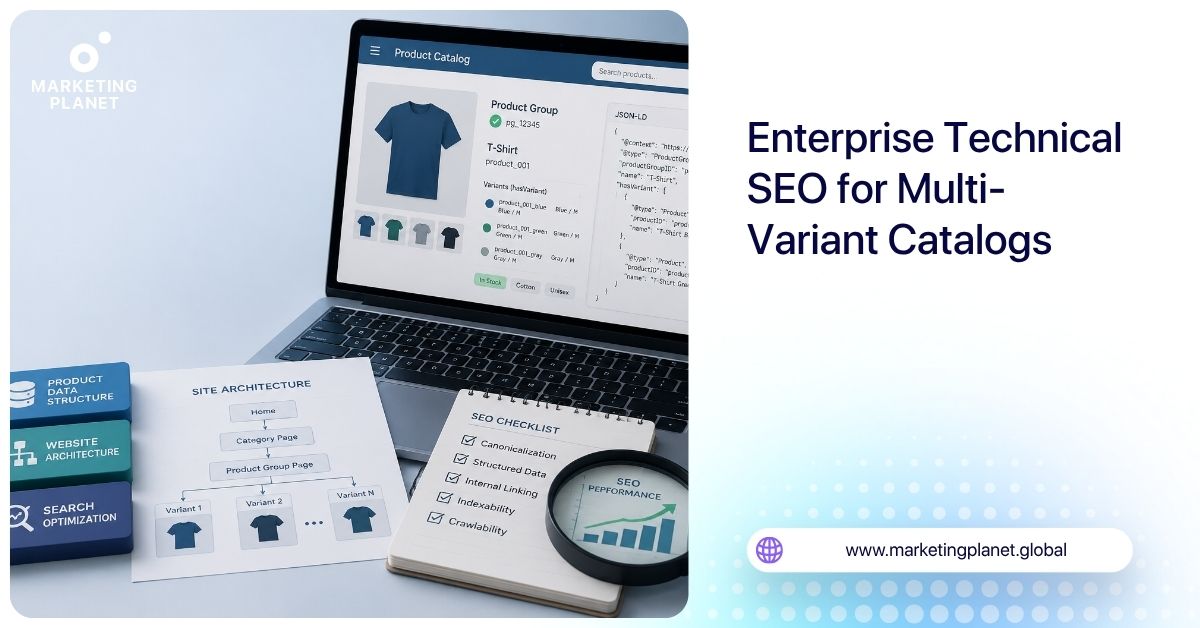
Managing a large B2B product catalog is no longer just an e-commerce challenge. It is a search infrastructure challenge. As inventories expand to include thousands of SKUs, configurable products, contract pricing, and ERP-driven updates, even minor structural inconsistencies can reduce index coverage, weaken search visibility, and impact qualified pipeline growth.
Enterprise ecommerce SEO services now require technical systems that accurately translate complex product data into machine-readable search signals.
Modern search engines evaluate relationships between products, not just individual pages. Fragmented variant structures and inconsistent structured data can reduce crawl efficiency and product visibility.
A synchronized catalog architecture helps search engines interpret product relationships more accurately and supports long-term organic growth.
Here is the Quick Answer:
- Enterprise B2B product catalogs require more than traditional SEO. A structured technical foundation helps search engines accurately interpret complex product relationships.
- ProductGroup Schema, hasVariant relationships, and variesBy properties help search engines understand multi-variant products while reducing conflicting or duplicated product signals.
- Synchronizing ERP systems, structured data, and product feeds improves index stability, crawl efficiency, and semantic consistency across large catalogs.
- Managing faceted navigation with proper canonicalization protects crawl budget and helps search engines prioritize high-value product pages.
- Marketing Planet combines enterprise technical SEO, website architecture, structured data implementation, and analytics engineering to build scalable search infrastructure that supports qualified pipeline growth.
Programmatic Product Catalog Ingestion Faults in Enterprise E-Commerce
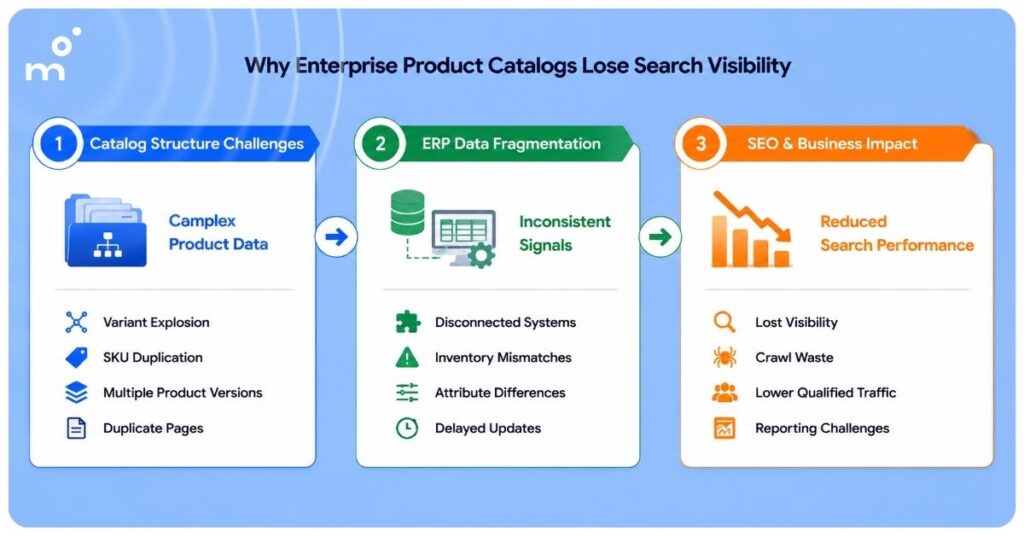
Enterprise B2B catalogs depend on structured data that accurately connects products, variants, and inventory records. As catalogs become larger and more complex, small inconsistencies between Enterprise Resource Planning (ERP) systems and website data can reduce search visibility, consume crawl resources, and weaken pipeline performance. Below are some of the most common structural challenges.
Why Large B2B Catalogs Lose Search Visibility
Large B2B catalogs often generate thousands of product variations from a single product family. Without a structured data model, search engines may struggle to recognize which pages represent unique products and which are simply variations.
Common causes include:
- Variant explosion: Every size, material, configuration, or pricing option creates a separate indexable page.
- SKU duplication: Identical products appear under different identifiers across catalogs or business units.
- ERP inconsistencies: Product data differs between internal systems and the public-facing website.
- Crawl inefficiency: Search engines spend crawl budget processing duplicate or low-value pages instead of priority inventory.
These issues reduce search engines’ ability to understand product relationships and maintain stable index coverage.
How ERP Data Fragmentation Creates Indexing Problems
Search engines rely on consistent product data across every system that feeds your website. When ERP records and website content fall out of sync, conflicting signals reduce indexing accuracy.
Typical sources of fragmentation include:
- Disconnected databases: Multiple systems publish different information for the same product.
- Inventory mismatches: Availability or pricing differs between structured data and on-page content.
- Inconsistent product attributes: Specifications, dimensions, or identifiers vary across systems.
- Delayed synchronization: Website updates lag behind ERP changes, leaving outdated information indexed.
Maintaining synchronized product data helps create reliable search signals that support long-term visibility.
The Cost of Structural Search Signal Failures
Technical catalog issues affect far more than search rankings. Poor structural signals can limit product discoverability and reduce the efficiency of your entire digital acquisition strategy.
Common business impacts include:
- Lost organic visibility: Priority product families appear less frequently in search results.
- Lower qualified pipeline: Fewer high-intent buyers discover relevant products during research.
- Crawl waste: Search engines spend resources crawling redundant pages instead of valuable inventory.
- Executive reporting challenges: Technical indexing problems make it harder to distinguish visibility issues from actual market performance.
Addressing these structural issues creates a stronger technical foundation for both search visibility and enterprise pipeline growth.
Enterprise Technical SEO Starts with ProductGroup Schema Architecture
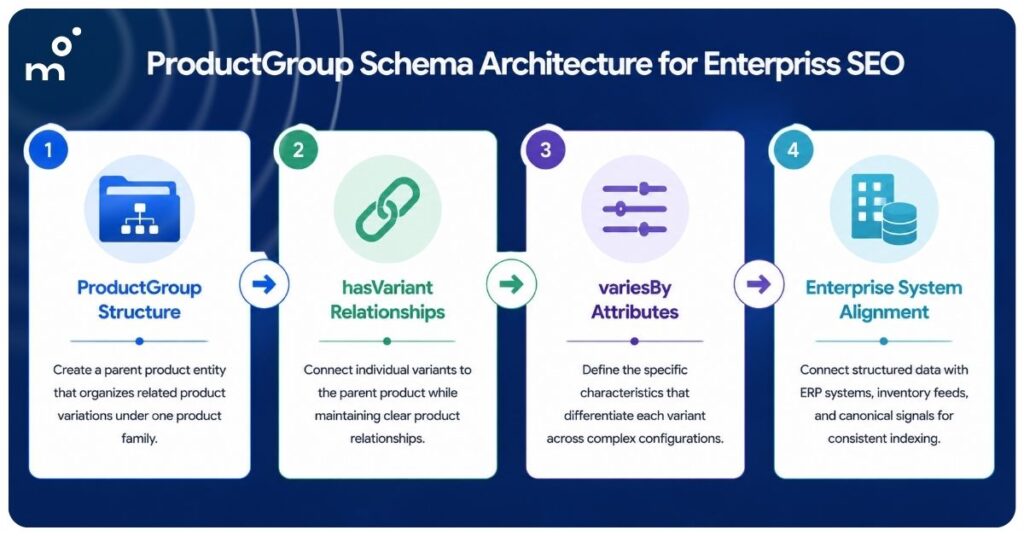
ProductGroup Schema Architecture provides the structural foundation for organizing complex B2B product catalogs. Below are the key principles that support accurate indexing and stronger search performance.
Understanding ProductGroup Schema Architecture
ProductGroup Schema is a structured data vocabulary that groups multiple versions of the same product under a single parent entity. Instead of presenting every configuration as an independent product, search engines recognize one parent product connected to multiple variants through the hasVariant relationship.
Each ProductGroup is assigned a unique productGroupID, allowing search engines to distinguish the shared characteristics of a product family from the attributes that make each variant unique. This structure creates stronger semantic relationships, simplifies product interpretation, and improves indexing consistency across large enterprise catalogs with hundreds or even thousands of related product configurations.
Using hasVariant Relationships Without Creating Duplicate Pages
The hasVariant property establishes the connection between a parent product and each of its individual variants. Rather than treating every variation as a separate product competing for visibility, search engines understand that all variants belong to a single product family.
This approach supports variant inheritance, allowing shared information such as product descriptions, images, technical documentation, and manufacturer details to remain centralized while assigning only unique attributes to each variant.
Product characteristics such as dimensions, pricing, availability, or specifications are maintained through clear attribute relationships, preserving accurate distinctions without fragmenting search signals. Combined with canonical entity modeling, this structure reduces duplication risks and helps consolidate indexing authority around the parent ProductGroup.
Implementing variesBy Arrays for Multi-Axis Product Configurations
Enterprise B2B products often differ across multiple dimensions simultaneously. A single product may be available in numerous sizes, colors, materials, wholesale pricing tiers, and specialized industrial specifications.
The variesBy property identifies which attributes distinguish one variant from another while keeping every configuration connected to the same ProductGroup. This allows search engines to interpret complex product matrices without treating every possible combination as a separate product entity, supporting cleaner indexing across extensive enterprise catalogs.
Connecting ProductGroup Structures to Enterprise Information Retrieval Systems
ProductGroup implementation delivers its greatest value when it becomes part of a broader enterprise information retrieval strategy rather than an isolated SEO enhancement.
Product relationships should align with ERP databases, structured data, canonical signals, inventory feeds, and internal knowledge architecture to create consistent machine-readable information across every digital touchpoint.
This unified approach strengthens how search engines and AI-powered retrieval systems interpret enterprise catalogs while reducing inconsistencies between operational databases and public-facing product pages.
As discussed in The Enterprise Guide to Information Retrieval: Engineering Growth Marketing Infrastructure for High-LTV Client Acquisition, ProductGroup structures form a core component of modern information retrieval systems, helping transform complex enterprise product data into accurate, scalable search signals that support long-term discoverability and pipeline performance.
Synchronizing ERP Data with Search Engine Indexing Systems
Enterprise search visibility depends on keeping ERP data and search signals aligned. Here are the key practices for maintaining accurate indexing across complex B2B product catalogs.
Mapping ERP Variant Tables to Search Signals
ERP systems typically store product information across multiple relational tables for inventory, pricing, specifications, and customer-specific configurations. Search engines, however, require these relationships to be presented as a unified product entity through structured data.
An effective mapping strategy should:
- Connect ERP records to a single parent ProductGroup.
- Associate each product variation through the hasVariant relationship.
- Maintain consistent product identifiers across all systems.
- Publish only the attributes that distinguish one variant from another.
This structured approach helps search engines interpret complex product relationships without creating duplicate or conflicting indexing signals.
ERP Data-Loop Ingestion Best Practices
Enterprise catalogs constantly change as inventory, specifications, and pricing are updated. A reliable ERP data-loop ingestion process ensures those changes are consistently reflected across the website, structured data, and search platforms.
This requires synchronizing ERP updates with structured markup, validating product attributes before publication, monitoring data feeds for inconsistencies, and regularly auditing structured data after major catalog changes.
Maintaining this continuous data flow helps prevent indexing conflicts and ensures search engines receive accurate, up-to-date product information.
Keeping Inventory, Pricing, and Availability Synchronized
Search engines compare product information across multiple sources to evaluate data consistency. Differences between website content, structured data, and external commerce feeds can reduce confidence in the accuracy of your catalog.
To maintain consistent search signals, enterprise platforms should ensure:
- Live inventory reflects current stock levels rather than outdated ERP records.
- Structured data matches the pricing, specifications, and availability displayed on each product page.
- Merchant Center graph alignment helps keep product feeds, structured data, and on-page content consistent, reducing the risk of mismatched product signals across Google surfaces.
- Product updates are synchronized across all systems to prevent conflicting indexing signals.
When inventory, pricing, and availability remain synchronized, enterprise catalogs provide reliable machine-readable data that supports stronger indexing, greater trust, and improved search visibility.
Managing Faceted Navigation Without Losing Crawl Budget
Faceted navigation helps users filter large product catalogs by attributes such as size, material, pricing tier, or industry application. While these filters improve the shopping experience, they can also generate thousands of parameterized URLs that search engines must crawl.
Without proper controls, these URLs consume valuable crawl resources, reduce indexing efficiency, and compete with priority commercial pages for search visibility.
Understanding Crawl Budget Degradation
Crawl budget degradation occurs when search engines spend excessive time crawling duplicate or low-value URLs instead of priority product and category pages. Large B2B catalogs with layered filters are especially vulnerable because a single category can produce thousands of URL combinations.
As crawl resources are diverted to redundant pages, important products may be crawled less frequently, delaying index updates and reducing overall search visibility.
Canonicalization of Faceted Navigations
Canonicalization helps search engines distinguish the preferred version of a page from alternative filtered URLs. A well-planned canonical strategy consolidates indexing signals while allowing customers to continue using faceted navigation.
A typical implementation process includes:
- Identify faceted URLs that generate duplicate or substantially similar content.
- Define the preferred canonical version for each product or category page.
- Apply canonical tags that consistently reference the primary URL.
- Prevent unnecessary filtered pages from competing for indexing signals.
- Regularly audit canonical relationships after catalog or navigation updates.
This process preserves user-friendly filtering while concentrating search authority on the pages that matter most.
Handling Dynamic URL Parameters at Enterprise Scale
Large enterprise catalogs often generate dynamic URL parameters for filters such as product type, material, region, pricing tier, or availability. Managing these parameters requires a structured framework that balances user experience with efficient crawling.
A scalable strategy typically combines several technical controls:
- Canonical tags consolidate indexing signals by identifying the preferred version of each page.
- Parameter control limits the creation and indexing of unnecessary URL variations.
- Robots directives help prevent search engines from crawling low-value parameter combinations while preserving access to important content.
- Crawl prioritization focuses search engine resources on high-value product, category, and commercial pages that contribute most to qualified pipeline generation.
Together, these practices help enterprise websites maintain efficient crawl allocation, protect indexing quality, and ensure search engines spend their resources discovering the content that delivers the greatest business value.
Building an Enterprise SEO Website Architecture for Multi-Variant Platforms
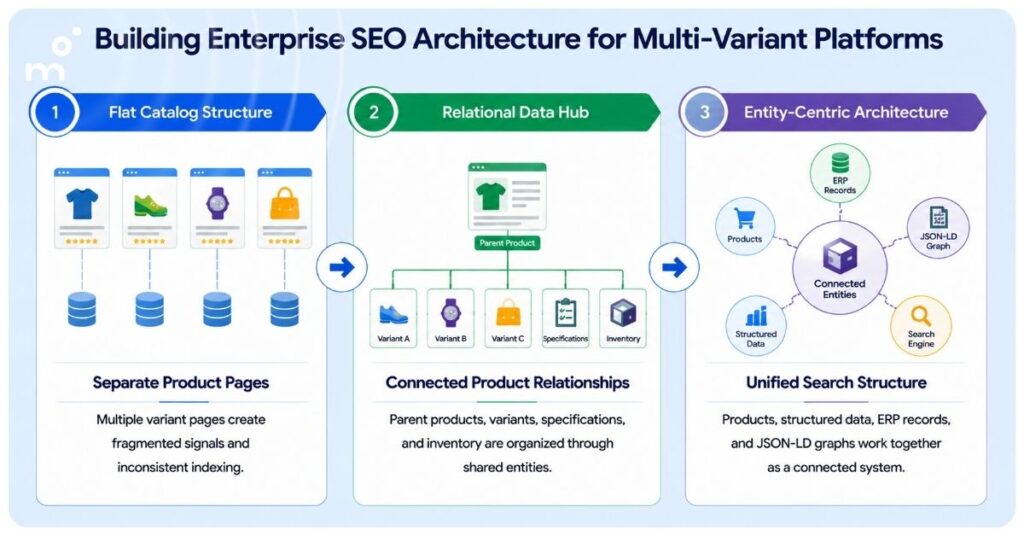
A scalable SEO website architecture helps search engines understand relationships between products, categories, and variants. Using relational data models, structured markup, and clear internal linking improves crawl efficiency, semantic understanding, and long-term indexing stability.
Flat Catalog Structures vs. Relational Data Hubs
Flat catalog structures often treat every product variation as a separate page, creating duplicate signals and fragmented indexing across large inventories.
In contrast, relational data hubs organize products around connected entities, allowing search engines to understand the relationships between parent products and their variants. This approach improves indexing consistency while making large catalogs easier to manage and scale.
Entity-Centric Catalog Design
An entity-centric catalog organizes products around a central product entity rather than individual URLs. Product variants, specifications, pricing, inventory, and supporting content remain connected within a unified structure.
This allows search engines to better understand product relationships while creating stronger alignment between website content, structured data, and ERP records.
Reducing JSON-LD Graph Fragmentation
JSON-LD Graph Fragmentation occurs when structured data is divided into disconnected pieces, making it difficult for search engines to interpret product relationships.
Building clean schema graphs, using reusable entities, and maintaining graph consistency across product pages and data feeds helps create a complete, machine-readable representation of the catalog. This results in more reliable indexing and stronger visibility across both search engines and AI-powered retrieval systems.
Comparison Table: Legacy Catalogs vs. Modern ProductGroup Architectures
The way an enterprise catalog is structured has a direct impact on crawl efficiency, indexing stability, and product discoverability. The table below compares the characteristics of traditional flat architectures with modern ProductGroup-based implementations.
| Flat Architecture vs. ProductGroup Architecture | ||
|---|---|---|
| Feature | Flat Architecture | ProductGroup Architecture |
| Crawl Budget | Crawl resources are frequently consumed by duplicate URLs and parameterized pages. | Crawl resources are focused on primary products and validated variants. |
| Index Stability | Index coverage may fluctuate because similar pages compete for visibility. | Parent and variant relationships create more stable and consistent indexing signals. |
| Duplicate Risk | Higher risk of duplicate content across product variations and filtered URLs. | Related variants are grouped under a single entity, reducing duplicate signals. |
| Variant Handling | Each product variation is typically treated as an independent page. | Variants remain connected through ProductGroup and hasVariant relationships. |
| Merchant Center Compatibility | Product feeds and website data are more likely to become inconsistent. | Structured product relationships improve Merchant Center graph alignment and feed consistency. |
| ERP Synchronization | ERP updates often require multiple independent page changes, increasing the risk of data mismatches. | Centralized product structures simplify synchronization between ERP systems and website content. |
| Semantic Graph Integrity | Fragmented structured data weakens entity relationships across the catalog. | Connected schema graphs strengthen semantic relationships and machine readability. |
| Pipeline Visibility | Reduced product discoverability can limit qualified traffic and pipeline opportunities. | Stronger indexing and product relationships improve visibility and support qualified pipeline growth. |
System Compliance Audit for Enterprise Catalogs
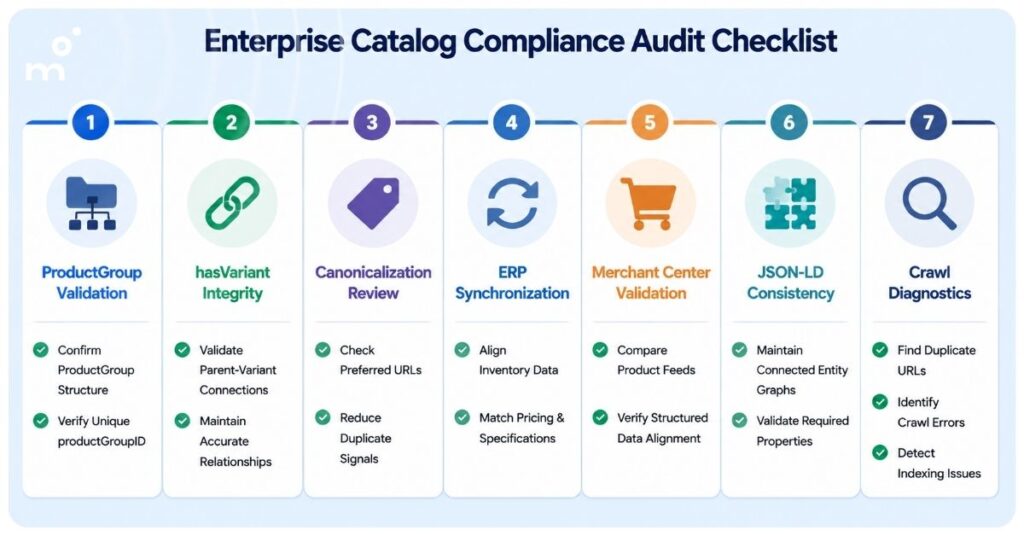
A technical audit helps verify that product data is structured consistently across your website, ERP platform, and search ecosystem. Reviewing these areas regularly can identify structural issues before they affect indexing stability, crawl efficiency, or product visibility.
Enterprise Catalog Compliance Checklist
✔ ProductGroup Validation: Confirm that related products are grouped under a valid ProductGroup entity with a unique productGroupID.
✔ hasVariant Integrity: Verify that every product variant is correctly connected to its parent product using the hasVariant relationship.
✔ Canonicalization Review: Ensure canonical tags consistently identify the preferred version of product and category pages while preventing duplicate indexing signals.
✔ ERP Synchronization: Check that inventory, specifications, pricing, and availability remain synchronized between ERP systems and website content.
✔ Merchant Center Validation: Confirm that Merchant Center product feeds align with on-page content and structured data to reduce data inconsistencies.
✔ JSON-LD Consistency: Review structured data to ensure entities are connected within a complete JSON-LD graph and that required properties are accurate and up to date.
✔ Crawl Diagnostics: Analyze crawl reports to identify duplicate URLs, orphan pages, excessive parameterized pages, crawl errors, and indexing anomalies that could affect search performance.
Regularly reviewing these technical elements helps maintain a scalable, search-friendly catalog and supports consistent visibility as enterprise product inventories continue to grow.
Enterprise Case Study: Recovering Visibility After Variant Fragmentation
A mid-market B2B enterprise managing a large multi-variant product catalog experienced a steady decline in organic visibility following several ERP and catalog updates. While the number of product pages continued to grow, search engines struggled to interpret the relationships between product variants because structured data, canonical signals, and ERP records were no longer aligned.
The technical assessment identified a sequence of structural issues that affected indexing performance:
Problem
A growing product catalog contained thousands of configurable variants spread across multiple ERP tables and independently generated product pages.
⬇
ERP Mismatch
Inventory records, product attributes, and structured data became inconsistent as updates moved between the ERP system and the website.
⬇
Duplicate Indexing
Search engines began indexing similar product variations as separate entities, reducing crawl efficiency and creating conflicting product signals.
⬇
ProductGroup Implementation
The catalog was restructured using ProductGroup Schema, hasVariant relationships, consistent canonicalization, and synchronized ERP data to accurately connect parent products with their variants.
⬇
Crawl Stabilization
Search engines were able to process the catalog more efficiently as redundant URLs were consolidated and structured product relationships became clearer.
⬇
Pipeline Recovery
As indexing became more stable, high-value product pages regained visibility, improving product discoverability and supporting a stronger flow of qualified B2B opportunities.
This example demonstrates that many enterprise visibility challenges originate from catalog architecture rather than content quality.
Aligning ERP systems, structured data, and ProductGroup relationships creates a more resilient technical foundation for long-term search performance and pipeline growth.
How Marketing Planet Engineers Enterprise Search Infrastructure
Enterprise search performance depends on more than rankings. It requires a technical foundation that connects product data, website architecture, and analytics into a unified search ecosystem.
Marketing Planet serves as a technical implementation partner, helping enterprise organizations build scalable infrastructure that improves indexing stability, strengthens data integrity, and supports measurable pipeline growth.
Our enterprise ecommerce SEO services combine enterprise technical SEO, advanced technical SEO services, scalable website architecture, structured data implementation, and analytics engineering to solve the structural challenges of complex B2B catalogs.
Every solution is built around accurate data relationships, efficient crawling, and long-term search performance through data-driven execution.
If your enterprise catalog is experiencing indexing instability, fragmented product data, or declining search visibility, schedule an enterprise technical architecture assessment with Marketing Planet. Our team will evaluate your current search infrastructure and identify technical opportunities to strengthen indexing, improve crawl efficiency, and support sustainable pipeline growth.
Conclusion
For enterprise B2B e-commerce platforms, search performance begins with structure. Well-organized product relationships, consistent semantic signals, and synchronized data help search engines accurately interpret complex catalogs and improve long-term discoverability.
As search systems continue to evolve, technical indexing plays an increasingly important role in supporting qualified pipeline growth and business performance.
Enterprise SEO is no longer limited to page optimization. It is an infrastructure discipline that connects ERP systems, website architecture, structured data, and analytics into a scalable search ecosystem. Organizations that invest in this technical foundation are better positioned to maintain visibility as their catalogs continue to grow.
Partner with Marketing Planet to strengthen the technical systems behind your enterprise search strategy.
FAQs
How does the ProductGroup structured data type prevent duplicate content penalties on massive B2B e-commerce platforms?
ProductGroup Schema groups related product variants under a single parent entity using structured relationships such as hasVariant. This helps search engines recognize variants as part of the same product family instead of separate, competing pages.
What is the operational impact of unoptimized faceted navigation on enterprise crawl budget allocations?
Unoptimized faceted navigation can generate thousands of parameterized URLs that consume crawl resources. As a result, search engines may spend less time indexing high-value product and category pages.
How do B2B bulk-pricing tiers intersect with search engine product snippet visibility rules?
B2B bulk-pricing tiers should be reflected through accurate offer data that matches what users can see on the page. ERP pricing rules can feed the JSON-LD offers structure, but pricing, availability, currency, and eligibility must stay consistent to avoid conflicting product signals.
Why should enterprise platforms transition from flat URL directories to relational data hub architectures?
Relational data hubs improve product relationships, reduce duplicate signals, and create a more scalable search architecture.
How do you synchronize real-time ERP catalog updates with search index variant fields?
Synchronization is achieved by connecting ERP updates with website content, structured data, and product feeds through automated data pipelines. This helps keep inventory, pricing, and product attributes consistent across all systems.
What metrics validate whether a technical e-commerce SEO strategy is producing actual pipeline revenue?
Key indicators include index coverage, crawl efficiency, product discoverability, qualified organic traffic, conversion quality, and revenue generated from organic search rather than traffic volume alone.
How does modern search engine core update activity impact multi-variant product catalog indexing?
Core updates are broad ranking-system changes, not product-catalog-specific penalties. Clear ProductGroup relationships, consistent structured data, and accurate variant mapping can help search systems interpret large catalogs more reliably, but they do not guarantee protection from ranking volatility.
Disclaimer: This content is provided for general informational and educational purposes only and does not constitute legal, financial, business, or professional marketing advice. Reading this article does not establish an agency-client relationship with Marketing Planet Inc. or Marketing Planet Media Group. Digital marketing platforms, algorithms, tools, and best practices change frequently, and results vary significantly based on individual industries, budgets, competition, and implementation. Marketing Planet makes no guarantees regarding specific outcomes, ROI, or performance metrics. References to third-party products or services do not imply endorsement. Please evaluate your specific business circumstances or consult with a professional before executing any strategies or making investments based on this content.
Source:
Google Search Central — Include Structured Data Relevant to E-commerce
Google Search Central — Product Variant Structured Data
Google Search Central Blog — Faceted Navigation: Best (and 5 of the Worst) Practices
Google Merchant Center Help — Product Data Specification
Google Search Central — Share Your Product Data With Google
Google Search Central — Designing a URL Structure for E-commerce Sites
Google Search Central — Product Structured Data
Google Merchant Center Help — About Product Data Sources
Google Search Central — Product Snippet Structured Data
Search Engine Journal — Google to Display More Product Options With New Markup
Search Engine Journal — Why Your Product Feed Is an SEO Asset and Who Should Own It