Managing digital visibility across multiple markets becomes increasingly difficult as businesses expand. Supporting different services, audiences, locations, languages, and business units often results in fragmented regional pages, inconsistent terminology, duplicate market signals, and disconnected reporting systems that make it harder to connect search performance with qualified business opportunities.
Modern enterprise SEO consultants solve these challenges by building structured entity systems instead of relying solely on keyword expansion or higher page volume. Global entity clustering establishes a governed framework that connects canonical entities, market variants, retrieval paths, evidence requirements, conversion journeys, and measurement systems.
For organizations operating across California, Vancouver, and global enterprise markets, this approach helps align technical SEO, content architecture, and revenue operations around measurable market coverage and qualified demand.
Here is the Quick Answer:
- Global entity clustering governs how services, markets, audiences, evidence, page objects, and commercial outcomes relate across enterprise search systems.
- Canonical entities and controlled market variants reduce duplication by assigning each entity a defined scope, relationship, owner, and page-eligibility status.
- Separate market experiences require verified demand, service availability, localization value, evidence, sales coverage, and conversion ownership—not geographic substitution alone.
- Retrieval integrity depends on crawlable links, coherent URL structures, canonical alignment, valid hreflang relationships where applicable, and indexable destinations.
- GA4 and CRM fields can connect entity clusters with lead stages, opportunities, and closed outcomes when event definitions and lifecycle rules are verified.
Why Global Entity Clustering Is an Executive Architecture Decision
Global entity clustering is a governed commercial and retrieval framework that connects entities, relationships, markets, content objects, and pipeline measurement into a structured system.
It helps enterprise organizations create consistent market coverage, clearer retrieval paths, and measurable connections between search visibility and qualified business opportunities.
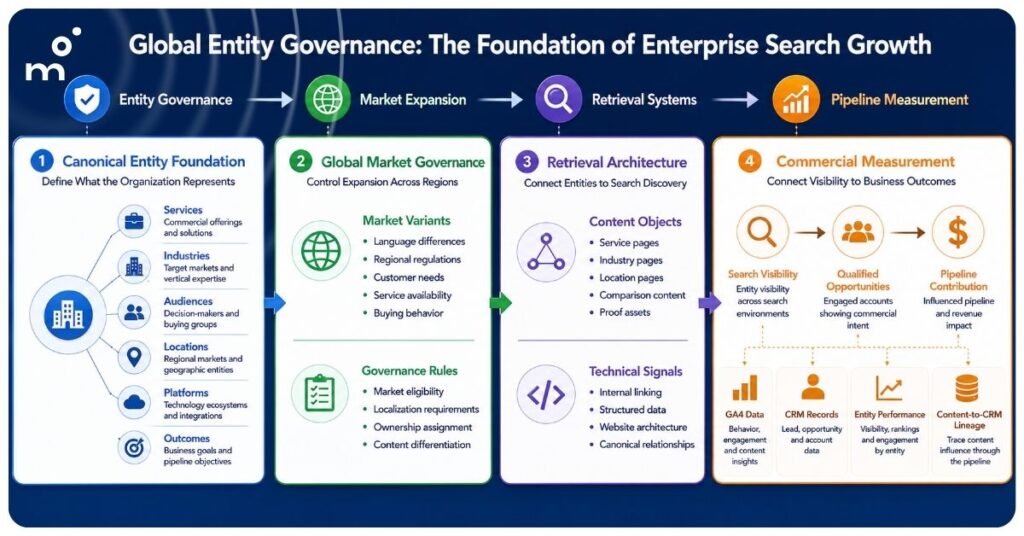
Why Enterprise Growth Requires Entity Governance
As organizations expand across regions, services, and business units, digital growth can become fragmented. Multiple regional websites, inconsistent taxonomy, duplicated market pages, disconnected agencies, and separate reporting systems can make it difficult to maintain a unified understanding of commercial assets.
Without governance, organizations may increase content volume without establishing whether that content contributes to qualified pipeline. Similar pages can compete for the same search purpose, teams may use different naming structures, and executives may lack visibility into which markets or entities contribute to business outcomes.
Entity governance creates clear ownership, definitions, and relationships before expansion occurs. This allows organizations to determine which entities require dedicated pages, which markets need localization, and how each asset should support measurable commercial objectives.
Global Entity Clustering Is Not Keyword Grouping
Global entity clustering goes beyond organizing similar keywords. It focuses on defining the actual business concepts, relationships, and commercial roles behind search demand.
A strong entity system begins with canonical entities, which act as the primary reference points for services, industries, audiences, locations, platforms, and outcomes. These entities are connected through defined relationship types, including parent-child relationships, localized variants, comparisons, proof assets, and conversion pathways.
Market expansion should use entity variants only when regional differences create meaningful value through language, regulations, customer needs, service availability, or buying behaviour. Each entity should have a clear retrieval path supported by website architecture, internal links, structured data, and measurement systems.
This approach connects with the strategic alignment framework for B2B executives, which explores how enterprise organizations move beyond isolated execution toward structured governance, prioritization, and measurable growth systems.
Information-retrieval research provides useful context through the cluster hypothesis: documents grouped together may behave similarly in relation to an information need. However, that research concept should not be treated as a ranking guarantee or as a complete enterprise governance model. Commercial entity clustering adds business-defined entities, typed relationships, market eligibility, page ownership, evidence, conversion routes, and measurement controls to the underlying retrieval logic.
Enterprise Entity Governance Risks
Enterprise organizations often encounter structural risks when global entities, markets, and content systems expand without clear governance.
The following framework highlights common challenges that affect retrieval, localization, reporting, and commercial alignment, along with the governance responses required to address them.
Global Entity Governance Risk Assessment |
||
|---|---|---|
| Risk | Business Impact | Governance Response |
| Fragmented Entities | Inconsistent Service, Audience, or Market Definitions Weaken Search Clarity and Reporting Accuracy. | Establish Canonical Entities, Ownership Rules, and Relationship Definitions. |
| Duplicate Markets | Similar Regional Pages Compete Without Clear Commercial Differentiation. | Create Market Eligibility Rules Before Developing New Variants. |
| Unsupported Expansion | New Markets Receive Resources Without Demand, Evidence, or Operational Support. | Validate Market Readiness Before Expansion. |
| Weak Localization | Generic Content Fails to Reflect Regional Needs, Terminology, or Proof Requirements. | Develop Market-Specific Localization and Evidence Frameworks. |
| Measurement Failure | Teams Cannot Connect Entity Performance to Pipeline Outcomes. | Connect GA4, CRM Fields, and Entity Data Through Content-to-CRM Lineage. |
How Canonical Entities Create a Global Source of Truth
Canonical entities create a controlled reference system for enterprise services, audiences, markets, and commercial relationships. By defining a single authoritative representation for each important business concept, organizations can reduce duplication, improve retrieval consistency, and create clearer connections between content architecture, localization, and pipeline measurement.
Building an Enterprise Entity Registry
An enterprise entity registry provides the foundation for managing global search architecture. Instead of allowing different teams or regions to create independent versions of the same concept, the registry establishes a shared reference point that defines how each entity should be represented and governed.
A complete entity record should include:
Global Entity Registry Framework |
|
|---|---|
| Field | Purpose |
| Entity ID | Creates a Unique Identifier for Tracking and Managing the Entity Across Systems. |
| Name | Defines the Approved Primary Representation of the Entity. |
| Definition | Establishes the Business Meaning, Scope, and Intended Use of the Entity. |
| Synonyms | Records Approved Variations, Terminology Differences, or Related Expressions. |
| Parent Entity | Identifies Broader Categories or Relationships Within the Entity Structure. |
| Owner | Assigns Responsibility for Accuracy, Updates, and Governance Decisions. |
| Market Scope | Defines Where the Entity Applies Based on Location, Language, Service Availability, or Business Requirements. |
| Status | Tracks Whether the Entity Is Active, Under Review, Expanded, Merged, or Retired. |
This structure helps enterprise teams maintain consistency across websites, content systems, analytics platforms, and CRM environments.
Naming and Scope Rules for Global Entities
Global organizations often develop inconsistent terminology as different departments, regions, or agencies create content independently. A service may have multiple names across markets, regional aliases may become unmanaged variants, and similar concepts may be represented as separate entities without a clear relationship.
- Naming and scope rules help prevent these issues by establishing:
- Approved entity names and terminology standards.
- Clear distinctions between separate services and related concepts.
- Rules for when a regional variation represents a legitimate entity variant.
- Ownership approval before creating new entities or market-specific versions.
These controls prevent duplicate service names, unclear relationships, and unnecessary page expansion while allowing meaningful localization where market differences create real value.
Entity Registry Governance Model
An entity registry requires ongoing governance to remain accurate as services, markets, and business priorities change. Without ownership and review processes, enterprise organizations risk creating outdated entities, conflicting definitions, and inconsistent market coverage.
A governance model should define:
Creation Approval: New entities should be reviewed before entering the registry to confirm commercial relevance, ownership, and intended use.
Ownership: Each entity should have an assigned owner responsible for updates, accuracy, and coordination across teams.
Review Cadence: Regular reviews should identify outdated terminology, changing market requirements, duplicate entities, and relationship updates.
Retirement Decisions: Entities that no longer represent active services, markets, or business priorities should be merged, archived, or removed based on documented criteria.
A governed entity registry allows enterprises to scale globally while maintaining a consistent information structure that supports technical SEO, content operations, localization, and measurable commercial outcomes.
When a Market Deserves a Separate Entity Variant
Localization should be based on commercial relevance rather than geographic expansion alone. A separate entity variant should exist only when a market introduces meaningful differences in customer needs, service availability, language, regulations, evidence requirements, or conversion pathways.
This approach helps enterprises expand globally while maintaining a structured and purposeful search architecture.
Market Eligibility Gate
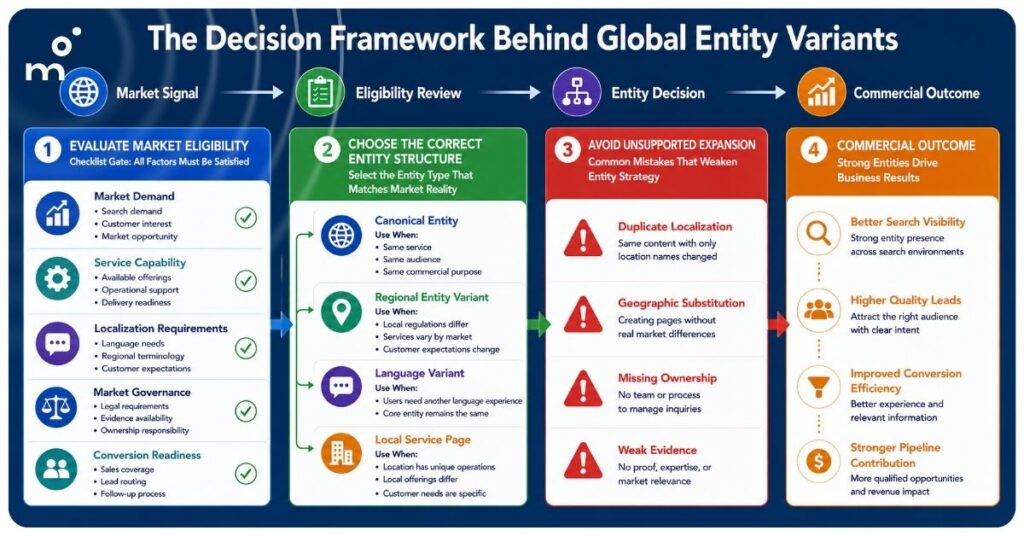
Before creating a regional or language-specific entity variant, organizations should evaluate whether the market has the operational and commercial foundation required to support a distinct experience.
A market eligibility review should consider demand, service availability, language requirements, legal context, market evidence, sales coverage, and conversion ownership. Strong demand alone is not enough to justify expansion. The organization must also be able to support the market with relevant services, appropriate proof, and a clear process for managing qualified opportunities.
This evaluation prevents enterprises from creating unsupported market experiences that add complexity without improving commercial coverage.
Entity Variant Decision Framework
An entity variant should be created only when it represents a meaningful difference in how users search, evaluate, or engage with the organization.
A global canonical entity is appropriate when the service, audience, and commercial purpose remain consistent across markets. A regional variant may be required when location-specific factors such as regulations, service availability, or customer expectations change the experience. A language variant is useful when users require a different language experience while the underlying entity remains the same.
A local service page should be created when a specific location has distinct operational details, offerings, or customer needs. In cases where a market has limited demand, no service capability, insufficient evidence, or no conversion ownership, creating a separate page may not provide meaningful value.
Global Entity Variant Decision Framework |
||
|---|---|---|
| Scenario | Appropriate Decision | Required Conditions |
| Global Canonical Entity | Maintain One Primary Entity and Page Object | The service, audience, evidence, commercial purpose, and conversion route remain materially consistent across markets. |
| Regional Variant | Create a Governed Regional Version | The region changes service availability, regulations, buyer expectations, proof requirements, pricing context, or conversion routing. |
| Language Variant | Create a Genuine Language Alternate | Users require a distinct language experience, and the alternate can be maintained with accurate language, metadata, internal links, and reciprocal hreflang annotations where applicable. |
| Local Service Page | Create a Location-Specific Commercial Page | The organization serves the location and can provide distinct local information, evidence, operational details, and conversion ownership. |
| No Page Required | Retain the Existing Entity or Exclude the Market | Demand, serviceability, evidence, localization value, sales coverage, or conversion ownership is insufficient to justify a separate page. |
Avoiding Unsupported Market Expansion
Global expansion can create unnecessary complexity when organizations create pages without a clear entity purpose. Geographic substitutions, duplicate localization, and unsupported market pages can weaken information architecture by creating overlapping content without distinct commercial roles.
Google’s people-first content guidance helps organizations evaluate whether each market page provides genuine value, demonstrates expertise, and serves a real audience need.
Enterprises should avoid creating regional pages that only replace location names while keeping the same content structure and messaging. Effective localization requires meaningful differences, such as market-specific terminology, customer challenges, regulatory considerations, evidence, or service details.
Unsupported expansion can also occur when a business creates visibility in markets where it cannot provide the expected service experience. Without operational ownership, conversion routing, and relevant proof, additional pages may generate inquiries that cannot be effectively managed.
A disciplined entity variant strategy ensures that each market page supports a clear business objective, strengthens retrieval pathways, and contributes to measurable commercial coverage.
How Entity Relationships Build Retrieval Paths
Typed entity relationships create structured pathways between content, users, and search systems by defining how commercial concepts connect across an enterprise website.
Instead of treating pages as isolated assets, organizations can use relationship models to guide navigation, improve information discovery, and create clearer connections between entities, supporting content, and conversion opportunities.
These relationship models also support broader search intelligence frameworks for building entity data graphs and matching enterprise intent, where relationships between concepts, user needs, and information structures are analyzed to improve enterprise retrieval systems.
Entity Relationship Taxonomy
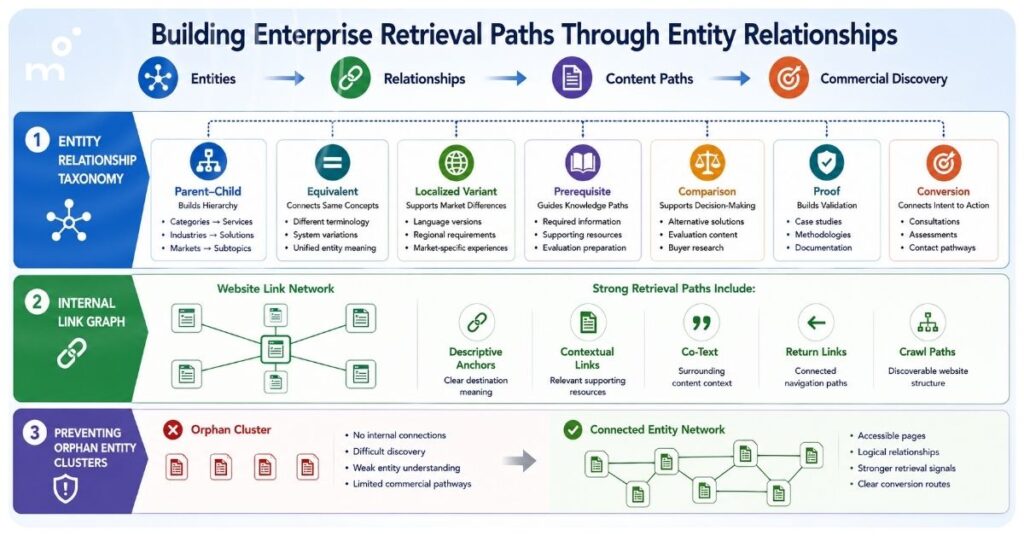
Entity relationships define the role each page or concept plays within a broader information architecture. These relationships help organizations determine how content should connect, how users should navigate between resources, and how search systems can interpret the structure of a website.
Common relationship types include:
Entity Relationship Taxonomy Framework |
|
|---|---|
| Relationship Type | Purpose |
| Parent-Child | Connects Broader Categories with More Specific Services, Solutions, Markets, or Subtopics. |
| Equivalent | Identifies Entities That Represent the Same Concept Across Different Terminology or Systems. |
| Localized Variant | Connects Market-Specific or Language-Specific Versions of an Entity Where Meaningful Differences Exist. |
| Prerequisite | Links Supporting Knowledge, Requirements, or Resources Needed Before Evaluating a Solution. |
| Comparison | Connects Alternative Solutions, Evaluation Resources, or Decision-Stage Content. |
| Proof | Connects Entities With Supporting Evidence Such as Case Studies, Methodologies, Documentation, or Validation Assets. |
| Conversion | Connects Informational Entities With Relevant Commercial Actions Such as Consultations, Assessments, or Contact Pathways. |
By defining these relationships, enterprises can create a structured model where every page has a clear purpose within the broader retrieval system.
Building Internal Link Graphs
A strong internal linking system transforms individual pages into connected retrieval pathways. Within SEO website architecture, internal links help search systems understand relationships between commercial entities, supporting content, and important conversion destinations. Following Google’s link best practices for creating crawlable and descriptive links helps enterprises build clearer navigation structures that support both users and search systems.
Effective internal link graphs rely on:
Descriptive Anchors: Link text should clearly communicate the destination topic or entity relationship instead of using vague navigation terms.
Contextual Links: Links should appear naturally within relevant content where users need additional information or supporting resources.
Co-Text: The surrounding text should provide additional context about why the linked page is relevant.
Return Links: Connected pages should maintain logical relationships by allowing users and search systems to navigate back through the entity structure.
Crawl Paths: Internal links should create accessible routes that allow important pages to be discovered without unnecessary navigation depth.
For enterprise websites, internal linking is not only a navigation feature. It is a method of organizing commercial knowledge, guiding users through decision pathways, and supporting consistent entity discovery.
Preventing Orphan Entity Clusters
Orphan entity clusters occur when valuable pages or related content groups exist without meaningful connections to the wider website structure.
These disconnected assets may be difficult for users to find and harder for search systems to interpret within the context of the organization’s broader information architecture.
Preventing orphan clusters requires attention to:
Indexability: Important pages should be technically accessible for search discovery and should not contain unnecessary indexing restrictions.
Sitemap Support: XML sitemaps should accurately represent eligible pages and help search systems discover important content structures.
Internal Navigation: Pages should connect through relevant menus, category structures, related resources, or contextual links.
Crawl Accessibility: Enterprise websites should maintain clear crawl paths without excessive technical barriers, unnecessary depth, or disconnected page systems.
A well-governed entity relationship model ensures that content assets work together as part of a connected retrieval system. This creates stronger architectural clarity while supporting scalable enterprise SEO, content management, and commercial discovery.
How International Technical Signals Support the Cluster
International entity systems depend on consistent technical signals that help search engines interpret relationships between markets, languages, and content variations. Technical SEO elements such as URL structures, canonical signals, hreflang relationships, and crawl accessibility create the foundation for scalable global retrieval by ensuring each market version has a clear purpose and connection within the broader entity cluster.
Technical Foundations for Global Entity Clusters
Global websites require coordinated technical signals to maintain consistency across multiple regions and languages.
Global Technical Signal Framework |
|
|---|---|
| Technical Signal | Purpose Within Global Entity Systems |
| URL Structures | Create Clear Patterns That Organize Regional, Language, or Market-Specific Content Within the Website Architecture. |
| Canonicals | Identify The Preferred Version of a Page and Help Prevent Conflicting Indexing Signals Across Similar Content Variations. |
| Hreflang | Communicate Relationships Between Genuine Language and Regional Alternatives. |
| Sitemaps | Support Efficient Discovery of Eligible International Pages and Maintain Visibility Into the Site Structure. |
| Language Signals | Provide Additional Context About the Intended Audience and Content Language of Each Page. |
| Rendering | Ensure Search Systems and Users Can Access Complete Page Content Across Different Technical Environments. |
| Mobile Parity | Maintain Consistent Functionality, Content Availability, and User Experience Across Devices and Markets. |
These signals work together as part of a broader enterprise technical SEO framework. A global entity cluster is only effective when the technical foundation clearly communicates which pages belong together, which markets they serve, and how they should be interpreted.
Maintaining clear technical structures, accessible content, and well-defined relationships also aligns with Google’s guidance for generative search experiences by supporting clearer information retrieval and helping search systems better understand content relationships.
Hreflang Clusters and Regional Relationships
A hreflang cluster connects genuine alternate versions of a page that target different languages or regions. It functions as a technical relationship system that helps search engines understand which version of a page is intended for a specific audience. However, hreflang implementation does not replace localization strategy because regional relevance depends on more than language differences alone.
Effective hreflang structures connect genuine language or regional alternatives of the same content. Each eligible version should reference the others reciprocally, use valid language or language-region codes, and maintain canonical signals consistent with the localized URL structure. Hreflang helps Google understand these relationships but does not replace meaningful localization or determine whether a separate market experience should exist.
Organizations investing in multilingual SEO services should combine hreflang implementation with broader localization planning that considers market-specific terminology, customer expectations, evidence requirements, and conversion pathways.
Technical signals help search engines interpret relationships among genuine localized versions, but they do not determine whether the business should create a separate market experience. That decision should be based on serviceability, audience need, evidence, operational ownership, and commercial purpose.
Technical QA Checklist
A global entity cluster should undergo regular technical validation to maintain retrieval consistency across markets.
✔ Canonical Alignment
Ensure preferred URLs are correctly defined and do not conflict with regional or language variations.
✔ Valid Hreflang Relationships
Confirm that alternate pages reference each other correctly and use accurate language and regional codes.
✔ Crawl Testing
Verify that important international pages can be discovered, accessed, and navigated through standard crawl paths.
✔ Index Validation
Review whether eligible pages are indexed correctly and whether unintended pages create duplication issues.
✔ Language Consistency
Confirm that page language, metadata, structured data, and visible content align with the intended market.
Maintaining these technical controls allows enterprises to scale international entity clusters while preserving clearer retrieval paths, stronger governance, and more reliable market coverage.
How Localization Depth Determines Commercial Relevance
Effective localization requires more than converting text into another language. Enterprise organizations need market-specific evidence, terminology, regulations, buyer expectations, and conversion pathways to create meaningful experiences for different audiences.
A localized entity should represent a genuine market relationship rather than a duplicate version of an existing page.
Translation vs Market Localization
Translation focuses on converting existing content from one language into another while preserving the original meaning. Although translation is an important component of international expansion, it does not always reflect how users search, evaluate solutions, or make decisions within different markets.
Market localization requires a deeper adaptation of the commercial experience. It considers how a market understands a problem, evaluates solutions, and interacts with a brand.
A complete localization approach may include:
- Translation: Adapting language while maintaining the original message and structure.
- Transcreation: Adjusting messaging, terminology, and examples to better match cultural expectations and communication patterns.
- Market Adaptation: Modifying content, evidence, conversion paths, and commercial details based on regional requirements, customer behaviour, and business availability.
For enterprise organizations, localization decisions should be based on commercial relevance rather than the availability of another language version alone.
Building a Localization Evidence Stack
A strong localized entity requires supporting evidence that demonstrates relevance within its intended market. Reusing identical proof across every region can create weaker commercial alignment because customers often evaluate solutions through local requirements, industry expectations, and regional context.
A localization evidence stack should consider:
Localization Evidence Stack: Building Market-Specific Commercial Relevance |
|
|---|---|
| Evidence Component | Purpose |
| Market Problems | Identifies the Specific Challenges, Priorities, and Business Conditions Affecting the Target Audience. |
| Terminology | Aligns Language With How Users, Industries, and Professionals Describe Services or Solutions Within the Market. |
| Regulations | Accounts for Regional Standards, Legal Requirements, and Operational Considerations That Influence the Market Experience. |
| Customer Proof | Provides Relevant Examples, Case Evidence, Methodologies, or Supporting Information Connected to the Market. |
| Buyer Roles | Reflects the Decision-Makers, Evaluators, and Stakeholders Involved in the Purchase Process. |
| Service Limitations | Defines Availability, Operational Boundaries, and Market-Specific Constraints Before Expansion. |
This evidence framework helps organizations determine if a market requires a dedicated entity variant, localized page object, or a different conversion pathway.
Evidence Completeness Warning
Market-specific claims, customer examples, performance data, and regional proof points should be published only after the supporting evidence, source, market applicability, and verification date have been confirmed. Where verified evidence is unavailable, the affected claim or example should be omitted rather than inferred.
Maintaining evidence completeness ensures that global entity systems remain accurate, trustworthy, and aligned with the markets they serve.
How Consultants Detect Coverage Gaps and Cannibalization
Enterprise consultants identify coverage gaps and cannibalization by analyzing how entities, pages, markets, and commercial pathways connect across the search ecosystem.
This process evaluates whether important entities have appropriate page objects, supporting evidence, retrieval paths, and conversion mechanisms while identifying areas where overlapping assets create unclear search intent or inefficient resource allocation. When these issues create visibility changes or structural performance problems, organizations can apply a deeper algorithmic problem-solving framework for diagnosing technical SEO and architecture-level issues to evaluate crawl barriers, structural weaknesses, and opportunities for improving retrieval performance.
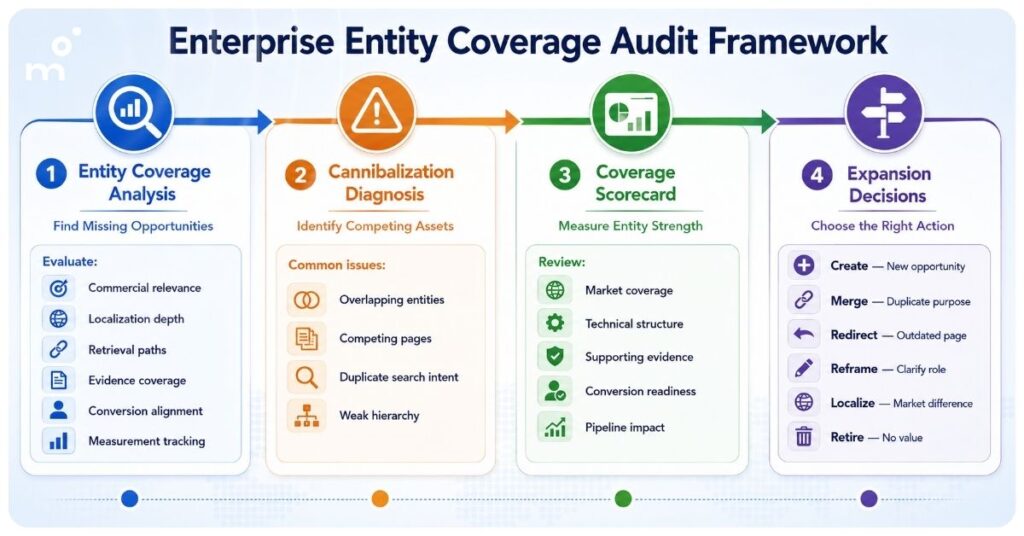
Global Entity Coverage Scorecard
A global entity coverage scorecard provides a structured view of how effectively an organization represents commercially relevant entities across markets.
Rather than measuring success through page volume alone, the framework evaluates whether each entity has sufficient relevance, localization, technical support, evidence, conversion alignment, and measurement capability.
Global Entity Coverage Diagnostic Framework |
||||
|---|---|---|---|---|
| Control Area | Diagnostic Question | Assessment Status | Evidence Source | Required Action |
| Eligible Entity Coverage | Do commercially relevant entities have eligible page objects in supported markets? | Requires Organization-Specific Assessment | Entity Registry and Approved Market Inventory | Create, Reframe, or Defer |
| Entity Cannibalization | Do multiple pages target the same entity and search task without clear differentiation? | Requires Organization-Specific Assessment | URL, Entity, Search-Task, and Conversion Review | Merge, Redirect, or Differentiate |
| Unsupported Markets | Do pages target markets without verified serviceability, evidence, sales coverage, or conversion ownership? | Requires Organization-Specific Assessment | Market Eligibility Records | Remove, Consolidate, or Defer |
| Orphan Entities | Do eligible entity pages lack crawlable internal links, navigation paths, or appropriate sitemap inclusion? | Requires Organization-Specific Assessment | Crawl and Internal-Link Audit | Connect or Retire |
| Localization Depth | Do regional variants contain market-relevant terminology, evidence, requirements, and conversion information? | Requires Organization-Specific Assessment | Localization and Content Review | Localize or Consolidate |
| Evidence Completeness | Does each entity have appropriate methodology, proof, constraints, authorship, and verification dates? | Requires Organization-Specific Assessment | Evidence Inventory | Add Evidence or Disqualify |
| Conversion Fit | Does the CTA, form, routing logic, and owner match the market, entity, and buying role? | Requires Organization-Specific Assessment | UX, Form, and Routing Review | Reconfigure the Conversion Path |
| Measurement Integrity | Can the page and entity be traced through analytics, CRM stages, opportunities, and outcomes? | Requires Organization-Specific Assessment | GA4 and CRM Schema Review | Repair Tracking or Data Lineage |
➤ Data Verification Warning: Do not publish market-share, traffic, conversion, revenue, or coverage percentages until the organization has documented the eligible inventory, calculation method, data sources, reporting period, verification date, and responsible owner.
This scorecard helps executives identify where additional investment may be required, such as creating missing entity coverage, improving market-specific evidence, strengthening technical architecture, or connecting content performance with CRM outcomes.
Entity Cannibalization Diagnosis
Entity cannibalization occurs when multiple pages compete for the same commercial purpose without a clear relationship or hierarchy. This often happens when organizations expand content across regions, services, or business units without maintaining a centralized entity model.
Common indicators include:
Overlapping Entities: Multiple pages represent similar services, audiences, or solutions without clearly defined differences.
Competing Pages: Several URLs target the same search task, making it unclear which page should serve as the primary resource.
Unclear Hierarchy: Parent, child, and related entities are not connected through a consistent information architecture.
Duplicate Search Tasks: Different pages attempt to answer the same user need without unique evidence, conversion paths, or commercial roles.
A consultant-led review evaluates each page based on its entity, search task, evidence, internal links, technical signals, and conversion purpose. The outcome may involve consolidation, restructuring, or clearer differentiation rather than simply creating additional content.
Expansion Decision Matrix
After evaluating entity coverage and cannibalization risks, organizations can assign the appropriate action based on commercial purpose, technical condition, and market readiness.
Entity Expansion Decision Matrix |
|
|---|---|
| Action | When It Applies |
| Create | A New Entity or Market Opportunity Has Clear Demand, Evidence, Service Availability, and Conversion Ownership. |
| Merge | Multiple Pages Represent the Same Entity or Search Task and Require Consolidation Into a Stronger Resource. |
| Redirect | An Outdated or Duplicate Page Should Pass Users and Signals to a More Relevant Destination. |
| Reframe | An Existing Page Has Value But Requires a Clearer Entity Definition, Search Purpose, or Commercial Role. |
| Localize | A Market Variation Requires Unique Terminology, Evidence, Regulations, or Buyer Context. |
| Retire | A Page Lacks Commercial Relevance, Evidence, Service Availability, or a Measurable Purpose. |
A structured expansion model allows enterprises to make informed decisions about where to invest, consolidate, or remove content. This ensures global entity systems grow through qualified market coverage rather than uncontrolled page expansion.
How Entity Clusters Map to Buying Committees
Enterprise entities connect with different stakeholders by aligning commercial content, evidence, and conversion pathways with each role involved in the buying process.
A structured entity model recognizes that enterprise decisions are rarely made by one person, requiring different retrieval paths for executives, technical teams, operational users, procurement groups, and compliance stakeholders.
Buying Role Matrix
Enterprise buying committees often include multiple participants with different priorities, evaluation criteria, and information requirements.
Enterprise Buying Committee Role Matrix |
||
|---|---|---|
| Buying Role | Primary Need | Required Information Path |
| Economic Buyer | Business Value, Financial Impact, Strategic Alignment | ROI Considerations, Business Outcomes, Pipeline Impact, and Executive-Level Evidence |
| Technical Evaluator | System Compatibility, Architecture, Security, and Implementation Requirements | Technical Documentation, Integration Details, Infrastructure Information, and Specifications |
| Operational User | Practical Usability and Workflow Impact | Process Information, Implementation Examples, User Experience Details, and Operational Benefits |
| Procurement | Vendor Evaluation, Purchasing Requirements, and Commercial Terms | Pricing Structure, Contractual Information, Service Scope, and Purchasing Requirements |
| Legal Reviewer | Risk Management, Compliance, and Governance Requirements | Regulatory Information, Policies, Data Handling Practices, and Contractual Documentation |
| Executive Sponsor | Strategic Direction, Organizational Impact, and Long-Term Value | Market Positioning, Strategic Outcomes, Governance Approach, and Implementation Roadmap |
Mapping entities to buying roles helps organizations create relevant retrieval paths instead of directing every stakeholder toward the same commercial page or conversion experience.
Evidence Routing
Different buying roles require different forms of evidence before moving forward in the decision process. A strong entity architecture connects each commercial entity with the proof required by the relevant stakeholders.
Evidence routing may include:
Methodology: Explains the approach, framework, processes, and strategic reasoning behind a solution.
Proof: Provides supporting examples, case evidence, customer outcomes, or documented experience where available.
Compliance: Addresses governance requirements, regulatory considerations, privacy standards, and operational controls.
Implementation: Demonstrates how solutions are deployed, integrated, maintained, and supported.
Pricing: Provides appropriate commercial information, scope considerations, and purchasing guidance.
Integration: Explains technical compatibility, platform relationships, workflows, and system dependencies.
By connecting evidence modules to entity clusters and buying roles, enterprises can create more relevant experiences that support evaluation without overwhelming users with unnecessary information.
Avoiding One-Path Buyer Journeys
Enterprise buying journeys rarely follow a single linear path. Different stakeholders enter the search process with different questions, responsibilities, and decision criteria.
An executive sponsor may search for strategic value, while a technical evaluator may need implementation details and a procurement team may require commercial information. Each stakeholder requires a different retrieval path, evidence sequence, and conversion opportunity.
A mature enterprise funnel avoids forcing every visitor into one generic journey. Instead, it creates connected pathways where:
- Different stakeholders can discover relevant entity pages.
- Supporting evidence is available at the appropriate decision stage.
- Internal links guide users toward the information needed for evaluation.
- Conversion options match the stakeholder’s level of intent and responsibility.
By aligning entity clusters with buying committees, organizations create a more complete commercial discovery system that supports complex decisions and improves the connection between search visibility and qualified pipeline.
How Global Entity Clusters Connect to GA4 and CRM
Entity architecture becomes commercially valuable when it can be measured across analytics and revenue systems. Connecting entity clusters with GA4 and CRM platforms allows enterprises to trace how search visibility, content interactions, leads, opportunities, and closed outcomes connect throughout the customer journey.
Measurement Schema
A structured measurement schema creates consistency between search architecture and business reporting. Each interaction should maintain connections between the originating entity, market context, conversion pathway, and revenue stage.
Global Entity Measurement Schema |
|
|---|---|
| Measurement Field | Purpose |
| Entity ID | Identifies the Canonical Entity or Entity Cluster Associated With the User Journey. |
| Market | Records the Geographic or Regional Context Connected to the Interaction. |
| Language | Tracks the Language Experience Associated With the Content or Conversion Path. |
| Page Type | Identifies The Commercial Page Object, Such As a Service, Solution, Industry, Location, or Evidence Page. |
| CTA | Records the Conversion Action Selected by The User. |
| Lead Stage | Tracks Progression Through Qualification and Sales Lifecycle Stages. |
| Opportunity | Connects Qualified Leads to Active Sales Opportunities. |
| Outcome | Captures the Final Business Result, Such as Closed Outcomes or Other Defined Lifecycle States. |
This structure allows marketing and revenue teams to evaluate entity performance beyond traffic metrics by understanding which commercial assets contribute to qualified opportunities.
Recommended Event Sequence
A measurement framework should distinguish website interactions from lead-lifecycle and CRM outcomes. Google Analytics provides recommended lead-generation events, but organizations must confirm which events are deployed, how qualification is defined, and how offline sales states return to analytics.
- form_start: A user begins interacting with a lead form.
- generate_lead: A user submits information that creates a lead.
- qualify_lead: The lead is marked as meeting documented qualification criteria.
- disqualify_lead: The lead is marked as not meeting qualification criteria.
- working_lead: A representative begins actively working the lead.
- close_convert_lead: The lead is marked as converted under the organization’s documented lifecycle definition.
- close_unconvert_lead: The lead is closed without conversion.
Opportunity creation, sales acceptance, opportunity value, won revenue, and lost revenue may remain CRM states unless the organization has confirmed corresponding imported or custom analytics events.
➤ Implementation Warning: Before applying this sequence, verify the deployed GA4 events and parameters, qualification rules, identity keys, offline-event process, CRM lifecycle stages, and reporting destination. Do not assume that every recommended event or CRM state is currently implemented.
Content-to-CRM Lineage
Content-to-CRM lineage creates a direct connection between global entity architecture and revenue reporting. Instead of measuring content performance only through rankings, impressions, or traffic, enterprises can understand how specific entity clusters contribute to commercial activity.
The lineage model connects:
Entity Cluster: Identifies the service, industry, problem, market, or solution concept that initiated the search journey.
Landing Page: Records the commercial page object that introduced the user to the organization.
Lead Record: Captures conversion details, qualification information, source data, and lifecycle status.
Opportunity: Connects qualified leads to active sales processes and potential business value.
Closed Outcome: Measures the final result and provides insight into commercial contribution.
When identity matching, event definitions, CRM fields, offline-data coverage, duplicate handling, and attribution rules are reliable, connecting entity data with GA4 and CRM lifecycle stages can provide a clearer view of how global search infrastructure supports qualified demand. This approach enables more accurate executive reporting and helps teams prioritize entity coverage based on measurable commercial impact rather than content volume alone.
How Enterprise Consultants Prioritize Global Expansion
Enterprise consultants prioritize global expansion by evaluating commercial opportunity alongside operational readiness. A market should not be selected only because search demand exists; it should demonstrate business relevance, supporting evidence, technical feasibility, conversion ownership, and measurement capability.
This approach helps organizations invest in markets where entity coverage can create meaningful commercial value.
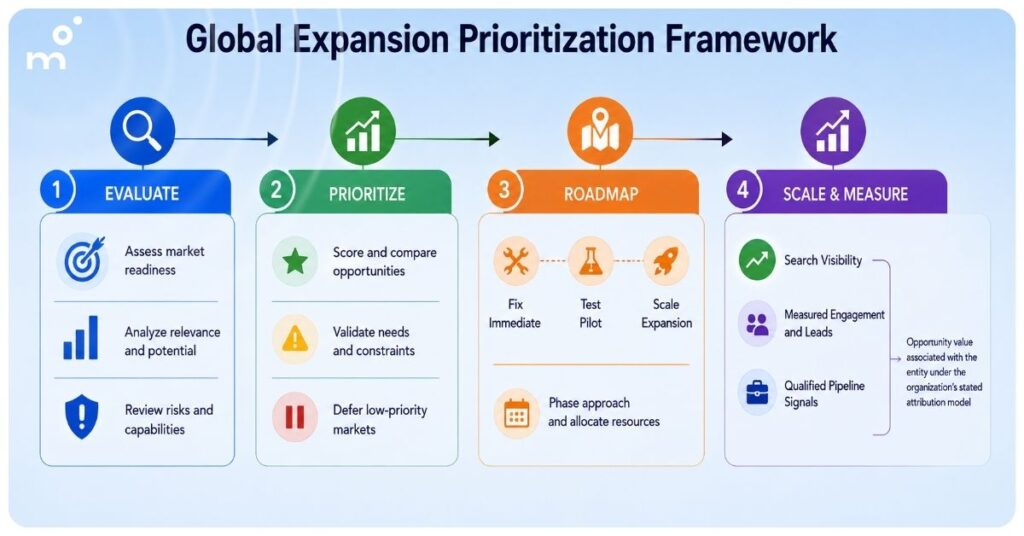
Global Expansion Prioritization Model
A structured prioritization model helps enterprises evaluate which markets and entity opportunities should receive investment first. Instead of expanding based on page volume or geographic reach alone, consultants assess each opportunity through commercial, technical, and operational criteria.
Enterprise Market Expansion Evaluation Matrix |
|
|---|---|
| Category | Evaluation Focus |
| Commercial Relevance | Evaluates Market Demand, Business Alignment, Customer Need, And Revenue Opportunity. |
| Evidence Readiness | Measures Availability Of Market-Specific Proof, Case Examples, Expertise, And Supporting Resources. |
| Technical Effort | Assesses Required Investment In Website Architecture, Localization, Structured Data, Internal Linking, And Implementation Resources. |
| Sales Coverage | Determines Whether Internal Teams, Partners, Or Operational Processes Exist To Support Market Opportunities. |
| Risk | Reviews Operational, Regulatory, Localization, And Resource Risks Before Expansion. |
| Measurement Readiness | Confirms That Analytics, CRM Fields, Attribution Systems, And Reporting Structures Can Track Performance. |
This evaluation model allows organizations to prioritize markets based on realistic execution capacity rather than expanding into areas without sufficient support or commercial justification.
Executive Roadmap Planning
Global expansion requires a phased roadmap that balances immediate improvements with long-term scalability. Instead of creating multiple market variations simultaneously, enterprise teams should organize initiatives based on urgency, readiness, and expected commercial impact.
Immediate fixes focus on resolving existing structural issues, including duplicate entities, unclear page relationships, technical inconsistencies, weak internal linking, or inaccurate market signals.
Controlled pilots allow organizations to test selected markets or entity variants where demand, evidence, and operational support are already established. Scalable expansion applies successful frameworks across additional markets through consistent governance, localization processes, technical architecture, and measurement systems.
Deferred markets remain under review until they have sufficient demand, service availability, evidence, ownership, or reporting capability.
This roadmap approach helps enterprises expand responsibly while maintaining control over technical quality, operational complexity, and commercial alignment.
Why Page Count Is Not a Success Metric
Increasing the number of pages does not automatically improve enterprise search performance or business outcomes. A larger website footprint creates value only when each page represents a meaningful entity, supports a defined search task, provides relevant evidence, and contributes to a measurable commercial pathway.
Enterprise organizations should evaluate expansion through qualified coverage, entity completeness, and pipeline contribution.
Qualified coverage measures how effectively the organization represents valuable entities and markets with accurate, accessible experiences. Entity completeness evaluates whether services, audiences, locations, evidence, and conversion pathways are properly connected.
Pipeline contribution measures how effectively these entity systems support qualified leads, opportunities, and measurable business outcomes.
A governed global entity strategy prioritizes meaningful market coverage over page volume, allowing enterprises to build scalable search infrastructure that supports long-term commercial objectives.
What the Final Global Entity Coverage Graph Must Contain
A global entity coverage graph provides the final governance layer for enterprise search architecture by connecting entities, relationships, markets, technical signals, evidence, conversions, and measurement systems.
This framework ensures that every commercial asset has a defined purpose, responsible owner, and measurable role within the broader information and revenue ecosystem.
Global Entity Coverage Control Table
The control table creates a centralized view of how each entity moves from market definition to measurable commercial outcomes. It allows enterprise teams to evaluate coverage quality, identify missing relationships, and maintain ownership across global search systems.
Global Entity Coverage Governance Matrix |
||||||||||
|---|---|---|---|---|---|---|---|---|---|---|
| Entity | Relationship | Market | Page | Technical Status | Evidence | CTA | GA4 Event | CRM Stage | Owner | Review-Date Requirement |
| Service Entity | Parent–Child | North America | Service Page | Requires Organization-Specific Validation | Methodology, Case Evidence | Consultation | generate_lead | Qualified Lead | Marketing | Required Before Deployment |
| Industry Entity | Industry Relationship | Global | Industry Page | Requires Organization-Specific Validation | Industry Evidence | Assessment | generate_lead | Sales Review | Content | Required Before Deployment |
| Location Entity | Localized Variant | Regional | Location Page | Requires Organization-Specific Validation | Regional Evidence | Contact | generate_lead | Opportunity | SEO | Required Before Deployment |
| Problem Entity | Problem–Solution | Target Market | Solution Page | Requires Organization-Specific Validation | Educational Evidence | Download | file_download or generate_lead* | Working Lead | Content | Required Before Deployment |
| Platform Entity | Integration | Enterprise | Integration Page | Requires Organization-Specific Validation | Technical Documentation | Demo | generate_lead or qualify_lead* | Opportunity | Development | Required Before Deployment |
*Use generate_lead only when the download requires a submission that creates a lead. Use qualify_lead only after the lead satisfies documented qualification criteria. For an ungated downloadable file, use the organization’s verified download-tracking event.
➤ Implementation Note: Technical status, review dates, event mappings, CRM stages, and ownership must be validated against the organization’s deployed systems before implementation.
Disqualification Triggers
Not every entity should become part of a global coverage system. A controlled framework requires clear disqualification criteria to prevent unnecessary expansion, weak retrieval structures, and unsupported commercial pages.
An entity or market should be reviewed for removal or exclusion when it has no clear business purpose, insufficient evidence, or no measurable role within the customer journey.
Common disqualification triggers include:
Unsupported Market: The organization cannot demonstrate service availability, demand, operational support, or ownership within the market.
Duplicate Entity: Multiple pages represent the same entity or search purpose without meaningful differentiation.
No Evidence: The page lacks supporting information, expertise, proof, methodology, or market-specific validation.
No Service Availability: The organization cannot fulfill the product, service, or solution expectations represented by the entity.
No Crawl Path: The entity exists without proper internal linking, navigation, sitemap support, or technical accessibility.
No Conversion Owner: There is no responsible team or process for managing inquiries generated from the entity.
No Measurement: The entity cannot be connected to analytics, CRM fields, lifecycle stages, or commercial reporting.
Removing unsupported entities allows enterprise organizations to maintain stronger architecture, clearer market coverage, and more reliable measurement.
Assess Your Enterprise Entity Architecture
A global entity system requires ongoing evaluation across technical architecture, market coverage, localization, conversion pathways, and revenue measurement. Marketing Planet helps enterprise organizations identify entity gaps, improve retrieval structures, and build governed search frameworks that connect global visibility with qualified business opportunities.
Request a global entity coverage diagnostic to evaluate your current entity architecture, identify market coverage opportunities, and create a structured roadmap for scalable enterprise search growth.
How Marketing Planet Builds Global Entity Coverage Systems
Marketing Planet operates as a boutique enterprise consulting partner that helps organizations turn fragmented regional websites, content systems, and measurement structures into a more governed global search architecture.
Our work brings together enterprise technical SEO, semantic architecture, multilingual and cross-border planning, UI/UX, analytics, and executive reporting. Depending on the engagement, this may include:
- Entity Governance: Defining canonical entities, relationships, market scope, ownership, review rules, and retirement conditions.
- Technical SEO: Improving URL structures, crawl paths, internal links, canonical signals, international annotations, and indexability.
- Multilingual Planning: Determining where language or regional variants are justified and what localization depth each market requires.
- Content Architecture: Connecting services, industries, problems, audiences, evidence, and conversion pages through governed relationships.
- UI/UX and Conversion Planning: Aligning navigation, evidence routes, forms, CTAs, and lead routing with market and buying-role requirements.
- Analytics and Reporting: Mapping entity and market data to verified GA4 events, CRM stages, opportunities, and executive reporting fields.
This integrated model allows Marketing Planet to support organizations evaluating an enterprise SEO agency, cross-border SEO agency, multilingual SEO services, or specialist B2B SEO consulting without reducing the engagement to isolated execution tasks.
Schedule a strategic global search architecture review to identify structural duplication, unsupported market variants, retrieval gaps, weak localization, and measurement limitations.
Conclusion
Entity clustering is a governance framework, not simply a method for grouping keywords. By defining canonical entities, controlled variants, and structured relationships, enterprises can create a scalable foundation for global search architecture and market expansion.
A strong retrieval system connects technical SEO, website architecture, localization, and content strategy with commercial discovery. When combined with analytics and CRM integration, entity coverage can be measured through qualified leads, opportunities, and pipeline contribution rather than page volume alone.
Marketing Planet helps enterprises build structured global search infrastructure by combining technical SEO, semantic architecture, multilingual planning, analytics, and entity governance into one connected growth framework.
Connect with Marketing Planet to evaluate your global search architecture, uncover entity coverage gaps, and develop a scalable roadmap for stronger enterprise visibility and qualified demand.