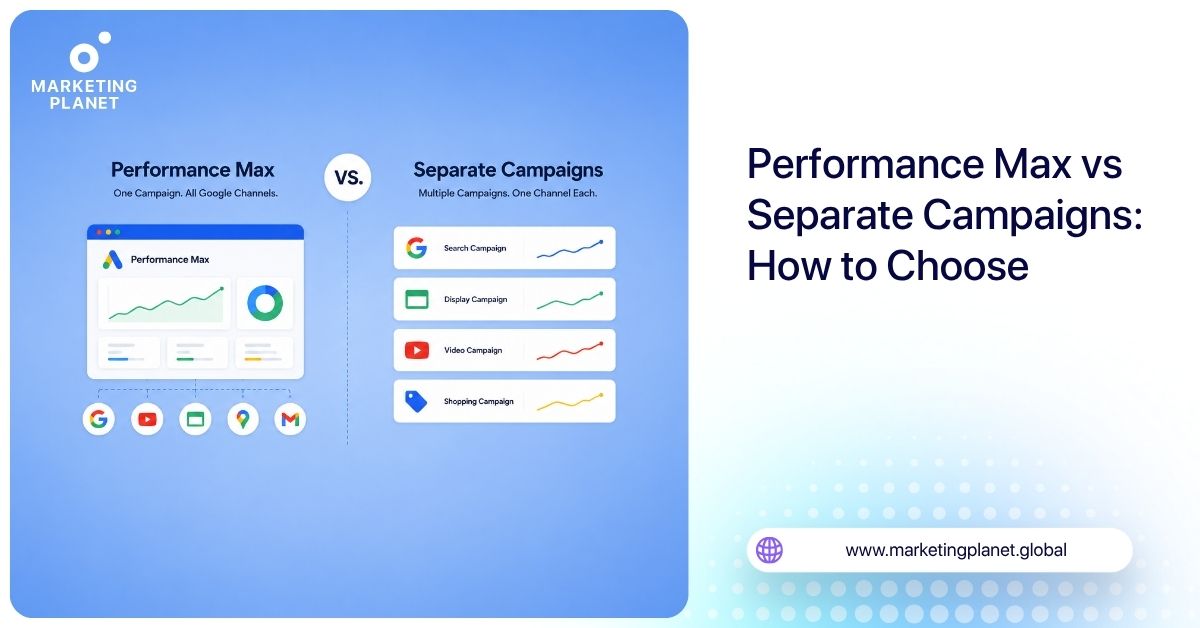
Google Ads has become increasingly automated, with Performance Max positioned as Google’s most advanced campaign type. As a result, many businesses are asking whether Performance Max is better than running separate campaigns.
The answer depends on your goals, budget, conversion data, and the level of control you need. While Performance Max uses Google’s AI to reach users across multiple channels from a single campaign, separate campaigns allow advertisers to organize efforts by channel, product category, service, location, audience, or funnel stage.
For some businesses, particularly ecommerce brands with strong conversion data, Performance Max may drive impressive results. For others, especially lead-generation businesses focused on lead quality and search intent, a more segmented campaign structure may offer greater visibility and control.
The strongest Google Ads strategies are often not built around choosing one approach over the other. They are built around using the right campaign structure for the right objective.
In most cases, Performance Max is not a full replacement for separate campaigns. It often works best as part of a hybrid strategy, where Search campaigns capture high-intent demand and Performance Max expands reach across Google’s broader advertising network.
Here is the Quick Answer:
Performance Max is not automatically better than running separate Google Ads campaigns. It often works well for ecommerce brands, broad reach, mature accounts, and advertisers with strong conversion data. Separate campaigns usually offer more control, clearer reporting, and stronger lead-quality management, especially for service-based and lead-generation businesses.
For many businesses, the best approach is a hybrid strategy. Search campaigns can capture high-intent demand, while Performance Max can expand reach across Google’s broader advertising network. The right structure depends on budget, conversion tracking, lead quality, account maturity, and business goals.
What Is a Performance Max Campaign?
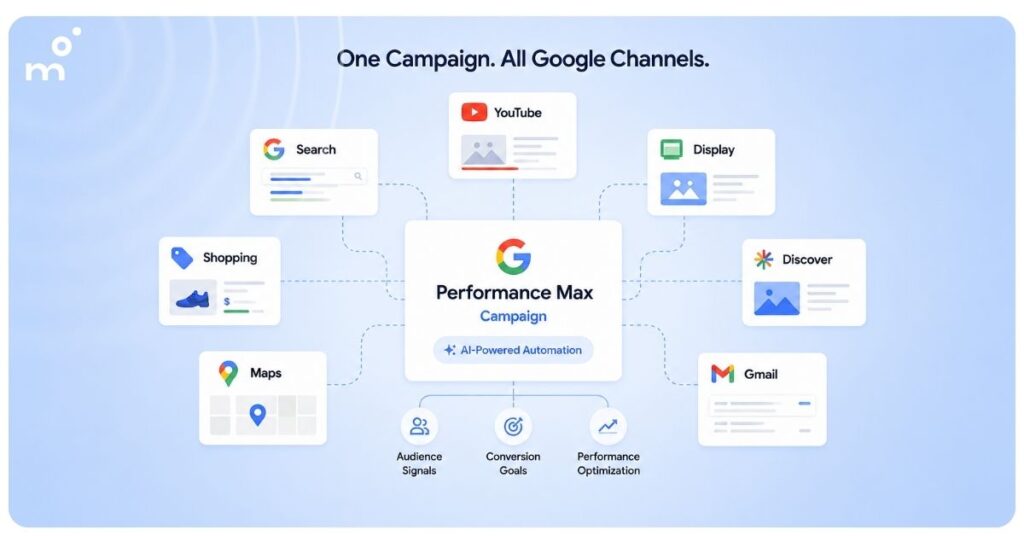
Performance Max is Google’s most automated campaign type. Instead of creating separate campaigns for Search, Display, YouTube, Discover, Gmail, Maps, and Shopping, advertisers can use a single campaign to reach potential customers across Google’s advertising network.
Key characteristics of Performance Max include:
- Automation: Google’s AI manages bidding, targeting, placements, and budget allocation automatically.
- Multi-channel reach: Ads can appear across Search, YouTube, Display, Discover, Gmail, Maps, and Shopping from a single campaign.
- AI optimization: Machine learning evaluates signals such as search intent, user behavior, location, device, and historical conversion data to identify opportunities for conversions.
- Goal-based bidding: Campaigns are optimized around specific objectives, such as leads, sales, revenue, or return on ad spend (ROAS).
To run a Performance Max campaign, advertisers typically provide:
- Creative assets, including headlines, descriptions, images, and videos
- Conversion goals
- Bidding objectives
- First-party data and audience signals
Understanding Audience Signals
Audience signals are often misunderstood. They do not function as strict targeting controls.
Instead, audience signals help Google’s system understand who is most likely to convert by providing a starting point for its learning process. Advertisers may use:
- Customer lists
- Website visitors
- Custom audience segments
- Interest-based audiences
While these signals can improve campaign learning, Google is not restricted to showing ads only to those audiences. Performance Max can expand beyond them to find additional users who may be likely to convert.
The primary advantage of Performance Max is its ability to automate optimization across multiple channels. The trade-off is that advertisers generally have less control over targeting, reporting, and campaign management compared to running separate Google Ads campaigns.
What Are Separate Google Ads Campaigns?
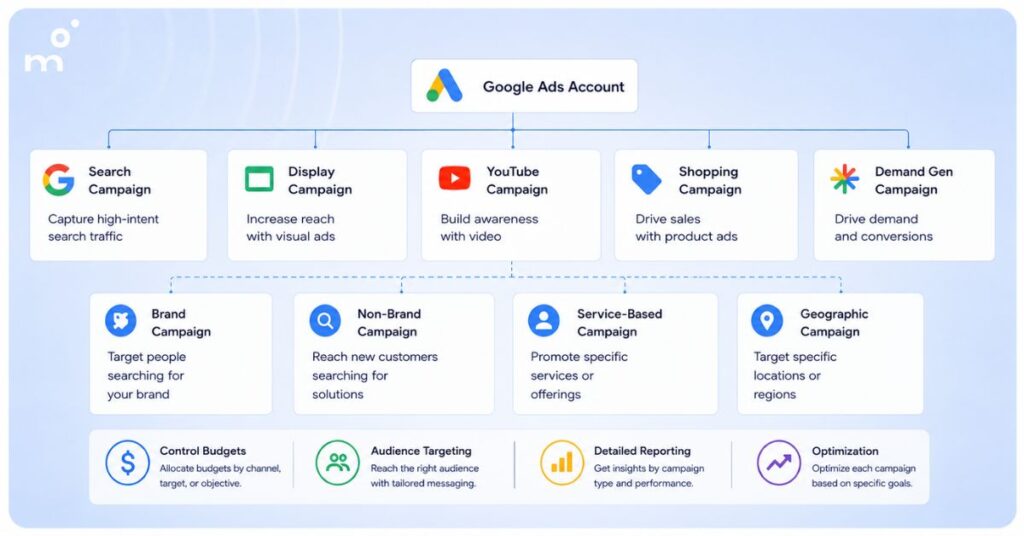
Separate Google Ads campaigns use a segmented structure instead of relying on a single automated campaign. Rather than allowing Google’s AI to manage everything from one campaign, advertisers create dedicated campaigns based on channels, audiences, products, services, locations, or business objectives.
Common examples include:
- Search campaigns focused on users actively searching for specific products or services through keyword targeting.
- Display campaigns designed to reach audiences across websites, apps, and Google’s display network with visual ads.
- YouTube campaigns that use video ads to build awareness, engagement, and demand across YouTube placements.
- Shopping campaigns that showcase products directly in Google Shopping results for ecommerce businesses.
- Demand Gen campaigns designed to reach audiences across Google’s visual surfaces, including YouTube, Discover, Gmail, Maps, and the Google Display Network.
- Brand campaigns targeting searches that include a company’s brand name.
- Non-brand campaigns targeting broader commercial and informational searches.
- Service-based campaigns organized around individual services, such as roofing, personal injury law, dental implants, or HVAC repair.
- Geographic campaigns segmented by city, region, territory, or service area.
This approach gives advertisers greater control over campaign structure, budget allocation, targeting, and reporting. Instead of one campaign making decisions across all channels, each campaign can be optimized according to its specific role within the customer journey.
Why Businesses Still Use Separate Google Ads Campaigns
A segmented campaign structure gives advertisers greater control over how budgets, targeting, and messaging are managed. Key advantages include:
- More control over keyword targeting and search intent
- Clearer reporting by channel, service, or location
- Better budget allocation across business priorities
- Greater visibility into lead quality and conversion sources
- Easier testing of creative assets and offers
- More precise management of brand and non-brand traffic
For example, a law firm may run separate campaigns for different practice areas, while a multi-location business may segment campaigns by service area. Ecommerce brands often separate Shopping, Search, and YouTube campaigns to support different stages of the customer journey.
Although separate campaigns typically require more management, they offer a level of control and transparency that many advertisers value when optimizing for lead quality, budget efficiency, and business-specific goals.
Performance Max vs Separate Campaigns: Key Differences
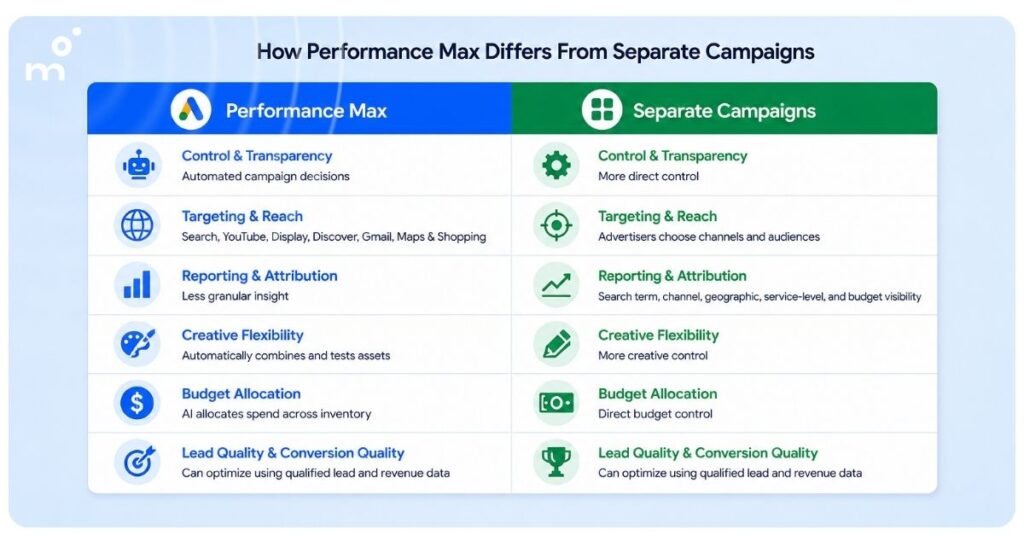
Both Performance Max and separate campaign structures can drive results, but they operate very differently. The right choice often depends on how much control, visibility, and optimization flexibility your business requires.
Control and Transparency
Performance Max automates many campaign decisions, including bidding, placements, audience expansion, and how spend is allocated across available inventory within the campaign. This can reduce management time, but it also limits visibility into certain performance details.
Separate campaigns provide advertisers with more direct control over keywords, audiences, locations, budgets, and channel-specific strategies.
For businesses that want a clearer understanding of where budget is being spent and how performance is being generated, a segmented campaign structure often offers greater transparency.
Targeting and Reach
One of Performance Max’s biggest strengths is reach. It can serve ads across Search, YouTube, Display, Discover, Gmail, Maps, and Shopping, allowing Google’s AI to identify conversion opportunities across multiple touchpoints.
Separate campaigns take a more focused approach. Instead of relying on automation to determine placements, advertisers decide which channels, audiences, and campaign types support specific objectives. This can be particularly valuable when different channels play different roles in the customer journey.
Reporting and Attribution
Reporting is one of the most significant differences between the two approaches.
Performance Max has become more transparent over time, but advertisers still receive less granular insight than they would from a fully segmented account structure. Separate campaigns make it easier to evaluate:
- Search term performance
- Channel-specific results
- Geographic performance
- Service-level performance
- Budget efficiency by campaign
For businesses that depend on detailed reporting and ongoing optimization, this visibility can be a major advantage.
Creative Flexibility
Performance Max automatically combines and tests creative assets to identify combinations that may improve performance.
This allows Google’s machine learning systems to adapt messaging across multiple placements without requiring extensive manual management.
Separate campaigns offer more creative control. Search campaigns can focus on intent-driven messaging, YouTube campaigns can support awareness objectives, and Display campaigns can be tailored to specific audience segments. This flexibility can be valuable when promoting different products, services, or offers.
Budget Allocation
Budget management is another area where the two approaches differ significantly.
With Performance Max, Google’s AI allocates spend across available inventory based on predicted conversion opportunities. While this can improve efficiency in some accounts, it can also make it difficult to prioritize specific services, locations, or campaign objectives.
Separate campaigns allow advertisers to control budget allocation directly. For example, a company may choose to invest more heavily in a high-margin service, a priority market, or a campaign that consistently produces qualified leads.
Lead Quality and Conversion Quality
For lead-generation businesses, success is rarely measured by conversion volume alone. A campaign that generates 100 low-quality leads may be less valuable than one that produces 20 qualified opportunities.
This is where campaign structure, conversion tracking, and data quality become critical. Businesses should evaluate metrics such as:
- Qualified leads
- Call quality
- Booked consultations
- Sales-qualified opportunities
- Closed revenue
Both Performance Max and separate campaigns can benefit from CRM integration and offline conversion tracking. By importing qualified leads, sales outcomes, or revenue data back into Google Ads, advertisers can help Google’s optimization systems focus on meaningful business outcomes rather than simply maximizing lead volume.
For many service-based businesses, lead quality often becomes the deciding factor when choosing between Performance Max, separate campaigns, or a hybrid strategy that combines both approaches.
When Performance Max Usually Performs Better
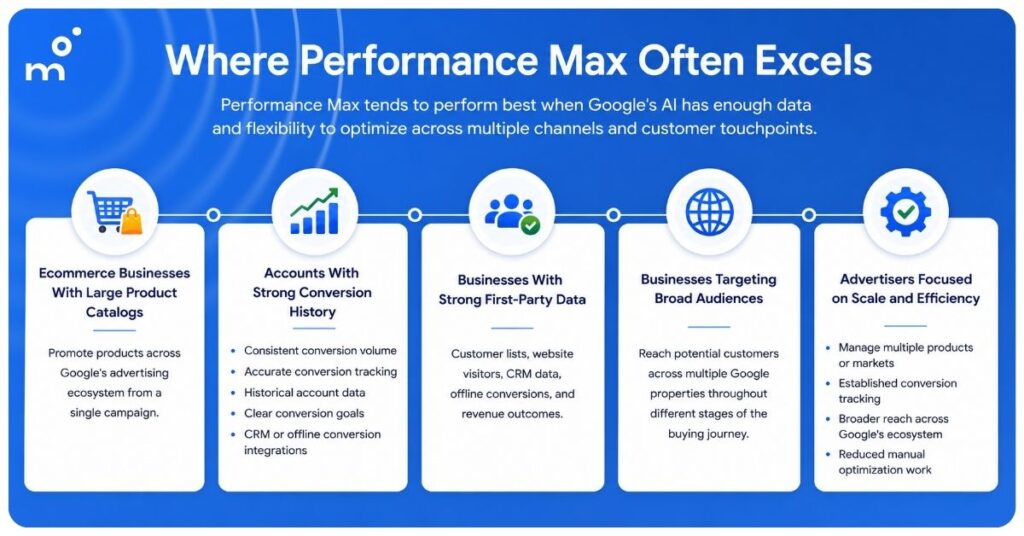
Performance Max is not the right solution for every business, but there are situations where its automation and cross-channel reach can create a clear advantage. In general, Performance Max tends to perform best when Google’s AI has enough data and flexibility to optimize across multiple channels and customer touchpoints.
Ecommerce Businesses With Large Product Catalogs
Performance Max is often a strong fit for ecommerce brands because it can promote products across Google’s advertising ecosystem from a single campaign, helping advertisers reach potential customers throughout different stages of the buying journey.
Rather than manually managing campaigns for dozens or hundreds of products, advertisers can leverage automation to help identify high-performing products, audiences, and placements.
This approach tends to become more valuable as product catalogs grow and campaign management becomes more complex.
Accounts With Strong Conversion History
Performance Max relies heavily on conversion data to make optimization decisions. Historical conversion data helps Google’s AI understand which users are most likely to convert, allowing it to adjust bidding, placements, and targeting more effectively.
Businesses that often see stronger Performance Max results typically have:
- Consistent conversion volume
- Accurate conversion tracking
- Historical account data
- Clear conversion goals
- CRM or offline conversion integrations
Without reliable data, Google’s system has less information to guide optimization.
Businesses With Strong First-Party Data
Performance Max can also be useful for advertisers with strong first-party data, clear conversion goals, and enough historical performance data to guide automation. This may include ecommerce brands, multi-location businesses, and mature lead-generation accounts that import qualified lead or revenue data back into Google Ads.
For these advertisers, Performance Max has stronger signals to work with. Customer lists, website visitors, CRM data, offline conversions, and revenue outcomes can help Google’s system optimize toward more meaningful business results rather than basic lead volume alone.
Businesses Targeting Broad Audiences
Some products and services appeal to a wide range of potential customers. In these situations, Performance Max can help uncover demand that may not be captured through keyword targeting alone.
For example, an ecommerce retailer selling home décor, fitness equipment, or consumer electronics may benefit from reaching users across multiple Google properties throughout different stages of the buying journey. Google’s AI can identify people who are researching, comparing options, or showing signals that suggest future purchase intent.
Advertisers Focused on Scale and Efficiency
Performance Max is designed to automate many of the tasks that traditionally require ongoing campaign management. Businesses looking to expand reach across multiple channels may find it easier to scale through a consolidated campaign structure rather than managing separate campaigns individually.
This can be particularly beneficial for advertisers that:
- Manage multiple products or markets
- Have established conversion tracking
- Need broader reach across Google’s ecosystem
- Want to reduce manual optimization work
While Performance Max can be highly effective in these scenarios, strong performance still depends on quality data, creative assets, and clearly defined business objectives.
When Separate Campaigns Usually Perform Better
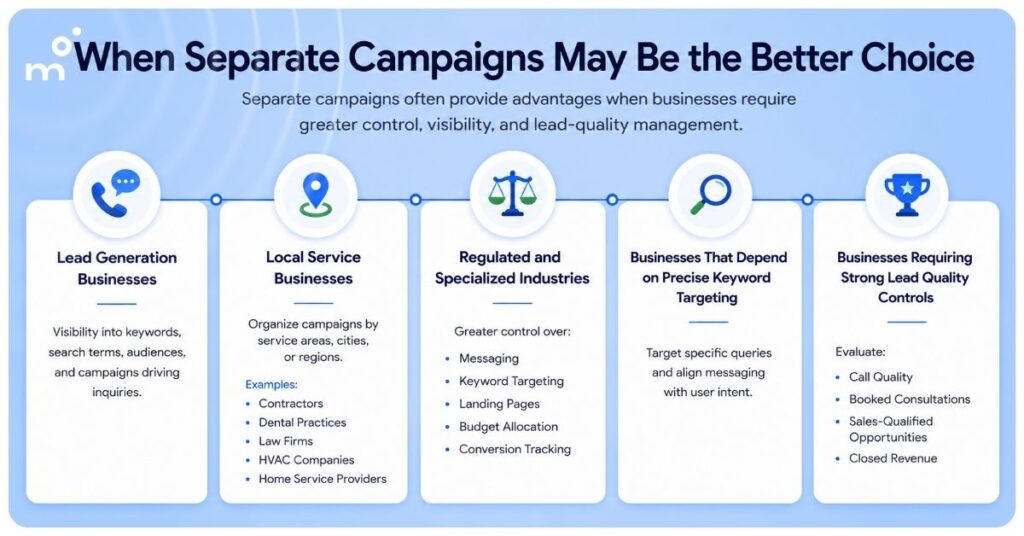
While Performance Max can be highly effective in the right circumstances, separate campaigns often provide advantages when businesses require greater control, visibility, and lead-quality management. This is especially true when conversion quality matters more than conversion volume.
Lead Generation Businesses
For many lead-generation businesses, understanding where leads come from is critical. Service-based companies often need visibility into the keywords, search terms, audiences, and campaigns driving inquiries.
Separate campaigns can make it easier to evaluate performance and optimize based on factors that directly impact revenue, not just lead volume. This level of visibility is particularly valuable when managing longer sales cycles or higher-value services.
Local Service Businesses
Businesses that rely on local customers often benefit from campaign structures organized around service areas, cities, or regions. Separate campaigns allow advertisers to allocate budget strategically, tailor messaging to local markets, and evaluate performance by location.
Examples include:
- Contractors
- Dental practices
- Law firms
- HVAC companies
- Home service providers
For these businesses, geographic segmentation can provide insights that are difficult to obtain from a more consolidated campaign structure.
Regulated and Specialized Industries
Industries such as healthcare, legal services, financial services, and certain B2B sectors often operate under stricter compliance requirements and highly competitive advertising environments.
In these situations, advertisers may need greater control over:
- Messaging
- Keyword targeting
- Landing pages
- Budget allocation
- Conversion tracking
A segmented campaign structure can make it easier to maintain compliance standards while optimizing for specific business objectives.
Businesses That Depend on Precise Keyword Targeting
Search campaigns remain one of the most effective ways to capture high-intent traffic because advertisers can target specific queries and align messaging with user intent.
For example, a personal injury law firm may want to prioritize searches related to specific case types, while a home services company may focus budget on high-converting service keywords. Google’s Search campaign documentation explains how keyword targeting helps advertisers connect with users actively searching for relevant products or services.
When keyword-level control is a priority, separate campaigns often provide more flexibility than a fully automated approach.
Businesses Requiring Strong Lead Quality Controls
Not all conversions carry the same value. Many businesses would rather receive fewer qualified leads than a large volume of low-quality inquiries.
Separate campaigns can provide greater visibility into lead sources, making it easier to evaluate factors such as call quality, booked consultations, sales-qualified opportunities, and closed revenue.
When combined with CRM integration, offline conversion tracking, and revenue attribution, a segmented campaign structure can help advertisers optimize toward meaningful business outcomes rather than simply maximizing lead volume.
For businesses where lead quality is a primary KPI, separate campaigns often provide the control and transparency needed to make informed optimization decisions.
Can Performance Max and Search Campaigns Work Together?
Many businesses assume they must choose between Performance Max and Search campaigns. In reality, some of the strongest Google Ads accounts use both, with each campaign type serving a different purpose within the overall strategy.
Understanding Keyword Prioritization and Search Query Ownership
When Search campaigns and Performance Max are eligible for similar queries, Google uses prioritization rules to determine which campaign enters the auction.
According to Google’s keyword prioritization guidance, eligible Search keywords may be prioritized for identical queries, but Search campaigns do not automatically win every auction.
For non-identical queries, Google may serve the campaign with the highest Ad Rank based on factors such as bidding, relevance, and predicted performance. As a result, exact match keywords remain a useful control mechanism, but they should not be viewed as a guarantee of complete search query ownership.
Using Brand Exclusions Strategically
One common concern is that Performance Max may consume budget on branded searches that could already be captured through dedicated brand campaigns.
In many cases, advertisers choose to maintain separate brand Search campaigns while using brand exclusions in Performance Max where appropriate. This can help preserve reporting clarity and make it easier to evaluate the incremental value generated by each campaign type.
The ideal approach depends on business goals, account structure, and reporting requirements.
Audience Signals and Search Intent Serve Different Purposes
Search campaigns primarily rely on user intent. Someone searches for a product, service, or solution, and the advertiser targets that intent through keywords.
Performance Max approaches targeting differently. Audience signals help guide Google’s machine learning system by identifying users who may be likely to convert, but they do not function as strict targeting restrictions. Google’s audience signals documentation explains that these signals act as inputs to help the system learn, while allowing it to expand beyond those audiences when appropriate.
This distinction is one reason Search and Performance Max can work well together. Search captures known demand, while Performance Max can help identify additional conversion opportunities across Google’s ecosystem.
Budget Segmentation Creates Greater Control
Running both campaign types successfully often requires intentional budget segmentation.
For example:
- Brand searches may remain in dedicated Search campaigns.
- High-intent non-brand keywords may be managed through Search.
- Performance Max may focus on scaling reach and uncovering new opportunities.
- Ecommerce campaigns may combine Shopping-focused activity with Performance Max expansion.
This structure allows businesses to maintain visibility into critical areas while still benefiting from automation.
Why Hybrid Strategies Often Outperform Either Approach Alone
Many mature Google Ads accounts evolve toward a hybrid model rather than relying entirely on one campaign type.
A common example might include:
- Brand Search campaigns for brand protection
- Non-brand Search campaigns for high-intent queries
- Performance Max campaigns for broader reach and scale
- Dedicated campaigns for priority products, services, or locations
This approach gives advertisers the ability to balance automation with control while maintaining visibility into lead quality, conversion performance, and budget allocation.
The strongest campaign structures are rarely built around a single Google Ads feature. They are built around business goals, conversion data, reporting requirements, and the ability to allocate budget where it creates the greatest impact.
How to Decide Which Strategy Is Right for Your Business
There is no universal answer to the Performance Max versus separate campaigns debate. The best approach depends on factors such as business goals, conversion volume, lead quality requirements, budget, and account maturity.
The table below provides a general framework to help guide decision-making. These recommendations should be viewed as starting points rather than fixed rules, as results can vary based on industry competition, CPCs, geography, and available conversion data.
| A Simple Framework for Choosing the Right Campaign Structure | ||
|---|---|---|
| Situation | Recommended approach | Why |
| New account | Search first | Provides clearer keyword, query, and conversion data before expanding automation |
| Ecommerce business | PMax + Search | Supports product visibility and scale while preserving high-intent search coverage |
| Lead generation business | Search-heavy or hybrid | Allows tighter control over intent, lead quality, and conversion sources |
| Small budget | Start narrow | Limited budgets usually need focus before broad automation |
| Large budget | Hybrid strategy | Allows automation, segmentation, testing, and budget control across objectives |
| Mature advertiser | Hybrid with offline conversion data | Uses historical data, CRM feedback, and conversion quality signals to guide optimization |
Business maturity often plays an important role in determining the right campaign structure:
- Startup businesses: Search campaigns are often a practical starting point because they provide greater visibility into keywords, search intent, and conversion behavior.
- Growth-stage businesses: As conversion data and budgets increase, many businesses benefit from combining Search campaigns with Performance Max to balance control and scale.
- Mature advertisers: Established accounts with strong tracking, CRM integrations, and historical data often achieve the best results through a hybrid strategy that combines multiple campaign types.
Ultimately, the best approach is the one that aligns with your goals, budget, conversion data, and lead quality requirements. Testing and ongoing optimization remain essential regardless of the campaign structure you choose.
Common Mistakes Businesses Make With Performance Max
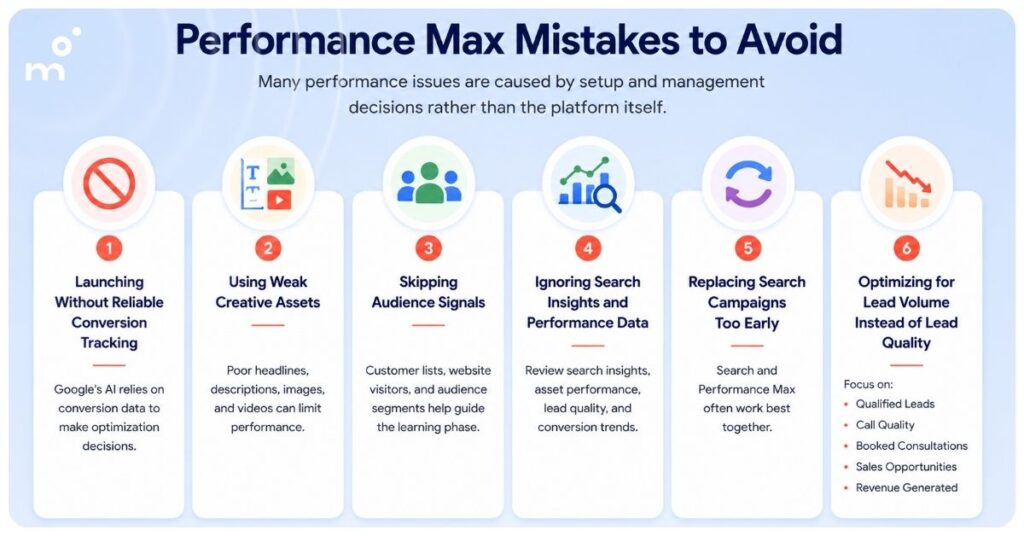
Performance Max can be a powerful campaign type, but success depends heavily on the quality of the data, assets, and signals provided to Google’s AI. Many performance issues are not caused by the platform itself, but by how campaigns are set up and managed.
Some of the most common mistakes include:
Launching Without Reliable Conversion Tracking
Performance Max relies on conversion data to make optimization decisions. If conversion tracking is inaccurate, incomplete, or missing altogether, Google’s AI may optimize toward the wrong outcomes.
Using Weak Creative Assets
The quality of your headlines, descriptions, images, and videos can directly influence campaign performance. Poor creative assets limit Google’s ability to test combinations and identify what resonates with potential customers.
Skipping Audience Signals
Audience signals are not strict targeting controls, but they provide valuable guidance during the learning phase. Failing to provide customer lists, website visitors, or relevant audience segments can make it more difficult for the system to identify likely converters early on.
Ignoring Search Insights and Performance Data
Although Performance Max automates many campaign decisions, it should not operate without oversight. Reviewing search insights, asset performance, lead quality, and conversion trends can help identify opportunities for improvement and uncover potential issues.
Replacing Search Campaigns Too Early
Some advertisers pause successful Search campaigns immediately after launching Performance Max. This can reduce visibility into high-intent traffic and make it harder to evaluate where results are coming from.
In many cases, Search and Performance Max work best together rather than as replacements for one another.
Optimizing for Lead Volume Instead of Lead Quality
More leads do not always mean better results. Businesses that focus exclusively on conversion volume may attract inquiries that never become customers.
Performance should be evaluated using metrics such as:
- Qualified leads
- Call quality
- Booked consultations
- Sales opportunities
- Revenue generated
Failing to Import Offline Conversions
Many valuable business outcomes happen after a form submission or phone call. Without offline conversion tracking, Google may not understand which leads ultimately become customers.
Importing CRM data, qualified leads, closed deals, and revenue information can give Google Ads stronger signals for optimizing toward outcomes that have a meaningful impact on business growth.
The businesses that see the strongest Performance Max results are typically those that combine automation with accurate tracking, quality data, strong creative assets, and ongoing strategic oversight.
How Marketing Planet Builds Google Ads Strategies Around Business Goals
At Marketing Planet, campaign recommendations are based on business objectives, lead quality requirements, available data, and growth goals rather than a preference for any specific campaign type.
Our approach begins with understanding how a business generates revenue and how customers move through the buying journey. From there, we develop a PPC strategy that aligns campaign structure, budget allocation, and performance measurement with the outcomes that matter most.
Key areas of focus include:
- PPC management tailored to business goals and market conditions
- Campaign strategy built around lead generation, ecommerce, or customer acquisition objectives
- Accurate conversion tracking to support informed optimization decisions
- CRM integration to connect advertising performance with sales outcomes
- Offline conversion imports that help Google optimize toward qualified leads and closed business, rather than lead volume alone
- Comprehensive campaign audits to identify inefficiencies, missed opportunities, and areas for growth
Rather than focusing solely on clicks, impressions, and conversion volume, Marketing Planet prioritizes the metrics that drive business performance. This may include lead quality, booked consultations, customer acquisition costs, revenue, and return on ad spend.
Businesses can explore Marketing Planet’s marketing case studies to see how data-driven strategies have been applied across different industries and growth stages. Companies seeking to enhance their online presence can also explore our digital marketing services, which combine paid advertising with broader growth strategies.
If you’re unsure which campaign structure best supports your goals, a Google Ads audit can provide valuable insights into performance gaps, tracking issues, budget allocation, and opportunities for improvement.
The goal is simple: build a Google Ads strategy that uses the right mix of automation, control, and measurement to generate meaningful business outcomes and support sustainable growth.
Conclusion
Performance Max is not automatically better than separate campaigns. The right approach depends on your goals, budget, conversion data, reporting requirements, and lead quality expectations.
For some businesses, Performance Max can deliver strong results through automation and broader reach. For others, a segmented campaign structure may provide greater control and visibility. Many successful advertisers combine both to balance scale and performance.
If you’re unsure which campaign structure is right for your business, Marketing Planet can help. From comprehensive Google Ads audits and PPC strategy development to full-service campaign management, our team helps businesses build data-driven advertising strategies focused on meaningful growth. Contact us to discuss your goals and identify opportunities to improve your Google Ads performance.
Source:
About ad group and asset group prioritization within a Google Ads account
About Performance Max campaigns – Google Ads Help
About offline conversion imports – Google Ads Help
About enhanced conversions – Google Ads Help
About Smart Bidding – Google Ads Help
About Google Ads campaign types – Search Ads 360 Help
Choose the right campaign type
About audience signals for Performance Max campaigns
Performance Max Campaigns: The Complete Guide for Small Business Owners
Performance Max vs Search Campaigns: Key Differences
Integrating PMax and Search Campaigns: Synergy Strategies for Large E-Commerce
Is Performance Max Actually Better Than Running Separate Campaigns? – Ask A PPC
What Is Performance Max & How Does It Work? | by sophie fell | Nothing But PPC | Medium Google Performance Max: Everything You Need To Know