Scaling a dental or medical network across multiple locations creates complex patient acquisition challenges. As networks expand to 15, 50, or more regional nodes, inconsistent data, fragmented local signals, and disconnected booking systems can limit visibility and increase acquisition costs.
Effective dental patient acquisition systems require more than individual location pages; they need a unified infrastructure connecting local search, entity data, and patient conversion pathways.
Marketing Planet helps healthcare organizations build scalable acquisition frameworks through advanced search engine optimization, technical website architecture, structured data implementation, and conversion-focused engineering. By connecting localized search visibility with booking systems, we help networks create a stronger foundation for sustainable patient growth.
Here is the Quick Answer:
- Multi-location healthcare networks need more than individual location pages to scale patient acquisition. A connected technical infrastructure is required to align search visibility, entity data, and booking experiences.
- Dental patient acquisition systems rely on scalable website architecture, structured data, and synchronized Google Business Profiles to help search engines understand each clinic, provider, and service.
- Programmatic location directories and nested MedicalBusiness and DentalBusiness Schema structures create clearer relationships between healthcare entities while supporting regional search visibility.
- Integrated booking systems, analytics, and technical SEO help organizations measure Patient Acquisition Cost (PAC) and improve the efficiency of patient growth efforts.
- Marketing Planet helps healthcare networks build data-driven acquisition frameworks that connect local search performance with measurable patient bookings.
- Google states that local ranking is influenced by relevance, distance, and prominence, making consistent clinic data, GBP synchronization, and localized entity signals essential for multi-location patient acquisition systems.
Programmatic Architecture: Building the Edge-Rendered Directory Hub
Enterprise healthcare networks use programmatic architecture and localized directory systems to create scalable location pages that maintain search visibility across multiple regions.
By connecting centralized location data with structured URLs, dynamic rendering, and localized content delivery, organizations can improve crawl efficiency, indexation accuracy, and regional search performance as they expand.
Why Flat Website Architectures Fail at Multi-Location Scale
Flat website architectures often become difficult to manage as healthcare networks expand from a small number of locations to dozens of regional clinics. Each new location introduces additional requirements for unique content, accurate business information, booking availability, and local search signals.
Without a connected architecture, multi-location networks may experience:
- Duplicate location signals across similar pages.
- Fragmented regional authority between disconnected URLs.
- Inefficient crawling caused by unclear website relationships.
- Difficult content management as location data changes.
A flat structure typically treats each location as an independent page without a broader relationship between clinics, providers, services, and regional data. This can make it harder for search engines to understand the full network.
A programmatic directory structure creates a more scalable approach by organizing locations through centralized data and connected entities. Instead of manually managing isolated pages, healthcare networks can use:
- Centralized location databases.
- Scalable regional folder structures.
- Connected clinic, provider, and service entities.
This approach allows each location to maintain local relevance while contributing to a stronger overall search infrastructure.
Building an Edge-Rendered Programmatic Directory
An edge-rendered programmatic directory uses centralized data systems and distributed delivery infrastructure to generate location experiences at scale.
Instead of creating and maintaining every location page manually, healthcare networks can dynamically serve regional content based on structured location data.
This architecture supports:
- Dynamic Location Routing: Serving relevant clinic information based on geographic intent and URL structure.
- Regional Content Delivery: Delivering location-specific information through optimized regional experiences.
- Location-Specific Booking Experiences: Connecting visitors with relevant services, providers, and scheduling options.
Edge workers can help process regional requests closer to users, improving delivery efficiency and supporting faster localized experiences.
When connected with regional scheduling data, this infrastructure allows healthcare networks to maintain accurate availability information while reducing unnecessary crawling of duplicate or outdated pages.
Programmatic Folder Routing and Crawl Efficiency
Programmatic folder routing helps search engines understand the relationship between locations, services, and regional pages across a large healthcare network. A structured URL hierarchy creates clearer signals about how individual clinics connect within the broader organization.
Instead of managing disconnected location pages, healthcare networks can use consistent directory structures that maintain local relevance while supporting scalable expansion. This approach helps search engines discover important pages, allocate crawl resources efficiently, and reduce confusion caused by duplicate or fragmented signals.
By combining structured routing with centralized location data, organizations can create a stronger foundation for maintaining local visibility as new clinics, providers, and services are added.
Flat Website Architecture vs Relational Location Infrastructure
The architecture behind a multi-location healthcare website directly influences scalability, search visibility, and operational efficiency.
The table below compares isolated flat structures with relational data hubs designed for enterprise location management.
| Flat Architecture vs. Relational Data Hub: Enterprise Location Infrastructure Comparison | ||
|---|---|---|
| Feature | Flat Architecture | Relational Data Hub |
| Crawl Efficiency | Search engines may encounter disconnected pages and repeated signals across locations. | Structured relationships help search engines efficiently discover and understand location networks. |
| Location Scalability | Adding new locations requires more manual page creation and maintenance. | Centralized data systems allow locations to scale through repeatable structures. |
| Index Stability | Similar pages may compete for visibility due to fragmented signals. | Connected entities create clearer relationships between locations and services. |
| Regional Relevance | Local signals may remain isolated within individual pages. | Location data, services, and regional attributes work together to strengthen relevance. |
| Booking Integration | Scheduling experiences may operate separately from location information. | Booking systems can connect directly with location and service data. |
| Data Synchronization | Updates require multiple manual changes across separate pages. | Centralized systems allow consistent updates across regional locations. |
Entity Alignment: Nested Schema Matrices for Dental Patient Acquisition Systems
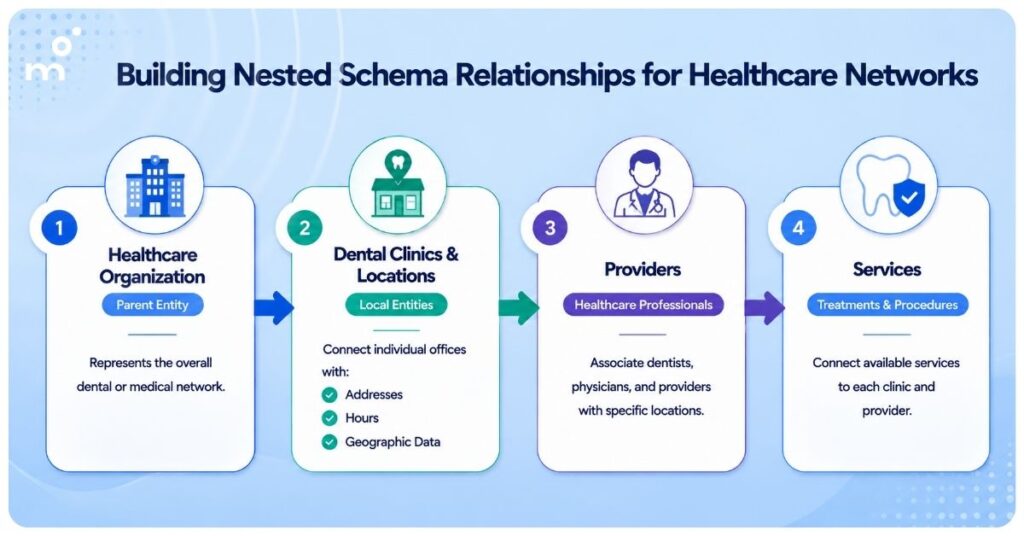
Structured data helps healthcare networks connect organizations, locations, providers, and services into machine-readable entities that search engines can better understand. For multi-location dental and medical groups, accurate schema relationships create clearer local signals, improve entity recognition, and support stronger visibility across location-based search experiences.
The following components outline how nested schema structures can be built, managed, and connected across enterprise healthcare networks.
Understanding MedicalBusiness and DentalBusiness Schema
Multi-location healthcare networks require more than location pages to establish clear digital identities. Search engines need to understand the relationship between the overall organization, individual clinics, healthcare providers, and available services.
MedicalBusiness and DentalBusiness Schema help define these relationships by providing structured information about healthcare entities, including:
- Healthcare Organizations: The parent entity representing the broader medical or dental network.
- Dental Clinics And Locations: Individual physical offices with unique addresses, contact information, and operating details.
- Providers: Dentists, physicians, and healthcare professionals associated with specific locations.
- Services: Treatments or procedures offered at each clinic or regional location.
- Opening Hours: Location-specific availability information that supports accurate search understanding.
- Geographic Coordinates: Precise location data that helps connect entities to regional search queries.
A scalable entity structure typically follows this relationship:
Organization
↓
Location
↓
Provider
↓
Service
This hierarchy allows search systems to understand that multiple clinics may belong to one healthcare network while still maintaining distinct local identities.
Engineering Nested Schema Relationships Across Locations
Managing structured data across multiple locations requires careful alignment between brand information, physical entities, and local attributes. A healthcare network may share one corporate identity while operating dozens of separate clinics, each with unique providers, services, and geographic information.
A strong schema framework should maintain:
- Consistent JSON-LD structures across locations.
- Accurate relationships between parent organizations and individual clinics.
- Matching information between structured data and visible website content.
- Correct location attributes, including addresses, services, providers, and operating hours.
Without proper entity relationships, search engines may struggle to distinguish between locations, providers, or departments. This can create unclear signals and make it harder for each location to appear for relevant regional searches.
Building consistent schema relationships allows healthcare networks to scale while preserving local relevance and entity accuracy across every market.
Connecting Local Schema to Enterprise Information Retrieval Systems
Local entity networks represent the foundation layer of broader information retrieval systems. By connecting locations, services, providers, and patient intent through structured data, healthcare organizations create clearer signals for search engines and AI-powered retrieval systems.
The relationship between local schema and enterprise search infrastructure is part of a larger framework discussed in The Enterprise Guide to Information Retrieval: Engineering Growth Marketing Infrastructure for High-LTV Client Acquisition, where structured data systems help organizations build reliable connections between digital entities, search discovery, and high-value customer journeys.
For multi-location healthcare networks, schema implementation is not only about adding markup to pages. It is about creating a connected information system where every location, service, and provider can be accurately understood across modern search environments.
Algorithmic Synchronization: Optimizing Multiple Google Business Profiles
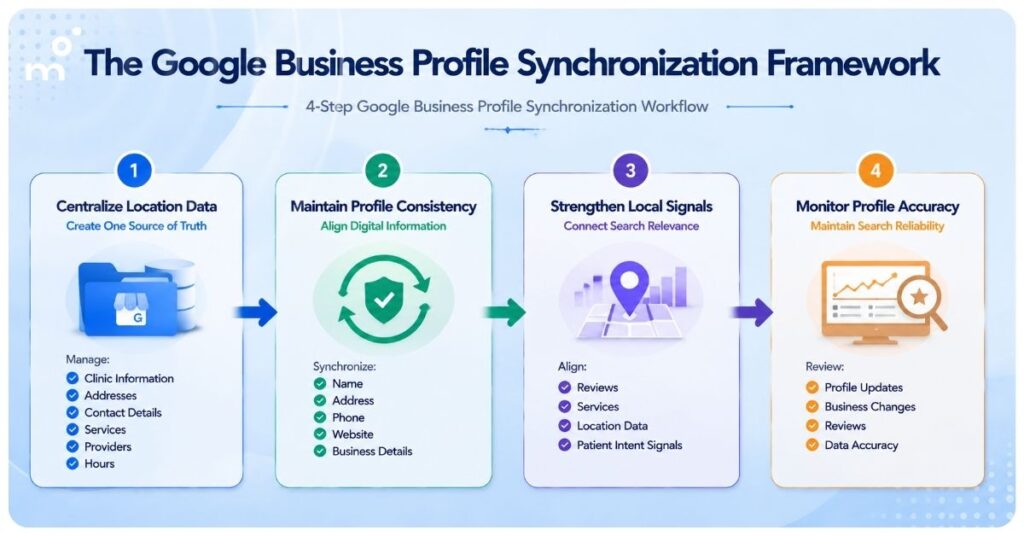
Multi-location healthcare networks must synchronize Google Business Profiles, website data, reviews, and location information to maintain accurate local search signals across every regional node. A structured synchronization process helps search engines understand the relationships between each clinic, provider, and service, while reducing inconsistencies that can impact local visibility and patient discovery.
Managing Multiple Google Business Profile Entities
Managing multiple Google Business Profiles requires clear separation between related healthcare entities. As networks expand, clinics, providers, and specialized departments may create overlapping digital identities that require proper structuring.
Common challenges include:
- Duplicate Listings: Multiple profiles representing the same location can create conflicting signals and reduce data accuracy.
- Clinic vs. Provider Profiles: Individual practitioners and physical locations must be represented as distinct but connected entities.
- Department-Level Profiles: Specialized departments within larger healthcare facilities require clear relationships to avoid confusion.
- Ownership Consistency: Profile access, management permissions, and business information should remain organized across all locations.
A well-structured Google business profile ecosystem helps search engines accurately associate each location with the correct services, providers, and geographic areas.
Building Transactional Justifications Through Local Signals
Transactional justifications are local search signals that demonstrate relevance for specific patient queries. These signals help search engines determine whether a healthcare location is a suitable match for users searching for specific treatments, services, or providers.
Strong transactional justifications are built through alignment between:
- Reviews: Patient feedback that reflects real experiences, services, and location relevance.
- Services: Clearly defined treatments and specialties associated with each location.
- Location Information: Accurate addresses, service areas, and geographic details.
- Patient Intent Signals: Content and information that match the needs behind local healthcare searches.
Local reviews and website content reinforce search understanding by providing additional context about what each location offers.
When Google Business Profiles, website pages, and structured data communicate consistent information, search systems can more confidently connect patient queries with relevant healthcare entities.
The Google Business Profile Synchronization Workflow
Maintaining accurate local search visibility requires an ongoing synchronization process across all regional locations.
For multi-location healthcare networks, centralized management helps ensure every Google business profile reflects accurate information, consistent branding, and current patient-facing details.
Step 1: Centralize Location Information
Create a unified source of truth for clinic details, including addresses, contact information, services, providers, operating hours, and appointment details.
Centralized data helps reduce inconsistencies across Google Business Profiles, website pages, and other digital platforms while making future updates easier to manage.
Step 2: Maintain NAPW Consistency
Ensure that Name, Address, Phone Number, and Website information remain consistent across Google Business Profiles, website pages, and other approved business listings.
Step 3: Synchronize Services and Attributes
Update each profile with accurate service categories, specialties, descriptions, appointment options, and location-specific attributes. Keeping this information aligned helps search engines understand which treatments and services are available at each location.
Step 4: Monitor Profile Accuracy
Regularly review profile information, updates, reviews, and business changes to identify inconsistencies. Ongoing monitoring helps healthcare networks maintain accurate local signals and respond quickly to outdated or incorrect information.
A synchronized Google business profile framework helps multi-location healthcare networks maintain reliable digital identities while supporting stronger local visibility across every market they serve.
Conversion Engineering: Reducing Friction in Local Patient Booking Loops
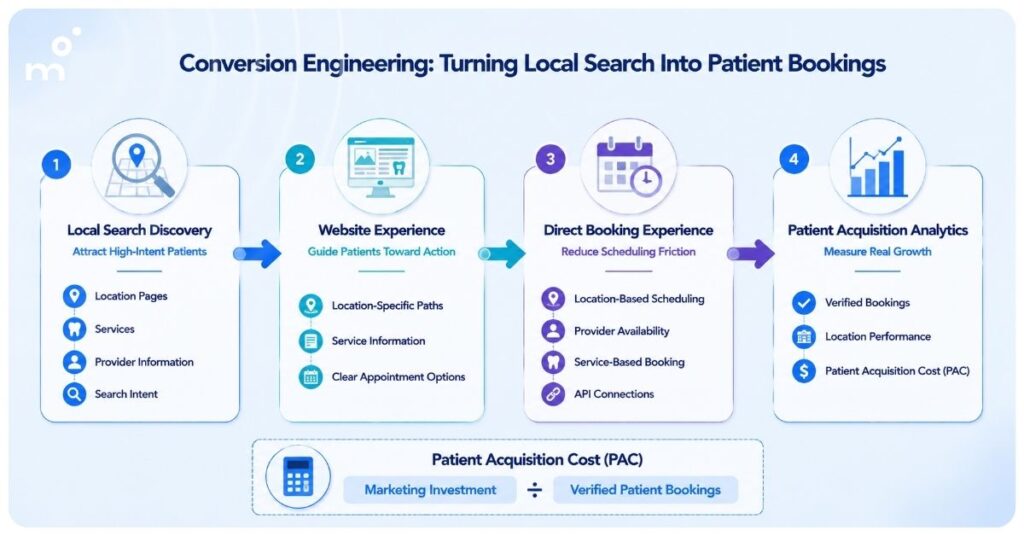
Patient acquisition systems must connect local search visibility with streamlined booking experiences to convert website visitors into measurable appointments.
For multi-location healthcare networks, effective conversion infrastructure requires alignment between location pages, scheduling systems, provider availability, and analytics tracking to ensure every qualified search interaction supports measurable patient growth.
Why Third-Party Scheduling Systems Create Conversion Gaps
Third-party scheduling platforms can create gaps between local search visibility and patient conversion. While external booking tools provide scheduling functionality, disconnected systems can make it harder for healthcare networks to track performance, optimize the patient journey, and connect marketing efforts with appointments.
Embedded scheduling experiences may create iframe limitations, reducing how much booking-related content search engines can interpret. External platforms can also limit crawl visibility, separate conversion tracking from website activity, and create gaps between websites, booking systems, CRM platforms, and analytics tools.
A connected booking infrastructure helps healthcare networks better understand how search interactions contribute to appointments while creating a smoother path from discovery to scheduling.
Building Direct Multi-Location Booking Experiences
A scalable booking experience should reflect the structure of the healthcare network itself. Instead of directing every visitor through a generic scheduling path, multi-location systems can create experiences based on location, service needs, and provider availability.
Effective booking frameworks include:
- Location-Specific Scheduling: Connecting patients with the correct clinic, regional availability, and appointment options.
- Provider Availability: Displaying relevant providers and schedules based on location and service requirements.
- Service-Based Booking Flows: Creating appointment paths aligned with specific treatments or healthcare needs.
- API Synchronization: Connecting booking systems with website infrastructure, CRM platforms, and analytics tools for accurate data flow.
By aligning scheduling experiences with local search intent, healthcare networks can reduce friction and create clearer pathways from discovery to appointment.
Measuring Patient Acquisition Cost Across Regional Locations
For multi-location healthcare networks, measuring marketing performance requires looking beyond traffic and impressions. Patient acquisition cost (PAC) evaluates how efficiently marketing investments generate verified patient bookings across individual locations.
Formula:
Patient Acquisition Cost (PAC) = Marketing Investment ÷ Verified Patient Bookings
Tracking PAC helps organizations understand which locations, campaigns, and services generate the strongest acquisition performance. A location generating high website traffic may still require optimization if those visitors do not convert into appointments.
Analyzing PAC alongside booking quality and location-level performance allows healthcare networks to make more informed decisions about marketing investments. By connecting search visibility, booking data, and analytics systems, organizations can identify opportunities to improve efficiency and create a more sustainable patient acquisition framework.
Technical Self-Assessment Checklist: Is Your Healthcare Network Ready to Scale?
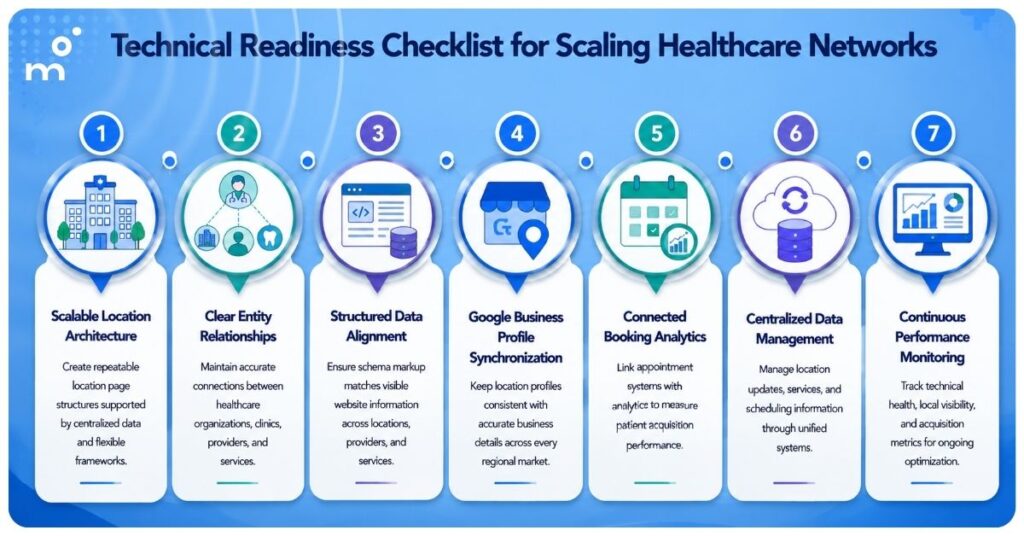
Scaling a healthcare network requires more than adding new location pages. A strong technical foundation ensures that search engines, patients, and internal systems can accurately understand every clinic, provider, service, and booking pathway. Use the following checklist to evaluate whether your infrastructure is prepared for multi-location growth.
✔ Location Pages Use Scalable Architecture: Location pages are built with structured URL patterns, centralized data, and repeatable frameworks that support expansion across multiple regions.
✔ Clinic And Provider Entities Are Clearly Separated: Each physical location, healthcare organization, and provider profile has a clear relationship to prevent entity confusion across search systems.
✔ Structured Data Matches Visible Website Information: Schema markup accurately reflects on-page details, including locations, services, providers, operating hours, and geographic information.
✔ Google Business Profiles Remain Synchronized: Business profiles maintain consistent information across locations, including names, addresses, phone numbers, websites, services, and attributes.
✔ Booking Systems Connect With Analytics: Appointment data flows into analytics platforms to measure which locations, services, and marketing channels generate patient bookings.
✔ Regional Data Updates Are Managed Centrally: Location details, scheduling information, and service changes are updated through a unified system to reduce inconsistencies.
✔ Local Search Performance Is Continuously Monitored: Search visibility, technical performance, and location-level acquisition metrics are regularly reviewed to identify optimization opportunities.
A scalable healthcare acquisition framework depends on consistent data, connected systems, and ongoing technical oversight. This foundation allows networks to expand while maintaining strong local visibility and patient conversion performance.
Legacy Local SEO vs Enterprise Patient Acquisition Architecture
As healthcare networks expand across multiple locations, the infrastructure behind local search becomes increasingly important.
The following table compares legacy local SEO approaches with enterprise patient acquisition architectures designed to support scalable visibility, accurate data relationships, and measurable appointment growth.
| Legacy Infrastructure vs Enterprise Architecture: A Multi-Location Healthcare Comparison | ||
|---|---|---|
| Area | Legacy Infrastructure | Enterprise Architecture |
| Location Management | Individual location pages are often managed separately, creating inconsistent information and difficult maintenance across multiple regions. | Centralized location data systems allow healthcare networks to manage clinics, providers, services, and regional details at scale. |
| Schema Implementation | Structured data may be incomplete, inconsistent, or disconnected between locations and healthcare entities. | Nested schema structures connect organizations, locations, providers, and services through clear entity relationships. |
| Booking Experience | Scheduling systems may operate separately from website content, limiting tracking and creating additional patient friction. | Integrated booking experiences connect location pages, availability, analytics, and patient conversion pathways. |
| Data Synchronization | Updates require manual changes across multiple platforms, increasing the risk of inconsistent business information. | Centralized data management synchronizes websites, Google Business Profiles, booking systems, and internal platforms. |
| Search Visibility | Local signals may become fragmented as locations compete without clear relationships between entities. | Connected search infrastructure strengthens local relevance and helps search engines understand each regional location. |
| Patient Acquisition Cost | Limited tracking makes it difficult to determine which locations and channels generate valuable patient bookings. | Integrated analytics provide clearer PAC insights by connecting marketing investment with verified patient acquisition outcomes. |
Why Marketing Planet Engineers Multi-Location Patient Acquisition Systems
Multi-location healthcare growth requires connected search, entity, booking, and analytics systems. Marketing Planet works as an advanced SEO partner and technical infrastructure partner to help healthcare networks build scalable patient acquisition frameworks.
Our healthcare SEO services combine technical strategy with conversion-focused infrastructure, including:
- SEO For Dental Clinics: Building search visibility around location-specific services, patient intent, and regional search opportunities.
- Programmatic Location Architecture: Creating scalable directory systems that support expansion across multiple clinics and markets.
- Schema Implementation: Connecting organizations, locations, providers, and services through structured data that improves search understanding.
- Custom Website Engineering: Developing flexible website frameworks that support localized experiences and enterprise growth.
- Booking System Integration: Connecting scheduling platforms with websites and analytics systems to create clearer conversion pathways.
- Analytics Infrastructure: Measuring patient acquisition performance through connected data sources and actionable insights.
As an analytics partner, Marketing Planet uses data-driven execution to help healthcare networks understand how search visibility contributes to patient bookings and acquisition efficiency. By connecting technical SEO, website architecture, and conversion systems, we create a foundation that supports sustainable multi-location growth.
Schedule an enterprise regional growth auditing session to evaluate your current infrastructure and identify opportunities to improve local visibility, booking efficiency, and patient acquisition performance.
Conclusion
Patient acquisition for multi-location healthcare networks requires more than creating location pages and improving rankings. Sustainable growth depends on connecting search visibility, entity relationships, website architecture, booking systems, and analytics into one unified infrastructure.
As networks expand across multiple regions, scalable technical frameworks help maintain local relevance while ensuring each clinic, provider, and service remains accurately represented across search platforms. Integrated SEO and technical systems allow organizations to improve visibility, understand acquisition performance, and create more efficient patient booking pathways.
Marketing Planet helps healthcare organizations transform fragmented digital systems into scalable patient acquisition frameworks built for long-term growth. Build a stronger foundation for multi-location growth with Marketing Planet’s technical SEO and infrastructure solutions.
FAQs
How do you resolve keyword cannibalization across overlapping regional dental or medical clinics?
Keyword cannibalization across locations is resolved by creating clear geographic and entity boundaries between clinics. This includes defining unique location pages, aligning services with specific regions, and ensuring each clinic has distinct content, structured data, and local signals.
What website architecture works best for a healthcare network with 50+ locations?
A scalable relational architecture with programmatic directories, centralized data, and connected location, provider, and service entities works best for large healthcare networks.
How do customer reviews impact AI search engine citation graphs?
Reviews provide context about services, locations, and patient experiences. Consistent review signals can help search systems better understand and associate healthcare entities with relevant searches.
Why should healthcare networks avoid third-party scheduling iframes?
Third-party scheduling iframes can create gaps between website content, booking experiences, and analytics tracking. When scheduling data is separated from the main website infrastructure, it may limit visibility into conversion pathways and make it harder to connect patient bookings with marketing performance.
How does schema markup differ between medical providers and clinic locations?
Schema markup separates the relationships between healthcare organizations, physical locations, and individual providers. A clinic location represents the physical business entity, while provider markup identifies the professionals associated with that location. Connecting these entities correctly helps search engines understand the full healthcare network structure.
How often should programmatic local directory data feeds be updated?
Local directory data should be updated whenever key information changes, including locations, providers, services, or operating hours. Centralized systems help maintain accuracy across platforms.
How do core web vitals impact local patient acquisition systems?
Core web vitals influence website speed, responsiveness, and usability. Strong performance helps reduce friction and supports better patient engagement from local search traffic.
Disclaimer: This content is provided for general informational and educational purposes only and does not constitute legal, financial, business, or professional marketing advice. Reading this article does not establish an agency-client relationship with Marketing Planet Inc. or Marketing Planet Media Group. Digital marketing platforms, algorithms, tools, and best practices change frequently, and results vary significantly based on individual industries, budgets, competition, and implementation. Marketing Planet makes no guarantees regarding specific outcomes, ROI, or performance metrics. References to third-party products or services do not imply endorsement. Please evaluate your specific business circumstances or consult with a professional before executing any strategies or making investments based on this content.
Source:
Google Analytics Help — Set Up and Configure Google Analytics 4
Google Business Profile Help — Improve Your Local Ranking on Google
Google Search Central — Page Experience and Search Ranking
Google Business Profile Help — Business Profile Guidelines
Google Analytics Help — About Google Analytics Events
Google Search Central — Core Web Vitals and Page Experience
Google Business Profile Help — Add or Remove Business Profile Owners and Managers
Google Search Central — Introduction to Structured Data Markup
Google Search Central — Local Business Structured Data
Google Search Central — Creating Helpful, Reliable, People-First Content
HubSpot — Customer Acquisition Cost (CAC) Guide
Nielsen Norman Group — Web Form Design Best Practices
W3C — Spatial Data on the Web Best Practices