
A sudden decline in organic visibility can create immediate pressure for enterprise marketing leaders, particularly when Search Console, GA4, CRM data, and pipeline reporting tell different stories. Recent deployments, site migrations, template updates, canonical changes, rendering failures, shifting demand, or Google ranking updates may all appear relevant, but timing alone does not establish causation.
A professional SEO consulting agency should diagnose the incident before recommending broad remediation. For enterprise organizations in California, Vancouver, and other complex markets, this requires a controlled process that verifies the data, isolates the affected inventory, reconstructs the change-event timeline, and tests each suspected cause against evidence, scope, mechanism, controls, and reversal criteria.
This structural approach helps executives distinguish an actual search decline from a measurement outage, demand contraction, conversion failure, or localized technical regression.
Throughout this framework, every suspected cause is evaluated through a structured causality model before remediation is approved. Each hypothesis is tested against data integrity, timing, affected scope, documented mechanism, appropriate control comparisons, validation through controlled remediation where feasible, and an assigned confidence level. This evidence-gated approach helps enterprise teams distinguish verified causes from plausible correlations and prioritize corrective actions with greater confidence.
Here is the Quick Answer:
- Enterprise structural drops should be verified across Search Console, GA4, CRM, server logs, and other business systems before remediation begins.
- A structured diagnostic process evaluates timing, affected scope, technical evidence, and causal mechanisms to identify the highest-confidence cause.
- Remediation should be prioritized based on evidence confidence, business impact, and validation criteria rather than assumptions or correlation.
- Recovery should be measured through predefined crawl, indexation, visibility, lead, and pipeline indicators.
- An evidence-led incident response framework helps enterprise organizations make informed decisions and strengthen long-term search governance.
How to Confirm Whether the Structural Drop Is Real
Before investigating technical SEO, content quality, or algorithmic changes, enterprise teams must confirm that a structural drop actually exists.
A decline in search visibility, analytics reporting, lead generation, or revenue does not always indicate the same underlying problem. Identifying which business system reflects the change is the first step toward an accurate diagnosis and evidence-based remediation.
Cross-System Validation Matrix
Enterprise incident diagnosis should begin by comparing multiple business and technical systems rather than relying on a single reporting platform. Cross-system validation helps determine whether the decline reflects actual search performance or a measurement issue affecting only one data source.
Enterprise Structural Drop Validation Matrix |
||
|---|---|---|
| Data Source | Primary Validation Purpose | Typical Questions Answered |
| Search Console | Confirms Search Visibility and User Discovery | Have Impressions, Clicks, or Indexed Pages Changed? |
| GA4 | Measures On-Site User Activity | Did Organic Sessions, Engagement, or Events Decline? |
| CRM | Validates Lead and Opportunity Creation | Did Qualified Leads or Opportunities Change? |
| Server Logs | Verifies Search Engine Crawling and Access | Are Search Engines Crawling the Affected Content? |
| Call Tracking | Measures Phone Inquiry Activity | Has Organic Call Volume Changed? |
| Business Outcomes | Confirms Commercial Performance | Are Revenue, Sales, or Qualified Opportunities Following the Same Trend? |
Agreement across multiple systems increases confidence that a structural change has occurred, while conflicting data suggests that additional validation is required before assigning a cause.
Measurement Integrity Before Diagnosis
Many reported traffic declines originate from measurement issues rather than actual changes in search performance. Before investigating indexing, rendering, or ranking signals, enterprise consultants verify that analytics systems are collecting data accurately.
This process includes checking for GA4 collection outages, broken or missing tags, CRM ingestion failures, attribution model changes, and reporting latency between platforms. Enterprise teams should also compare Search Console and Google Analytics data to reconcile differences between search discovery and on-site behavior before assigning a suspected cause.
A deployment that interrupts event tracking or modifies attribution settings may create the appearance of a decline even though search visibility remains stable. Confirming measurement integrity prevents organizations from investing time in unnecessary technical remediation based on incomplete or inaccurate reporting. Teams can also use Google’s tag diagnostics to verify that measurement tags are implemented correctly and collecting data as expected before continuing the investigation.
Why One Data Source Is Not Enough
No individual platform provides a complete view of enterprise search performance. Search Console measures how users discover content through Google Search, while GA4 records activity after users reach the website. CRM platforms measure business outcomes, and server logs provide evidence of crawler behavior. Each system captures a different stage of the customer journey and may report different trends during the same period.
When inconsistencies appear, enterprise teams should document the disagreement rather than immediately selecting one platform as the source of truth. Evidence should be prioritized according to the question being investigated, with each finding recorded alongside its supporting data and level of confidence.
This structured approach reduces diagnostic bias and creates a clear evidence trail before remediation decisions receive executive approval.
How the Shape of the Decline Narrows the Hypothesis Set
The pattern of a structural decline provides valuable diagnostic context, but it should not be treated as evidence of the underlying cause. By examining where, when, and how the decline occurs, enterprise teams can narrow the range of possible explanations and focus their investigation on the most likely technical, content, measurement, demand, or operational factors.
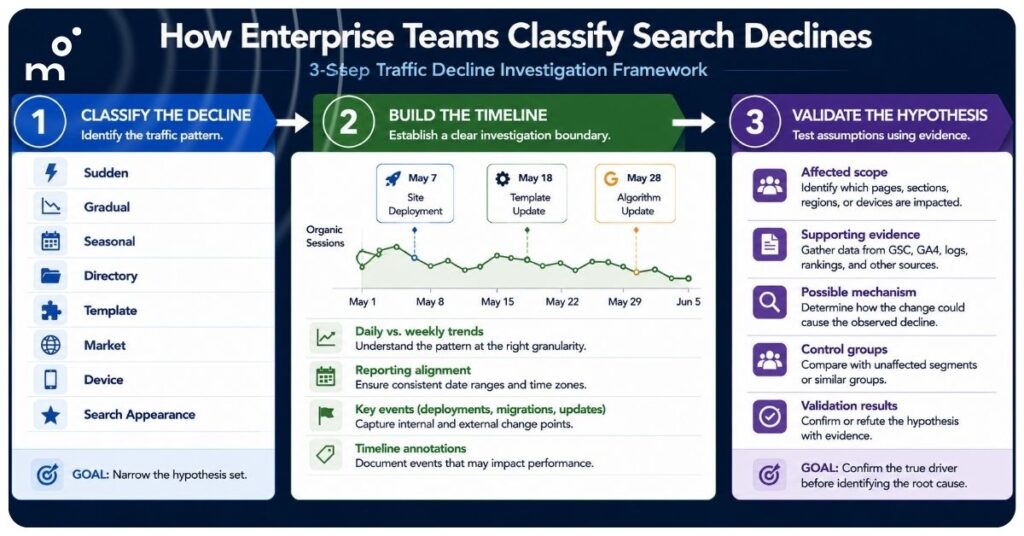
Traffic Shape Classification
The shape of a decline helps determine which hypotheses deserve further investigation. Different patterns often point toward different areas of the enterprise ecosystem, allowing consultants to prioritize evidence collection more efficiently.
Sudden Drop: Often associated with a discrete change event, such as a deployment, migration, analytics failure, robots directive, server issue, or other technical change that occurred within a defined timeframe.
Gradual Decline: May indicate content decay, increasing competition, evolving search behavior, or the cumulative effect of multiple smaller technical or content changes over time.
Seasonal Decline: Should be evaluated against historical performance, industry seasonality, market demand, and business cycles before technical issues are considered.
Directory Decline: Affects a specific website section and may indicate problems with internal linking, indexing, URL structure, redirects, or content management within that directory.
Template Decline: Often points to issues introduced through shared page templates, layouts, JavaScript components, structured data, or other reusable website elements.
Market Decline: May reflect localization challenges, regional technical issues, changing customer demand, or market-specific business conditions affecting a particular country or region.
Device Decline: Differences between desktop and mobile performance may highlight rendering problems, usability issues, page experience differences, or device-specific technical limitations.
Search Appearance Decline: Changes affecting rich results or other search features should be investigated separately from overall organic visibility because they may involve different eligibility requirements and technical signals.
Classifying these traffic patterns helps narrow the hypothesis set and establish a structured investigation, but no individual pattern should be treated as proof of the underlying cause.
Building a Time-Series Boundary
A reliable investigation begins by defining exactly when the decline started. Establishing a clear time-series boundary allows enterprise teams to compare performance before and after the first observable change while accounting for normal reporting behavior across different platforms.
Daily data is useful for identifying sudden events, deployments, or outages that occurred within a narrow timeframe. Weekly trends provide additional context by reducing short-term fluctuations and revealing broader performance patterns that may not be visible in daily reporting.
Reporting latency should also be considered because Search Console, analytics platforms, CRM systems, and other reporting tools often update on different schedules. Before comparing datasets, teams should confirm that all reporting periods are complete and aligned. Annotating important events, including deployments, migrations, template releases, analytics changes, and confirmed external events, creates a chronological record that supports objective hypothesis testing throughout the investigation.
Why Decline Shape Is Not Proof
Traffic patterns help generate hypotheses, but they do not establish causality. A decline that begins near a deployment, a Google core update, or a seasonal event may appear related, yet timing alone cannot demonstrate that one event caused the other.
Enterprise consultants use decline patterns as the starting point for investigation rather than the conclusion. Each hypothesis should be evaluated against the affected scope, supporting evidence, documented mechanism, unaffected control groups, and validation results before it is accepted. This evidence-based process prevents organizations from implementing broad remediation based solely on correlation and increases confidence that corrective actions address the actual source of the structural decline.
How to Build the Change-Event Timeline
A change-event timeline establishes the sequence of technical, content, operational, and external events surrounding a structural decline. By documenting when each change occurred and comparing it with the verified onset of the decline, enterprise teams can distinguish meaningful evidence from coincidental timing and prioritize the most credible hypotheses.
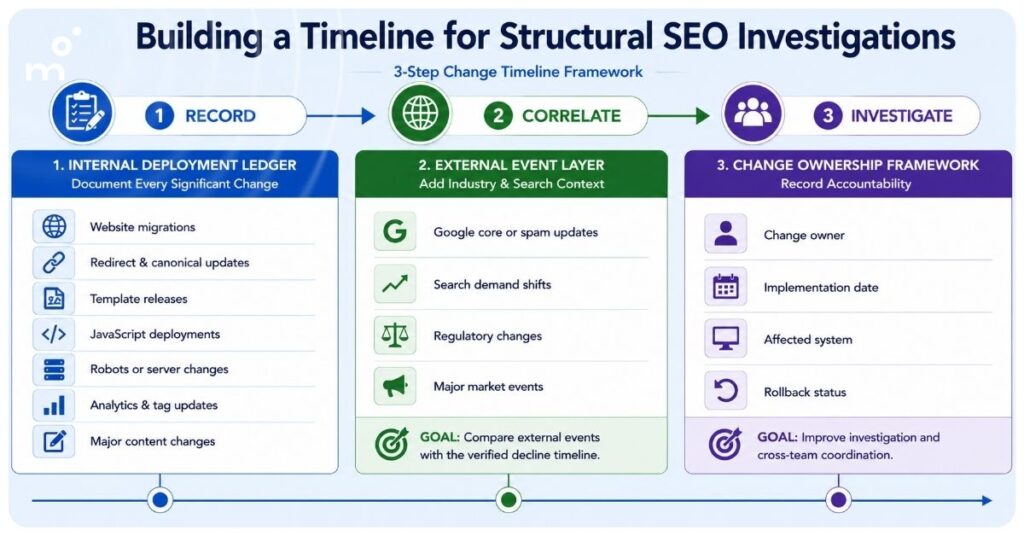
Internal Deployment Ledger
The internal deployment ledger provides a chronological record of every change that could reasonably influence search performance. Instead of assuming that a single deployment caused the decline, enterprise consultants compare multiple implementation records against the verified timeline to determine which events deserve further investigation.
A complete deployment ledger should document:
- Website migrations
- Redirect updates
- Canonical changes
- Template releases
- JavaScript deployments
- Robots directive modifications
- Server configuration changes
- Analytics or tag implementation updates
- Major content additions, removals, or revisions
Recording these events in a single timeline allows SEO, development, analytics, infrastructure, and content teams to investigate the same evidence set, making it easier to identify potential relationships between technical changes and the affected search inventory.
External Event Layer
Not every structural decline originates from an internal change. External factors should be documented alongside deployment history to determine whether broader industry or market conditions may have influenced performance during the same period.
This layer includes confirmed Google core updates, spam updates, significant shifts in search demand, regulatory or legal changes affecting the industry, and major market events that could influence user behavior or commercial activity. These events provide valuable context for investigation, but they should never be treated as direct explanations without additional supporting evidence.
External events become meaningful only when they align with the verified onset of the decline, affect the same inventory under investigation, and present a plausible mechanism that explains the observed behavior across search, traffic, or business systems.
Change Ownership Framework
Every recorded change should include clear ownership and implementation details. Assigning responsibility improves investigation efficiency, strengthens cross-functional communication, and provides executives with a transparent record of decision-making throughout the incident.
Each change record should capture:
- Change owner
- Implementation timestamp
- Affected system or website component
- Rollback status
Maintaining this information allows enterprise teams to identify the appropriate stakeholders, determine whether controlled rollback testing is possible, and document how implementation decisions relate to subsequent search performance. It also creates a consistent governance process that supports future incident reviews and continuous improvement.
How to Segment the Affected Search Inventory
A structural decline rarely affects every page, query, market, or user segment equally. Enterprise consultants segment the affected search inventory to identify where the decline is concentrated, which systems or assets are involved, and whether the issue represents a broad visibility change or a localized structural problem.
Scope Matrix
Segmentation creates a detailed view of the affected search ecosystem by separating performance changes across different dimensions. This allows teams to connect observed declines with specific technical boundaries, content systems, market structures, or user experiences.
| Segment | Diagnostic Purpose |
| Queries | Identifies Whether Specific Search Terms, Topics, Entities, or Intent Groups Experienced Visibility Changes. |
| URLs | Determines Which Landing Pages, Directories, or Content Assets Are Affected. |
| Templates | Evaluates Whether Shared Page Structures or Development Components Contributed to the Decline. |
| Directories | Identifies Whether Specific Sections, Categories, or Website Areas Show Concentrated Performance Changes. |
| Entities | Determines Whether Particular Services, Products, Industries, Locations, or Topics Are Impacted. |
| Markets | Compares Performance Across Regions, Countries, or Business Areas. |
| Devices | Evaluates Whether Desktop, Mobile, or Other Device Experiences Show Different Patterns. |
| Countries | Identifies Geographic Variations in Search Visibility and User Behavior. |
| Search Appearance | Determines Whether Changes Affect Specific Search Features, Rich Results, or Appearance Categories. |
A structured scope analysis prevents teams from applying sitewide solutions to problems that may only affect a specific template, market, directory, or search category.
Building Valid Control Groups
Control groups help determine whether a suspected cause explains the observed decline or whether another factor may be responsible. Without comparison groups, teams may incorrectly attribute normal fluctuations or unrelated changes to a specific technical or content issue.
Effective control groups may include unaffected templates, stable markets, comparable pages, or similar entities that experienced normal performance during the same period. For example, if one page template declines while another structurally similar template remains stable, the difference can provide valuable evidence during technical investigation.
Control groups should share relevant characteristics with the affected inventory while remaining isolated from the suspected issue. This creates a stronger basis for testing hypotheses and evaluating remediation outcomes.
Mapping Business Priority
Not every affected segment carries the same commercial importance. Enterprise diagnosis should connect search-impact analysis with business impact by evaluating how affected pages, entities, and markets contribute to qualified demand.
This requires connecting search segments with qualified leads, pipeline contribution, and executive reporting metrics. A decline affecting a high-value service entity, strategic market, or revenue-generating landing page may require faster attention than a larger decline affecting lower-priority content.
By combining search segmentation with commercial data, organizations can prioritize remediation based on business significance rather than traffic volume alone. This creates a clearer path from technical diagnosis to executive decision-making.
How to Diagnose Crawling and Indexation Failures
Crawling and indexation failures can prevent search engines from accessing, understanding, or storing important website content.
Enterprise consultants diagnose these issues by reviewing technical signals across affected pages, comparing intended configurations with actual search behavior, and identifying whether accessibility, canonicalization, or indexing problems explain the observed decline.
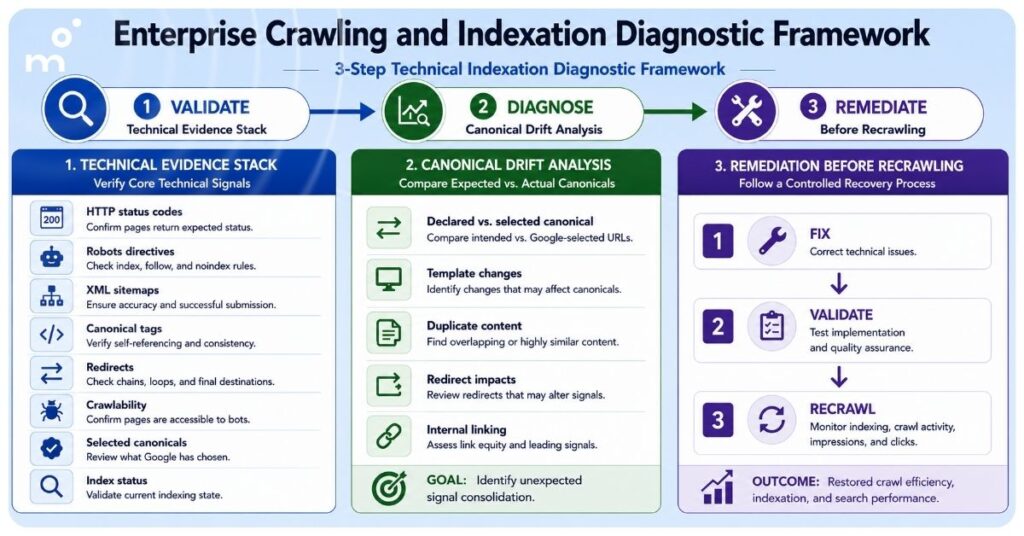
Technical Evidence Stack
A technical evidence stack provides a structured review of the signals that influence how search engines discover and process enterprise websites. Rather than making assumptions based on traffic changes alone, consultants validate each technical layer to determine where the search system may be experiencing friction.
The review process includes:
Status Codes: Verify that important URLs return the correct HTTP responses and identify unexpected errors, unavailable pages, or incorrect server responses.
Robots Directives: Review robots.txt rules, meta robots tags, and other directives that may restrict crawling or indexing.
Sitemaps: Confirm that XML sitemaps accurately represent eligible URLs and provide clear discovery paths for important content.
Canonicals: Evaluate whether canonical tags correctly identify the preferred version of each page and align with the intended indexation strategy.
Redirects: Analyze redirect chains, incorrect redirects, and outdated mappings that may affect crawl efficiency or signal consolidation.
Crawlability: Confirm that search engines can access important pages through functional links, navigation systems, and technical pathways.
Selected Canonicals: Compare Google’s selected canonical URL with the declared canonical to identify unexpected consolidation of search signals.
Index Status: Review whether affected pages are indexed, excluded, or experiencing changes in indexing behavior.
This evidence stack helps separate true indexation problems from unrelated issues such as demand changes, content shifts, or measurement discrepancies.
Canonical Drift Analysis
Canonical drift occurs when search engines select a different preferred URL than the one declared by the website. This can affect how signals are consolidated and which pages appear in search results.
A canonical drift analysis compares declared canonicals, selected canonicals, and changes before and after the decline began. Consultants review whether updates to templates, internal links, redirects, duplicate content patterns, or technical deployments influenced canonical selection. When Google’s selected canonical differs from the declared canonical, teams should review Google’s guidance for troubleshooting canonicalization and understanding how canonical selection is determined before implementing changes.
A difference between declared and selected canonicals does not always indicate an error, but it can reveal important inconsistencies when investigating unexpected indexation changes.
Remediation Before Recrawling
Recrawling should occur only after the underlying issue has been identified and corrected. Requesting search engine reprocessing before resolving the technical cause can make it difficult to determine whether the remediation was effective.
A controlled remediation process follows three stages:
Fix First: Correct the identified issue, such as incorrect directives, broken redirects, canonical conflicts, sitemap problems, or inaccessible content.
Validate: Confirm that the implementation works as intended through technical testing, rendered-page reviews, URL checks, and internal quality assurance.
Then Recrawl: Allow search engines to revisit the corrected pages and monitor predefined recovery indicators, such as crawl activity, index status, impressions, clicks, and relevant business signals.
This approach preserves diagnostic clarity and helps enterprise teams evaluate whether the remediation addressed the actual cause of the structural decline.
How to Diagnose Rendering and Template Regressions
Rendering and template regressions occur when website changes prevent search engines or users from accessing important content, links, metadata, or interactive elements as intended. Enterprise consultants diagnose these issues by comparing expected page output with actual rendered experiences and identifying whether a shared implementation change explains the affected scope.
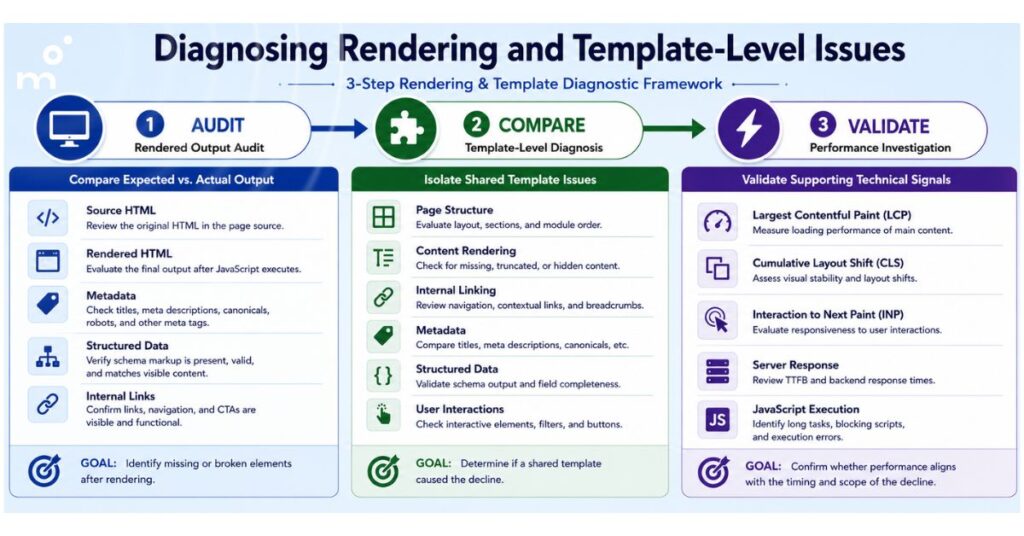
Rendered Output Audit
A rendered output audit compares what exists in the source code with what users and search engines actually receive after page processing. This helps identify situations where important content or technical signals exist in the original HTML but fail to appear correctly after JavaScript execution or browser rendering.
The audit should compare:
HTML: Review the original source output to confirm that important content, links, metadata, and technical elements are present.
Rendered HTML: Evaluate the final page output after scripts execute to identify missing content, delayed elements, or rendering failures.
Metadata: Verify that titles, descriptions, canonical tags, robots directives, and other metadata elements remain consistent after deployment changes.
Structured Data: Confirm that schema markup remains valid, complete, and aligned with visible page content.
Links: Check that internal links, navigation elements, and contextual pathways are available to users and accessible to search engines.
A difference between source HTML and rendered output can indicate JavaScript issues, template changes, or implementation problems that affect crawling, understanding, and indexing.
Template-Level Diagnosis
Enterprise websites often rely on shared templates across large groups of pages, which means a single development change can affect thousands of URLs. Template-level diagnosis helps determine whether a decline is isolated to specific page structures or reflects a broader website-wide issue.
Consultants compare affected templates against unaffected templates to identify differences in:
- Page structure
- Content rendering
- Internal linking
- Metadata implementation
- Structured data
- User interaction elements
- Technical performance
For example, if service pages decline while resource pages remain stable, the investigation should focus on the systems unique to the affected template rather than applying broad changes across the entire website.
Template comparisons create a controlled diagnostic environment where teams can identify whether the issue originates from a shared component, recent deployment, or isolated content structure.
Performance Investigation
Performance issues should be evaluated as part of a broader technical investigation rather than treated as the automatic cause of a visibility decline. Enterprise consultants review performance signals to determine whether speed, usability, or rendering failures may contribute to reduced search accessibility or conversion performance.
Key areas include:
Largest Contentful Paint (LCP): Evaluates how quickly the primary page content becomes visible to users.
Cumulative Layout Shift (CLS): Measures unexpected layout movement that can affect usability and page stability.
Interaction to Next Paint (INP): Assesses responsiveness during user interactions.
Server Response: Reviews server processing time, delivery consistency, and infrastructure-related delays.
JavaScript Failures: Identifies script errors, blocked resources, or execution problems that prevent important content or functionality from loading correctly.
Performance findings should be evaluated alongside crawl data, indexing signals, business impact, and affected page segments. A performance change becomes a stronger hypothesis only when it aligns with the timing, scope, and mechanism of the observed structural decline.
How to Evaluate Core Updates Without Guessing
Google core updates can coincide with changes in organic visibility, but timing alone does not establish that an update caused a specific decline. Enterprise consultants evaluate core update impact through structured analysis that compares rollout periods, affected content systems, search patterns, and supporting evidence before assigning a likely cause.
Update Correlation Test
A core update correlation test compares the timing of a confirmed Google update with the verified onset of an observed decline. This analysis requires more than identifying that both events occurred during the same period because correlation alone does not establish causation.
Consultants evaluate the rollout dates of the update, including the official start and completion period, to determine whether the website experienced changes during the active rollout window. They also examine the onset dates of the decline to identify when affected queries, pages, markets, or search appearances first showed measurable changes.
The relationship between the rollout period and decline onset helps determine whether a core update is a reasonable hypothesis for further investigation. However, the analysis must also consider the affected scope, content patterns, technical conditions, and available control groups. A visibility change that occurs near a core update may still be caused by unrelated technical deployments, demand shifts, competitive changes, or measurement issues. A core update should therefore be evaluated as one possible factor within a broader evidence-based diagnosis.
Content System Review
When a core update becomes a possible factor, enterprise teams should evaluate the broader content system rather than isolated pages. Core updates are designed to improve the quality and relevance of search results, so analysis should focus on whether affected content continues to provide meaningful value for users, following Google’s guidance on creating helpful, reliable, people-first content.
A content system review evaluates:
- Usefulness: Whether pages clearly address the needs, questions, or tasks users are attempting to complete.
- Originality: Whether content provides unique information, expertise, analysis, or practical value beyond commonly available material.
- Evidence: Whether claims are supported by appropriate sources, methodology, experience, or supporting documentation.
- Trust: Whether users can understand who created the content, why it is reliable, and what limitations may apply.
- Page Purpose: Whether each page has a clear role within the website architecture and serves a defined audience or search task.
This review should consider patterns across groups of pages, templates, and entities rather than focusing only on individual URLs. Enterprise websites often require system-level improvements when content quality, evidence structures, or page purpose are inconsistent across large sections.
Why Core Updates Are Not Penalties
A core update should not automatically be interpreted as a penalty or direct action against a website. Core updates involve broader changes to search systems, and visibility fluctuations may occur for many reasons, including changing search expectations, competitive environments, content relevance, or technical factors.
Because multiple variables can influence organic performance, consultants should avoid assumptions based only on timing or traffic movement. A reliable diagnosis requires evidence from affected segments, content analysis, technical validation, market data, and comparison groups.
Treating core updates as one possible hypothesis rather than a confirmed cause allows enterprise teams to make more accurate decisions and avoid unnecessary changes that may not address the actual source of the decline.
How to Separate Demand Shifts From Ranking Loss
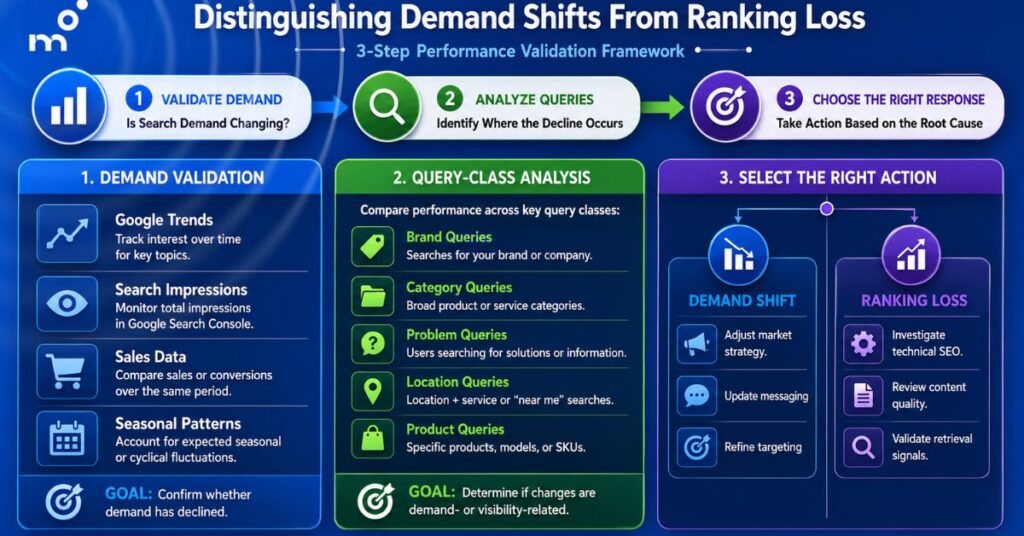
A decline in organic traffic does not always indicate a search visibility problem. Enterprise consultants must distinguish between reduced demand and actual ranking loss by analyzing search behavior, market conditions, and business performance data.
This prevents organizations from investing in technical remediation when the underlying change is caused by shifting customer interest or external market factors.
Demand Validation
Demand validation evaluates whether users are still searching for the products, services, problems, or topics represented by the affected pages. Before diagnosing technical SEO issues, consultants compare search demand indicators with website performance data to determine whether fewer searches are occurring or whether the website is losing visibility for existing demand.
Key validation sources include:
Google Trends: Helps identify changes in broader search interest, seasonal patterns, and shifts in user behavior over time.
Impressions: Search Console impression data can reveal whether search demand remains available while clicks or rankings change.
Sales Data: Revenue and sales information can indicate whether market demand has changed beyond organic search activity.
Seasonality: Historical patterns help determine whether expected fluctuations are being incorrectly interpreted as structural declines.
When search demand decreases across multiple channels, the appropriate response may involve adjusting market strategy, messaging, or targeting rather than applying technical SEO changes.
Query-Class Analysis
Query-class analysis separates different types of search demand to determine where changes are occurring. A decline affecting one query category may represent a different business issue than a decline across the entire search ecosystem.
Consultants compare:
Brand Queries: Searches directly related to the organization, products, or established reputation. Declines may indicate changes in brand demand, market awareness, or tracking issues.
Category Queries: Searches representing broader solution areas or industry needs. Changes may reflect competitive shifts, market trends, or changing user preferences.
Problem Queries: Searches based on user challenges or informational needs. Declines may indicate changes in demand, content relevance, or audience behavior.
Location Queries: Searches influenced by regional demand, service availability, or geographic market conditions.
Product Queries: Searches focused on specific offerings, features, or solutions that may change due to product lifecycle or customer preferences.
This segmentation helps determine whether the issue is related to search visibility, market demand, or changes within a specific customer journey stage.
When Technical SEO Is Not the Answer
Technical SEO is not always the correct solution for a decline in organic performance. If demand has decreased, customer behavior has shifted, or market conditions have changed, improving crawlability, indexing, or website architecture may not address the underlying issue.
For example, a decline caused by reduced interest in a product category, seasonal market changes, or industry disruption requires a different response than a decline caused by broken pages, rendering failures, or indexing problems.
Enterprise consultants should confirm that a technical mechanism exists before recommending technical remediation. By separating demand shifts from ranking loss, organizations can allocate resources toward solutions that address the actual cause of performance changes rather than responding to symptoms alone.
How to Test Conversion and Lead-Quality Failure
A decline in organic performance does not always originate from search visibility or technical issues. In enterprise environments, traffic can remain stable while qualified leads, sales opportunities, or pipeline contribution decrease because of changes after the visitor reaches the website.
A conversion and lead-quality investigation evaluates the full path from search interaction to business outcome.
Post-Click Funnel Audit
A post-click funnel audit examines whether organic visitors can successfully move from search to meaningful business engagement. This analysis helps determine whether changes in the conversion process, rather than search visibility, are reducing commercial performance.
The review begins with the landing pages to confirm they align with user intent and support clear conversion paths. Consultants then evaluate forms for submission errors or unnecessary friction, verify that leads are routed to the appropriate teams, and confirm that CRM systems accurately capture source data and lifecycle stages. The final step is reviewing sales acceptance to determine whether qualified leads continue to progress through the pipeline as expected.
This process helps identify whether the issue occurs during conversion, lead management, or sales qualification rather than within organic search itself.
Search-to-Pipeline Lineage
Search-to-pipeline lineage connects organic search activity with measurable business outcomes. Instead of evaluating performance only through clicks or sessions, enterprise teams can understand how specific search journeys contribute to qualified opportunities.
The lineage model connects:
Query → Page → Lead → Opportunity
The query identifies the search demand and intent that introduced the user to the organization. The page represents the commercial or informational asset that supported the interaction. The lead captures the conversion event and qualification details, while the opportunity connects the marketing interaction to measurable sales activity.
This framework allows organizations to analyze whether specific entities, markets, content groups, or landing pages generate meaningful commercial activity. It also helps identify situations where traffic remains consistent but lead quality, routing, or sales acceptance has changed.
Measurement Boundary
Conversion and lead-quality analysis requires verified business data before conclusions are assigned. Changes in attribution models, CRM processes, sales definitions, or tracking implementations can influence reported performance without reflecting a true change in customer behavior.
Before determining that organic search performance has declined commercially, teams should validate event tracking, CRM fields, lead qualification rules, attribution settings, and sales reporting processes. This ensures remediation efforts address actual pipeline issues rather than measurement inconsistencies.
How to Prioritize Remediation by Evidence and Business Impact
Effective remediation begins only after the available evidence has been evaluated and the likely causes have been prioritized. Enterprise consultants rank remediation activities according to diagnostic confidence, commercial impact, implementation complexity, and validation potential so that resources are directed toward changes most likely to improve business outcomes while minimizing operational risk.
Prioritization Matrix
A structured prioritization matrix helps enterprise teams determine which issues should be addressed first. Rather than reacting to the largest traffic decline or the most recent deployment, consultants evaluate each candidate issue against multiple decision factors before approving remediation.
| Evaluation Factor | Diagnostic Focus |
| Confidence | Measures the Strength of the Supporting Evidence and the Likelihood that the Suspected Cause Explains the Decline. |
| Severity | Evaluates the Scale of the Business and Search Impact Across the Affected Inventory. |
| Business Value | Assesses the Commercial Importance of the Affected Pages, Markets, Entities, or Conversion Paths. |
| Effort | Estimates the Technical, Operational, and Resource Investment Required to Implement the Remediation. |
| Reversibility | Determines Whether the Change Can Be Safely Rolled Back If Validation Does Not Support the Hypothesis. |
| Dependency | Identifies Technical, Content, Analytics, or Operational Prerequisites That Must Be Completed Before Implementation. |
Using these evaluation criteria helps enterprise organizations prioritize high-confidence, high-value remediation activities while reducing unnecessary changes that may complicate future investigations.
Structural Drop Confidence Classification Framework
Enterprise teams should assign a confidence level to every suspected cause before approving remediation. Standardized classifications improve executive reporting, reduce confirmation bias, and help ensure that implementation decisions remain proportional to the available evidence.
Confidence Levels and Recommended Actions |
||
|---|---|---|
| Confidence Level | Meaning | Recommended Action |
| Confirmed | Multiple independent evidence sources support the suspected cause, and the timing, scope, mechanism, control comparisons, and validation results align. | Proceed with remediation and monitor predefined recovery indicators. |
| Probable | Most available evidence supports the suspected cause, but one or more elements require additional confirmation. | Prioritize further validation before implementing broad changes. |
| Possible | Some evidence suggests the suspected cause, but important gaps remain in timing, scope, mechanism, or supporting data. | Continue investigation and avoid significant remediation until confidence improves. |
| Rejected | Available evidence does not support the suspected cause or controlled testing contradicts the hypothesis. | Remove the hypothesis from consideration and continue evaluating alternative explanations. |
Enterprise Change-Control Framework
Every approved remediation should follow a structured change-control process to reduce implementation risk and preserve diagnostic integrity. Enterprise environments often involve multiple teams working across development, content, analytics, infrastructure, and marketing, making coordinated governance essential.
A structured framework should include:
Staging: Test every remediation in a staging environment to verify technical behavior, identify implementation issues, and confirm that the proposed fix addresses the suspected cause before production deployment.
Approvals: Obtain approval from the appropriate technical, business, and operational stakeholders to ensure the remediation aligns with organizational priorities and change-management policies.
Rollback: Document a rollback plan before deployment so changes can be safely reversed if validation indicates that the hypothesis was incorrect or the implementation introduces additional issues.
Monitoring: Monitor predefined recovery indicators after deployment, including crawl activity, indexation, search visibility, conversion performance, and other validated business metrics to evaluate the effectiveness of the remediation.
A disciplined change-control framework improves cross-functional coordination, preserves diagnostic evidence, and provides executives with greater confidence in remediation decisions and post-implementation reporting.
Avoiding Simultaneous Changes
Implementing multiple unrelated fixes at the same time can make it impossible to determine which change influenced subsequent performance. When several technical, content, analytics, or infrastructure updates occur simultaneously, the evidence required to confirm or reject individual hypotheses becomes significantly weaker.
Enterprise consultants preserve causality by introducing controlled changes in a logical sequence whenever practical. Each implementation should be monitored against predefined validation indicators before additional modifications are introduced.
This structured approach allows organizations to associate observed performance changes with specific remediation activities, strengthening the quality of post-incident analysis and improving future decision-making.
How to Validate Recovery
Recovery validation confirms whether remediation has addressed the verified cause of a structural decline. Rather than assuming success after a deployment or technical fix, enterprise consultants monitor predefined search, technical, and commercial indicators to determine whether the expected outcomes are occurring across the affected inventory.
Recovery Indicator Set
Recovery should be measured using multiple indicators that reflect different stages of the search and business ecosystem. Monitoring only traffic or rankings can provide an incomplete picture, particularly when crawling, indexing, or commercial outcomes change at different rates.
The primary recovery indicators include:
Crawl Activity: Confirms that search engines are revisiting affected pages after remediation and that important URLs remain accessible.
Indexation: Verifies that corrected pages are indexed appropriately and that excluded or duplicate pages are returning to their intended state where applicable.
Impressions: Measures whether affected queries and pages regain visibility within relevant search results.
Clicks: Evaluates whether improved visibility results in increased user engagement through organic search.
Leads: Determines whether qualified inquiries recover alongside search performance.
Pipeline Contribution: Assesses whether recovered search activity supports opportunities and measurable commercial outcomes.
Together, these indicators provide a more complete assessment of recovery than any single metric alone.
Validation Window
Recovery should be evaluated over an appropriate observation period rather than immediately after implementation. Search engines require time to recrawl, reprocess, and reassess website changes, while business systems such as analytics and CRM platforms may introduce additional reporting delays.
The length of the validation window depends on factors such as the nature of the remediation, website size, crawl frequency, affected inventory, and reporting schedules. Because these variables differ across organizations, enterprise consultants avoid guaranteeing specific recovery timelines. Instead, they define an evidence-based observation period and monitor agreed recovery indicators until sufficient data is available to support a conclusion.
Rejecting Failed Hypotheses
Not every remediation confirms the original diagnosis. If expected leading indicators fail to improve within the agreed validation window, the original hypothesis should be re-evaluated rather than defended.
For example, if crawl activity returns to normal but indexation, impressions, or qualified leads remain unchanged, the investigated issue may not represent the primary cause of the decline. Likewise, if technical corrections produce no measurable changes across the affected scope, consultants should revisit the evidence, reassess competing hypotheses, and continue the investigation.
Rejecting unsupported hypotheses is an essential part of an evidence-led diagnostic process. It prevents enterprise teams from pursuing ineffective remediation strategies and strengthens confidence that future decisions are based on verified causes rather than assumptions.
How to Operationalize the Post-Incident Review
A post-incident review transforms an isolated structural decline into an opportunity to strengthen future search operations. Enterprise consultants document verified findings, identify process improvements, assign long-term ownership, and update governance procedures so that similar incidents can be detected earlier and managed more effectively.
Root-Cause Record
A structured root-cause record captures the evidence supporting the final diagnosis and provides a documented history of the incident. Rather than recording only the observed symptoms, the review should identify the verified cause, the contributing factors that allowed the issue to occur, the remediation implemented to resolve it, and the measured outcome following validation.
This record creates a reliable reference for future investigations, allowing enterprise teams to distinguish recurring technical patterns from isolated events. It also improves cross-functional communication by providing development, analytics, content, and marketing teams with a shared understanding of what occurred, why it happened, and how the issue was resolved.
Prevention Backlog
Every completed incident should generate a backlog of improvements designed to reduce the likelihood of similar issues occurring again. The objective is not simply to resolve the current problem but to strengthen the systems and processes that support long-term search performance.
The prevention backlog should include enhancements to monitoring processes, quality assurance procedures, technical governance, and ownership responsibilities. Monitoring improvements may involve additional alerts or reporting dashboards, while quality assurance initiatives can introduce new pre-release testing for templates, structured data, redirects, or analytics implementations. Governance updates help standardize deployment procedures, and clearly assigned ownership ensures accountability for future technical, content, and measurement changes.
By treating each incident as an opportunity for continuous improvement, organizations can reduce operational risk while increasing confidence in future deployments.
Executive Governance
A successful post-incident review should provide executives with a clear summary of the verified root cause, supporting evidence, remediation outcomes, remaining risks, and next steps. This ensures future decisions are based on documented findings rather than assumptions.
For more on how governance and executive decision-making support enterprise SEO, see The Consultative Architecture: Shifting from Execution to Strategic Algorithmic Alignment for B2B Executives.
If the investigation identifies duplicate entities, localization issues, or regional architecture challenges, refer to The Enterprise Consultant Edge: Leveraging Global Entity Clustering for Corporate Market Domination.
For deeper analysis of search intent, query relationships, and performance patterns, see Search Intelligence Operations: How Elite SEO Experts Build Data Graphs for Enterprise Intent Matching.
Together, these frameworks help enterprise organizations manage structural search incidents through evidence-based governance, coordinated decision-making, and continuous operational improvement.
What the Final Structural Drop Incident Ledger Must Contain
A structural drop incident ledger serves as the central record for enterprise search investigations. It consolidates the verified evidence, affected scope, diagnostic findings, ownership, remediation actions, and validation results into a single governance document, ensuring that executive decisions are based on documented facts rather than assumptions.
Structural Drop Incident Ledger
A standardized incident ledger allows enterprise teams to track every stage of the investigation from the initial detection of the decline through final validation. Maintaining a consistent record improves collaboration between SEO, development, analytics, content, and business stakeholders while creating a reliable reference for future incidents.
| Field | Purpose |
| Onset | First verified date and time the structural decline became observable, including reporting latency where relevant. |
| Affected Scope | Queries, URLs, templates, directories, entities, markets, devices, countries, or search appearances impacted by the decline. |
| Data-Source Agreement | Comparison of Search Console, GA4, CRM, server logs, call tracking, and business outcomes to determine whether the decline is consistently reflected across systems. |
| Suspected Event | Deployment, migration, content update, technical release, analytics change, infrastructure modification, or confirmed external event associated with the incident timeline. |
| Evidence Status | Current evidence classification for the suspected cause (Evidence Collected, Under Validation, Inconclusive, or Insufficient) based on documented findings. |
| Hypothesis | Suspected measurement, crawling, rendering, indexing, ranking, demand, competition, or conversion cause under investigation. |
| Mechanism | Documented explanation describing how the suspected cause could reasonably produce the observed decline. |
| Control Group | Comparable unaffected pages, templates, markets, devices, or channels used to validate or reject the hypothesis. |
| Confidence | Confirmed, Probable, Possible, or Rejected based on the available evidence. |
| Owner | Responsible team or individual accountable for investigation, remediation, and validation. |
| Remediation | Approved fix, rollback, corrective action, or controlled test associated with the hypothesis. |
| Validation Window | Agreed monitoring period and recovery indicators used to evaluate whether the remediation produced the expected outcome. |
| Executive Decision | Executive-approved disposition (Proceed with Remediation, Continue Investigation, Monitor, or Reject Hypothesis) based on the available evidence and confidence level. |
Disqualification Triggers
Every suspected cause should meet a minimum evidence standard before remediation is approved. If a hypothesis cannot satisfy the required diagnostic criteria, it should remain unconfirmed until additional evidence becomes available.
A hypothesis should be rejected or returned for further investigation when any of the following conditions exist:
Unverified Data: The suspected cause is supported by incomplete, inconsistent, or unvalidated information from analytics, Search Console, CRM, server logs, or other reporting systems.
No Timing Match: The proposed cause does not align with the verified onset of the structural decline or the documented change-event timeline.
No Defined Scope: The hypothesis cannot explain the affected queries, URLs, templates, directories, markets, devices, or search appearances.
No Documented Mechanism: There is no credible explanation describing how the suspected event could have produced the observed search or business impact.
No Valid Control Group: There are no unaffected pages, templates, markets, or comparable segments available to test the hypothesis against.
No Validation Plan: The proposed remediation cannot be evaluated through predefined recovery indicators, monitoring, or an agreed validation window.
Applying these disqualification criteria helps enterprise teams reduce confirmation bias, avoid unnecessary technical changes, and ensure that remediation decisions remain evidence-based throughout the diagnostic process.
Request a Structural Drop Diagnostic
Enterprise search incidents often involve multiple technical systems, business teams, and competing hypotheses. A disciplined diagnostic process helps organizations identify verified causes, prioritize remediation based on evidence, and provide executives with clear decision support instead of assumptions.
Marketing Planet provides enterprise SEO consulting services that combine technical SEO, analytics validation, content systems, development coordination, and executive reporting into a structured incident response framework. Request a structural drop diagnostic to evaluate your search performance, identify evidence-backed root causes, and develop a controlled remediation roadmap for your enterprise website.
How Marketing Planet Coordinates Enterprise Incident Response
Enterprise search incidents often involve multiple systems, teams, and business processes. Marketing Planet operates as an SEO consulting agency that helps organizations diagnose structural search declines through evidence-based investigation, coordinated remediation, and executive governance rather than reactive execution.
Our incident-response framework may include:
Enterprise Technical SEO: Conducting technical SEO assessments and audits to identify issues affecting crawling, rendering, indexing, canonicalization, and website architecture.
Analytics Validation: Comparing Search Console, GA4, CRM platforms, server logs, and business reporting to determine whether a decline reflects a genuine search issue or a measurement problem.
Content Systems Review: Evaluating content quality, entity relationships, information architecture, and page purpose across the affected inventory.
Development Coordination: Working with engineering teams to assess deployments, template changes, redirects, structured data, JavaScript, and other technical implementations.
UI/UX Assessment: Reviewing navigation, page layouts, and conversion pathways to identify user-experience issues that may affect engagement and lead generation.
Executive Reporting: Translating technical findings into business-focused reports covering confidence levels, business impact, ownership, remediation priorities, and validation progress.
Remediation Governance: Coordinating implementation through structured change control, approval workflows, rollback planning, and ongoing monitoring.
Cross-Functional Incident Management: Aligning SEO, development, analytics, content, and business teams so that remediation remains evidence-led and consistently executed.
By combining technical SEO, analytics validation, content-system review, development coordination, and marketing analytics, Marketing Planet helps enterprise organizations investigate structural search incidents with greater clarity and business alignment.
Request a Structural Drop Diagnostic to investigate suspected causes, prioritize remediation based on evidence, and build a structured recovery plan for your enterprise website.
Conclusion
Structural search declines cannot be diagnosed through assumptions, isolated metrics, or timing alone. Enterprise organizations need a disciplined process that verifies data integrity, defines the affected scope, reconstructs the change timeline, tests competing hypotheses, and validates every remediation against measurable outcomes. This evidence-led approach reduces uncertainty and helps ensure that corrective actions address the verified cause rather than the symptoms.
When search performance affects qualified leads, pipeline contribution, and executive reporting, a structured diagnostic framework becomes an essential part of enterprise decision-making. Marketing Planet helps organizations coordinate technical SEO, analytics validation, content systems, development, and governance to investigate structural search incidents with clarity and confidence.
Request a Structural Drop Diagnostic to investigate suspected causes, prioritize evidence-led remediation, and develop a controlled recovery strategy for your enterprise website.