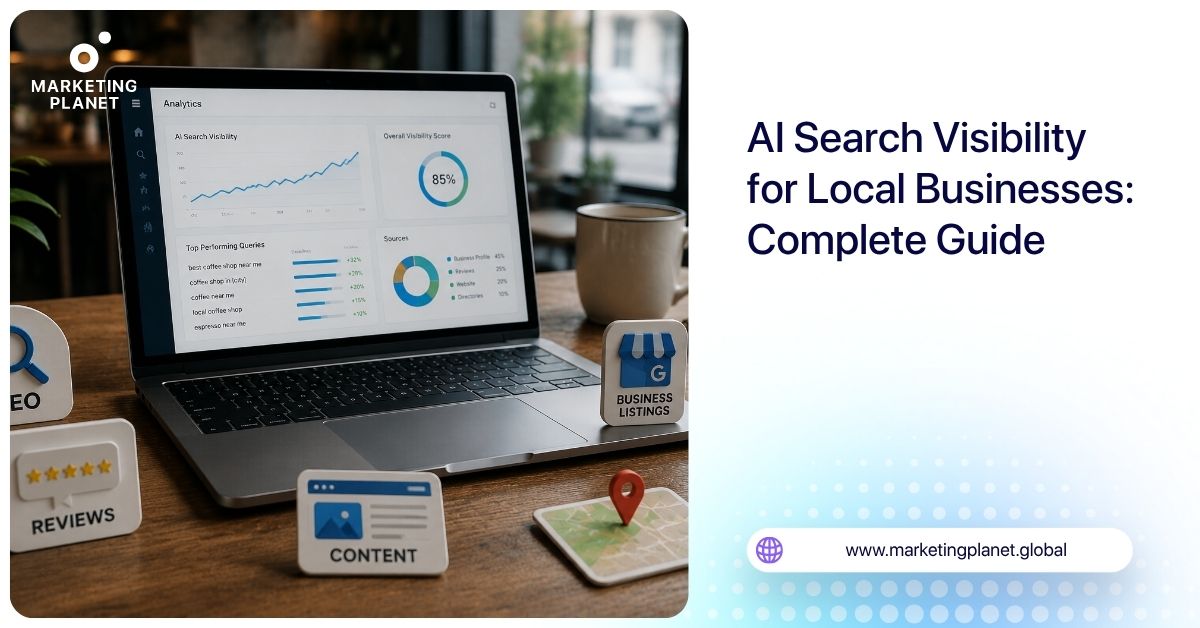
Artificial intelligence is changing how people find local businesses online. Instead of browsing through multiple search results, users are increasingly asking conversational questions through platforms like Google AI Overviews, ChatGPT Search, Bing Copilot, Gemini, and Perplexity.
These tools can summarize information, compare options, and surface businesses based on the information they can find and trust.
For local businesses, this has raised an important question: how can you improve visibility when customers are receiving AI-generated answers alongside traditional search results?
While AI-powered search experiences work differently, many still rely on the same signals that support strong local SEO. Accurate business information, helpful content, online reviews, trusted citations, and clear expertise all contribute to how a business is understood across the web.
Businesses that invest in these fundamentals are often better positioned to strengthen discoverability as search continues to evolve.
Here is the Quick Answer:
AI search is changing how customers discover local businesses, but it does not replace traditional SEO. Platforms like Google AI Overviews, ChatGPT Search, Bing Copilot, Gemini, and Perplexity may surface businesses based on the information they can find, understand, and trust.
Local businesses can improve AI search visibility by strengthening the same signals that support long-term search performance: accurate business information, optimized Google Business Profiles, helpful content, authentic reviews, local citations, structured data, and trusted third-party mentions. The goal is not to “hack” AI search, but to make your business easier to verify, cite, and recommend across the web.
What Is AI Search and Why Does It Matter for Local Businesses?
AI search refers to search experiences that use artificial intelligence to understand questions, gather information from multiple sources, and generate direct answers for users. Instead of simply displaying a list of websites, AI-powered search tools can summarize information, compare options, and provide recommendations within the search experience itself.
For local businesses, this shift changes how potential customers discover services, compare providers, and make decisions. While traditional search rankings still matter, businesses now need to think about how AI systems interpret and present their information online.
How AI-Powered Search Engines Deliver Answers
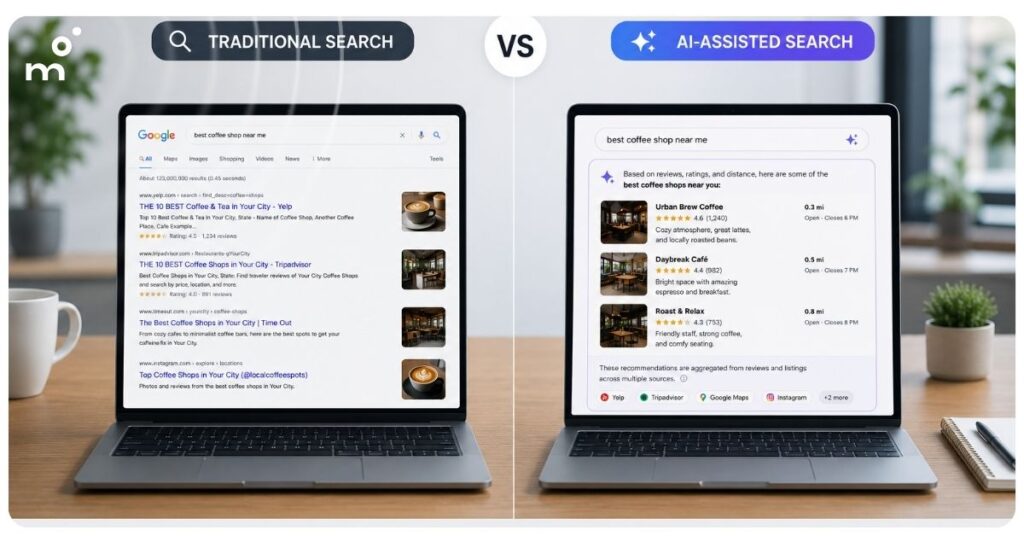
For years, customers searched Google, reviewed a list of links, and visited multiple websites before making a decision. AI-assisted search is changing that experience by providing direct answers to many questions.
Think of it this way:
Traditional search:
“Here are several websites that may answer your question.”
AI-assisted search:
“Here’s a summary of the answer based on information from multiple sources.”
To generate these responses, AI-powered search tools typically follow three steps:
- Understand the query by analyzing the user’s intent and context.
- Gather and synthesize information from relevant and trustworthy sources across the web.
- Generate a response that directly answers the question, often with citations or links to supporting sources.
Rather than creating information on their own, these systems often rely on existing web content, including business websites, authoritative publications, structured data, reviews, and other trusted online sources. This makes the quality and accuracy of your online presence increasingly important.
How AI Search Changes Local Discovery
AI search is also changing how people search for local businesses. Instead of using short keyword phrases, users are asking detailed, conversational questions that reflect exactly what they need.
Examples include:
“Best dentist near me for nervous patients”
“Top contractor for kitchen renovations in Vancouver”
“Persian restaurant in Los Angeles for large family dinners”
“Local SEO agency that works with small businesses”
AI-powered search tools attempt to understand the full meaning behind these searches and provide relevant recommendations. This allows businesses with strong local relevance and clear expertise to appear for highly specific customer needs.
For local businesses, this creates an opportunity to align website content, service pages, FAQs, and business profiles with the real questions customers ask throughout the buying process.
Why Traditional Rankings Alone Are No Longer Enough
Strong search rankings remain valuable, but ranking on page one is no longer the only goal. AI systems often evaluate a broader set of signals when determining which businesses to reference, cite, or recommend.
These signals may include:
- Consistent business information across the web
- Online reviews and reputation
- Local citations and directory listings
- Helpful and trustworthy content
- Structured data markup
- Clear business expertise and authority
In other words, businesses need more than rankings. They need strong entity signals that help search engines and AI platforms understand who they are, what they offer, where they operate, and why customers trust them.
The businesses most likely to strengthen visibility in AI-assisted search are often the ones that combine solid SEO fundamentals with a credible, consistent, and well-developed online presence.
AI Search Visibility vs Traditional Local SEO
One of the biggest misconceptions surrounding AI-powered search is that it has replaced SEO. In reality, AI search visibility and traditional local SEO are closely connected. The same signals that help businesses perform well in local search often help AI systems understand, trust, and surface businesses in AI-generated answers.
The difference is not that SEO has become less important. It is that AI-assisted search experiences place even greater emphasis on trust, clarity, authority, and relevance.
What Remains the Same
The fundamentals of local search have not disappeared. Search engines and AI-powered platforms still need reliable information to determine which businesses are relevant to a user’s question.
Many of the factors that support traditional local SEO remain valuable, including:
- Accurate business information
- Strong Google Business Profile optimization
- High-quality reviews
- Location relevance
- Helpful website content
- Local citations
- Technical website performance
Businesses that have invested in these areas already have a strong foundation for AI search visibility.
What Is Changing
The biggest change is how information is presented. Traditional search results display links and map listings, while AI-assisted search can summarize information, answer questions directly, and highlight a smaller group of relevant businesses.
As a result, businesses are no longer competing only for rankings. They are also competing to become trusted sources that AI systems can confidently understand, reference, and recommend.
This places greater importance on expertise, accurate business information, and helpful content.
Why SEO Is Still the Foundation
Many discussions about AI search create the impression that businesses need an entirely new optimization strategy. In practice, strong SEO remains the foundation of AI visibility.
AI-powered search tools often rely on information that already exists across search indexes, websites, business profiles, directories, reviews, and authoritative sources. If your business has weak SEO fundamentals, AI systems have less reliable information to work with.
For example, a contractor with detailed service pages, strong reviews, accurate listings, and locally focused content provides far more context than a competitor with a basic website and incomplete business profiles.
The goal is not to abandon traditional SEO. The goal is to strengthen it.
How AI Search Builds on Trust and Relevance Signals
AI systems are designed to help users find useful, trustworthy information. To do this, they often evaluate signals that indicate credibility and relevance.
These signals may include:
- Consistent business information across platforms
- Review quality and customer sentiment
- Expertise demonstrated through content
- Structured website data
- Mentions from trusted third-party sources
- Local relevance to the user’s query
- Brand authority within a specific industry
For local businesses, every review, citation, service page, and business listing helps shape how AI systems understand and evaluate a brand.
Rather than replacing SEO, AI search builds on the trust and relevance signals that have always mattered. Businesses with an accurate, helpful, and trustworthy online presence are often better positioned to strengthen visibility across both traditional and AI-assisted search.
Traditional Local SEO vs AI Search Visibility
While AI-assisted search is changing how customers discover businesses, many of the foundational principles of local SEO remain the same. The table below highlights the key differences and similarities.
| Comparing Traditional Local SEO and AI Search Visibility | ||
|---|---|---|
| Dimension | Traditional Local SEO | AI Search Visibility |
| Primary Goal | Rank Prominently in Local Search Results and Map Packs | Be Cited, Referenced, or Surfaced in AI-Generated Answers |
| Core Objective | Drive Website Visits and Local Actions | Increase Visibility, Trust, and Consideration During AI-Assisted Discovery |
| Search Experience | Users Compare Businesses Through Search Results and Maps | Users Often Receive Summarized Recommendations Before Clicking |
| Query Style | Short Keywords and Location-Based Searches | Conversational, Question-Based, and Intent-Driven Searches |
| Content Focus | Keyword-Targeted Service Pages and Local SEO Content | Clear, Helpful Content That Demonstrates Expertise and Answers Specific Questions |
| Authority Signals | Reviews, Citations, Backlinks, Local Relevance, and Domain Authority | Reviews, Citations, Expertise, Entity Clarity, Content Quality, and Trust Signals |
| Success Metrics | Rankings, Traffic, Click-Through Rate, Calls, and Conversions | Brand Mentions, Citations, Visibility Across AI Platforms, Qualified Traffic, and Conversions |
| Business Information | Important for Local Rankings and Map Visibility | Critical for Verification, Trust, and Entity Understanding |
| Competitive Advantage | Strong SEO, Local Relevance, and Established Authority | Clear Expertise, Trustworthy Information, Strong Reputation, and Consistent Online Signals |
| Long-Term Success | Consistent SEO Improvements, Content Growth, and Local Authority Building | Trust, Credibility, Expertise, and a Well-Developed Digital Presence Across the Web |
How Different AI Search Platforms Surface Information
Different AI-assisted search platforms do not use one shared ranking system. Google AI Overviews appear inside Google Search and are closely tied to Google’s search ecosystem. ChatGPT Search can provide conversational answers with links to relevant web sources. Bing Copilot combines search results with AI-generated summaries and cited sources. Perplexity is citation-forward and often presents answers alongside source links. Gemini may draw from Google’s broader ecosystem depending on the query and product experience.
For local businesses, the practical takeaway is not to optimize for one universal AI algorithm. The goal is to make the business easier to verify across multiple environments: search indexes, maps platforms, review sites, directories, business profiles, industry websites, and the business’s own website.
Google AI Overviews
Google AI Overviews are part of Google Search and may provide summarized answers for certain queries. Google Search Central advises site owners to approach AI features through the same fundamentals that support strong search visibility: helpful, reliable, people-first content, technical accessibility, and clear information that search systems can understand.
ChatGPT Search
OpenAI describes ChatGPT Search as a way to provide timely answers with links to relevant web sources. Since sources vary by query, local businesses should make their services, locations, reputation, and expertise easy to verify across their website and trusted third-party sources.
Bing Copilot
Microsoft describes Copilot Search as combining AI-generated answers with cited sources. For local businesses, accurate Bing Places listings, clear website content, and trusted external mentions can support discoverability beyond Google.
Perplexity
Perplexity emphasizes source citations alongside AI-generated answers. Businesses can benefit from being mentioned across trusted websites, directories, publications, and industry resources.
Gemini
Gemini is Google’s AI assistant, and its responses may vary depending on the query, product experience, and available information. For local businesses, the practical recommendation remains the same: maintain accurate business information, useful content, and strong local SEO signals across Google’s search and business-profile ecosystem.
What This Means for Local Businesses
The goal is not to optimize for a single AI algorithm. The goal is to make your business easy to understand, verify, trust, and cite across the web.
Businesses that maintain accurate information, earn genuine reviews, publish helpful content, and build authority through trusted sources are often better positioned to improve visibility across AI-assisted search experiences.
How AI Search Engines May Choose Local Businesses to Recommend
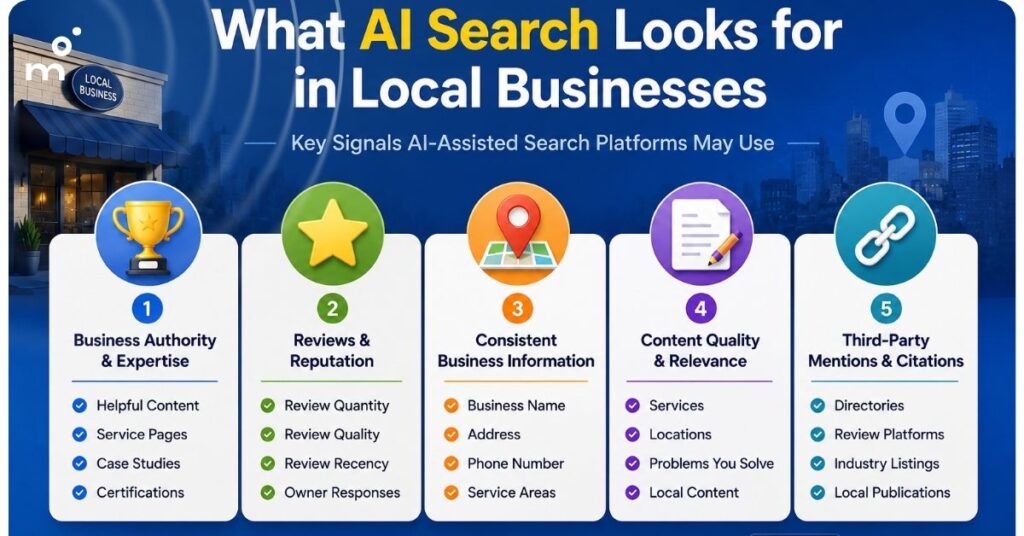
When someone asks an AI-assisted search platform for a local business recommendation, the system may draw from available web sources, search results, business listings, reviews, citations, and other accessible information to identify businesses that appear relevant, trustworthy, and credible.
Here are some of the key signals AI-assisted search platforms may use:
Business Authority and Expertise
AI systems are more likely to trust businesses that clearly demonstrate expertise. Detailed service pages, helpful content, and clear explanations of what you do help AI platforms understand your business and the customers you serve.
Authority can also be strengthened through case studies, certifications, industry recognition, and mentions from reputable websites.
Online Reviews and Reputation Signals
Reviews help AI systems assess customer experiences and overall reputation. In addition to star ratings, they may consider:
- Review quantity
- Review quality and detail
- Review recency
- Overall sentiment
- Owner responses
Consistent, positive reviews can strengthen trust and credibility.
Consistent Business Information
AI platforms compare information across websites, directories, maps, and business profiles to verify a business’s identity and location.
Important details that should remain consistent include:
- Business name
- Address
- Phone number
- Service areas
- Business categories
- Hours of operation
This is commonly known as NAP consistency (Name, Address, Phone Number).
Content Quality and Topical Relevance
AI systems need clear information to understand when your business is relevant to a search. Your website should clearly explain your services, locations, and the problems you solve.
Helpful, specific, and locally relevant content provides stronger context than generic service descriptions.
Trusted Third-Party Mentions and Citations
AI platforms may also look for independent validation from trusted sources across the web.
Examples include:
- Local directories
- Review platforms
- Industry listings
- Local publications
- Professional associations
- Partner websites
Consistent mentions from credible sources can strengthen trust and make your business easier to verify across AI-assisted search platforms.
7 Ways to Improve Your Local Business’s AI Search Visibility
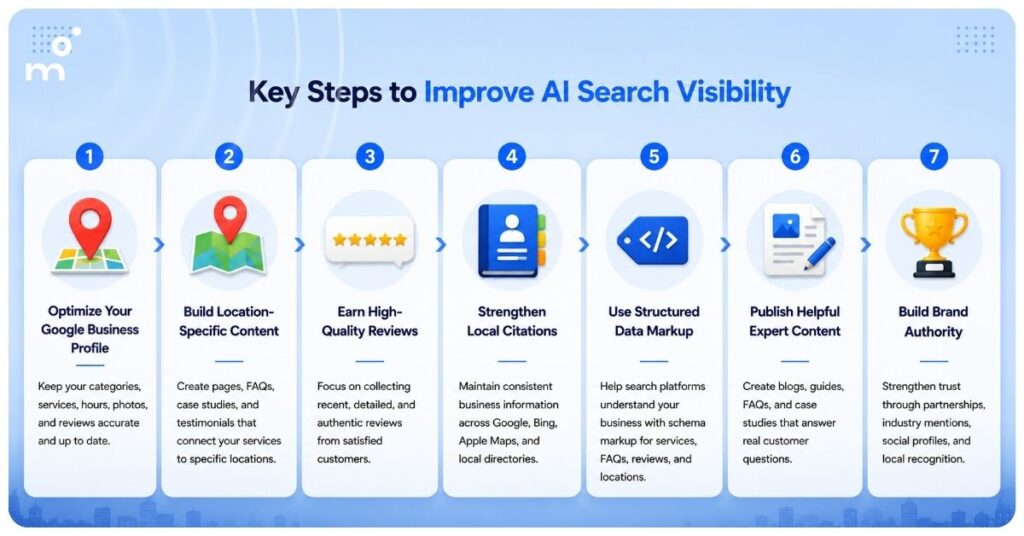
AI search visibility is built through the same digital signals that help customers and search platforms understand, verify, and trust your business. The following steps can help strengthen those signals across your website, business profiles, reviews, citations, and broader online presence.
Optimize Your Google Business Profile
Your Google Business Profile is one of the most important sources of local business information online. To strengthen it for both traditional and AI-assisted search, make sure the profile is complete, accurate, and actively maintained.
Start by selecting the most accurate primary category for your business, then add relevant secondary categories where appropriate. Complete your service list, business description, service areas, hours, contact information, website link, appointment links, and business attributes. If your hours change for holidays or seasonal periods, update them before customers find outdated information.
Visual content also matters. Upload recent, high-quality photos of your location, team, work, products, or completed projects where relevant. Use Google Posts to share updates, services, offers, events, or educational content. Review the Q&A section regularly and provide clear answers to common customer questions.
Review responses should also be part of your profile strategy. Responding professionally to customer feedback helps show that your business is active, attentive, and credible.
Build Location-Specific Website Content
Local businesses often serve different cities, neighbourhoods, or service areas, but many websites do not make that clear enough. Location-specific content helps search platforms understand where your business operates and which local customers you serve.
Create dedicated pages for your most important service areas when there is enough unique value to justify them. Each page should include specific service details, local context, customer concerns, FAQs, testimonials, project examples, or access information. Avoid creating duplicate pages that only swap one city name for another.
For example, a contractor serving Vancouver, Burnaby, and Richmond should not publish three nearly identical renovation pages. Each page should explain the types of projects commonly handled in that area, relevant local considerations, examples of completed work, and practical information for customers in that location.
Earn More High-Quality Reviews
Reviews help validate customer experience, service quality, and trust. For AI-assisted search, reviews may also provide language that helps platforms understand what customers associate with your business.
Build a consistent review-generation process. Ask satisfied customers for reviews shortly after a completed service, appointment, purchase, or project. Where appropriate, encourage them to mention the specific service they received, the location they visited, and what stood out about the experience.
Do not use fake reviews, review gating, or misleading incentives. The goal is to build an authentic review profile across relevant platforms. For many local businesses, this may include Google, Yelp, Facebook, industry-specific directories, healthcare platforms, legal directories, hospitality platforms, or home-service marketplaces.
Respond to reviews regularly. A professional response to positive feedback reinforces trust, while a calm and constructive response to negative feedback can show accountability.
Strengthen Local Citations
Local citations help verify your business information across the web. A citation may include your business name, address, phone number, website, category, hours, and service area.
Start by checking your most important listings, including Google Business Profile, Bing Places, Apple Maps, Yelp, Facebook, industry directories, local directories, and Chamber of Commerce listings. Make sure your business name, address, phone number, website URL, and categories are consistent.
For multi-location businesses, each location should have its own accurate listing where appropriate. Avoid mixing phone numbers, using outdated addresses, or sending all locations to the same generic page if dedicated location pages exist.
Citations should be accurate before they are numerous. A smaller number of clean, trusted listings is more valuable than a large number of inconsistent or low-quality directory profiles.
Use Structured Data Markup
Structured data helps search engines understand important information on your website in a machine-readable format. It does not guarantee AI search visibility, but it can support clearer interpretation of your business, services, locations, and page content.
Useful schema types for local businesses may include LocalBusiness Schema, Organization Schema, Service Schema, FAQ Schema, Breadcrumb Schema, and Review Schema where appropriate. The markup should match the visible content on the page and should not be used to make claims that users cannot verify on the website.
For example, a local clinic may use structured data to clarify its business name, address, phone number, opening hours, services, and FAQ content. A multi-location company may use structured data to distinguish each location and connect it to the correct landing page.
Publish Helpful Expert Content
Content should answer the questions customers ask before they contact your business. Instead of publishing generic blog posts, focus on content that supports real decision-making.
Create resources around service comparisons, process explanations, pricing factors, timelines, preparation steps, common concerns, and after-service expectations. A dental clinic might publish content about dental implant candidacy, treatment anxiety, recovery timelines, and alternatives to implants. A home-service company might create guides about project planning, material choices, permits, maintenance, and seasonal service needs.
This content should connect naturally to your main service pages. A blog should not sit alone on the website. It should support a larger content cluster that helps users and search platforms understand your expertise around a specific service, location, or customer need.
Build Brand Authority Across Multiple Platforms
AI-assisted search platforms may rely on more than your website when trying to understand your business. Trusted third-party mentions can help reinforce credibility and entity recognition.
Look for opportunities to strengthen your brand presence through local media, industry publications, sponsorships, professional associations, partner websites, podcasts, community events, and relevant directories. Make sure your social profiles, business listings, and industry profiles present consistent information about your services, locations, and brand.
For example, a local restaurant may benefit from mentions in food publications, event listings, local guides, review platforms, and community pages. A law firm may benefit from legal directories, professional associations, media commentary, and service-specific educational content.
The goal is to create a consistent, credible footprint across the web. When your business is repeatedly associated with the right services, locations, and expertise, it becomes easier for both customers and search platforms to understand what your brand represents.
The Role of Content Marketing in AI Search Visibility
Content marketing plays a major role in AI search visibility because it helps search platforms understand the depth, relevance, and expertise behind a business. For local companies, this means content should do more than repeat service keywords. It should clearly explain what the business offers, where it operates, who it helps, and what customers need to know before making a decision.
AI-assisted search experiences are often built around specific questions. A potential customer may ask which dental treatment is best for a nervous patient, what type of contractor handles basement renovations in Vancouver, or how to compare local SEO agencies for a small business. If your website does not answer those questions clearly, AI-powered platforms have less useful information to draw from.
A strong content strategy helps connect your business to the topics, services, locations, and customer concerns that matter most. This can include:
- Core service pages that explain each main offering in detail
- Location pages that connect services to specific cities, neighbourhoods, or service areas
- FAQ sections that answer real pre-sale questions
- Blog posts that explain common problems, options, timelines, costs, and decision factors
- Case studies that show practical experience and local relevance
- Comparison content that helps customers evaluate solutions
- Industry-specific guides that demonstrate expertise
For example, a dental clinic should not only have a page that says it offers dental implants. It may also need content explaining who is a suitable candidate, how the process works, how implants compare to bridges, what recovery may involve, and what questions patients should ask during a consultation. A contractor may need content around renovation permits, project timelines, material choices, service areas, and examples of completed local work.
This type of content helps build topical authority. Instead of publishing isolated blog posts, businesses can create topic clusters around their most important services. A main service page can be supported by related blogs, FAQs, case studies, and local landing pages. Together, these pages give search engines and AI-assisted platforms a clearer understanding of the business’s expertise.
Content also supports entity building. When your business is consistently associated with specific services, locations, customer needs, and industry terms, it becomes easier for search platforms to understand what your brand should be connected to. This is especially important for local businesses that want to appear for detailed, high-intent searches.
The goal is not to publish more content for the sake of volume. The goal is to create useful, well-structured content that answers real customer questions, supports trust, and gives both people and search platforms a clearer reason to understand and consider your business.
GEO vs SEO: What Local Businesses Should Know
Generative Engine Optimization (GEO) is an emerging term that refers to improving how content appears in AI-generated answers. While SEO focuses on helping websites rank in traditional search results, GEO focuses on making content easier for AI platforms to understand, reference, and cite. For local businesses, GEO should be viewed as an extension of strong SEO, not a replacement for it.
The comparison below highlights some of the key differences:
| SEO and GEO Compared: Key Differences for Local Businesses | ||
|---|---|---|
| Aspect | SEO (Search Engine Optimization) | GEO (Generative Engine Optimization) |
| Primary Goal | Improve Rankings in Search Results | Increase Visibility Within AI-Generated Answers |
| User Action | Users Click Through to a Website | Users May Receive Answers Before Clicking |
| Content Focus | Keywords, Topics, and Search Intent | Clarity, Context, and Answer Quality |
| Content Structure | Optimized for Search Engines and Users | Optimized for AI Interpretation and Extraction |
| Success Signals | Rankings, Traffic, Clicks, and Conversions | Citations, Mentions, Visibility, and Brand Recognition |
| Authority Signals | Backlinks, Reviews, Citations, and SEO Strength | Expertise, Trust Signals, Citations, and Content Quality |
| Content Style | Comprehensive, Keyword-Targeted Content | Clear, Direct, and Easily Understood Information |
| Structured Data | Supports Search Engine Understanding | Helps AI Systems Interpret Content More Accurately |
| Local Business Value | Improves Local Search Visibility | Improves the Likelihood of Being Understood and Referenced |
Common Mistakes That Reduce AI Search Visibility
Many businesses weaken their AI search visibility by providing incomplete, inconsistent, or outdated information online. Common mistakes include:
- Thin content: Pages that provide little value or context.
- Keyword stuffing: Overusing keywords instead of writing naturally.
- Inconsistent NAP information: Conflicting business names, addresses, or phone numbers.
- Fake or low-quality reviews: Reviews that lack authenticity and credibility.
- Neglected Google Business Profile: Outdated details, missing photos, or unanswered reviews.
- Missing service pages: Limited information about what your business offers.
- Weak local citations: Inaccurate or inconsistent directory listings.
- Unsupported claims: Statements that lack evidence or proof.
- Outdated website content: Old information that reduces trust and relevance.
How to Measure AI Search Visibility
Unlike traditional SEO, AI search visibility does not have a single ranking report or universal metric. AI-generated answers can vary by platform, query, location, user context, and timing, which makes measurement more complex.
Instead of relying on one KPI, businesses should monitor a combination of visibility, engagement, and conversion signals, including:
- Branded search growth: An increase in searches for your business name may indicate growing brand awareness and discoverability.
- Google Search Console trends: Monitor impressions, clicks, and visibility for important service and location keywords.
- Google Business Profile insights: Track calls, website visits, direction requests, and profile views.
- Review growth and sentiment: Look for improvements in review volume, freshness, ratings, and customer feedback themes.
- Referral traffic from AI and search platforms: Analyze website traffic sources to identify emerging visibility opportunities.
- Manual AI searches: Periodically check how your business appears in Google AI Overviews, ChatGPT Search, Bing Copilot, Perplexity, and Gemini for relevant industry and local queries.
- Lead quality and conversion rates: Track whether organic traffic is generating qualified inquiries, calls, bookings, or sales.
The most effective approach is to look for patterns across multiple metrics rather than focusing on a single number. While AI visibility measurement is still evolving, improvements in brand awareness, local engagement, search performance, and lead generation can provide valuable indicators that your optimization efforts are moving in the right direction.
How Marketing Planet Helps Businesses Prepare for AI Search
Marketing Planet helps businesses strengthen their online presence through digital marketing services that connect SEO, content strategy, website optimization, and reputation-building. That starts with the fundamentals: accurate business information, optimized service pages, local SEO, Google Business Profile improvements, technical website health, reputation management, and content that answers real customer questions.
Our team looks at how your business appears across search results, maps, directories, review platforms, and your own website. From there, we build a strategy designed to improve discoverability, trust, and conversion quality rather than chasing short-term AI search shortcuts.
You can also review Marketing Planet’s marketing case studies to see how strategy, SEO, content, and paid media support measurable growth.
For local businesses, AI-ready SEO is not about replacing proven search strategy. It is about making your business easier to understand, verify, and choose across the platforms customers use to make decisions.
The Future of Local Search Is AI-Assisted
Local search is becoming more conversational, contextual, and trust-driven. While AI-powered search experiences are changing how customers find businesses, the fundamentals remain the same: accurate information, helpful content, strong local signals, and a trustworthy online presence.
Rather than chasing shortcuts, focus on building the credibility and authority that support long-term visibility. Businesses that invest in strong SEO, content, and reputation management will be better positioned as search continues to evolve.
Ready to improve your AI search visibility? Contact Marketing Planet to discuss an AI-ready SEO strategy for your business.
Source:
SEO vs. GEO: How They’re Different & What You Need to Know
SEO vs. GEO: What’s different? What’s the same?
10 Best AI Search Engines I Tried and Tested – Radarkit
How different AI engines generate and cite answers
How to Optimize Your Local Business for AI Search and Discovery
AI Visibility Optimization: The Complete Guide to Securing Brand
How to Optimize Your Local Business for AI Search | Ottawa, ON
Optimizing for AI search: The SEO trifecta for local visibility
AI Visibility Optimization for Local Business: Everything You Need To Know
How to Improve Brand Visibility in AI Search Engines: Complete Guide 2026 | Seal Global Blog
AI Search Optimization & Staying Visible | Uberall
7 Ways to Improve AI Search Visibility for Your Business
How AI Search Engines Choose Who To Recommend (And How To Make The List) | by Dan Jones | Medium
How AI Decides Which Local Business to Recommend – Elvin Web Marketing
AI Search Visibility vs Traditional SEO
AI Search Guide 2025: How It Works & Why Businesses Need It AI Search Is Changing How Customers Find Local Businesses